Medical School Hamburg, Hamburg, Germany.
Department of Physical Medicine and Rehabilitation, Spaulding National Running Center, Harvard Medical School, Cambridge, MA, USA.
Sports Med. 2021 May;51(5):1011-1039. doi: 10.1007/s40279-020-01412-7. Epub 2021 Jan 12.
Running is a popular sport with high injury rates. Although risk factors have intensively been investigated, synthesized knowledge about the differences in injury rates of female and male runners is scarce.
To systematically investigate the differences in injury rates and characteristics between female and male runners.
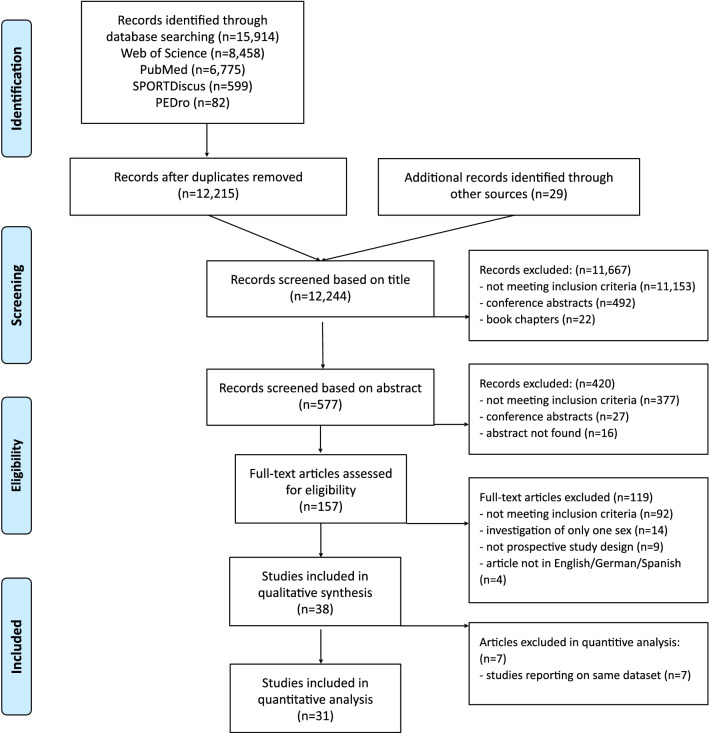
Database searches (PubMed, Web of Science, PEDro, SPORTDiscus) were conducted according to PRISMA guidelines using the keywords "running AND injur*". Prospective studies reporting running related injury rates for both sexes were included. A random-effects meta-analysis was used to pool the risk ratios (RR) for the occurrence of injuries in female vs. male runners. Potential moderators (effect modifiers) were analysed using meta-regression.
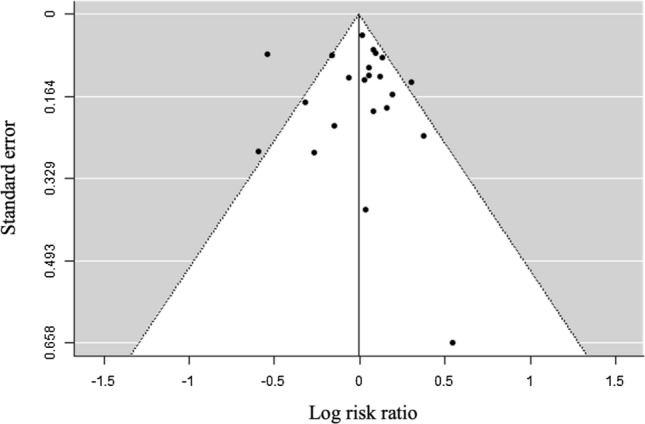
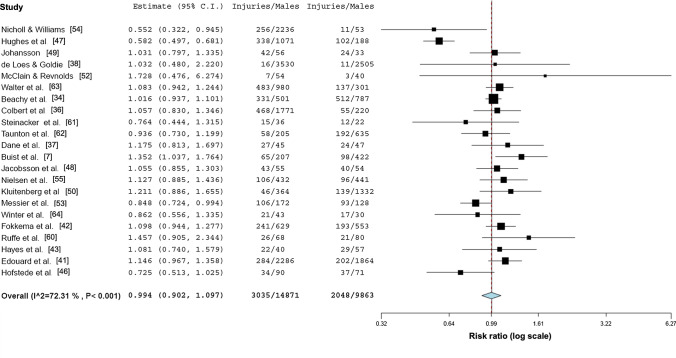
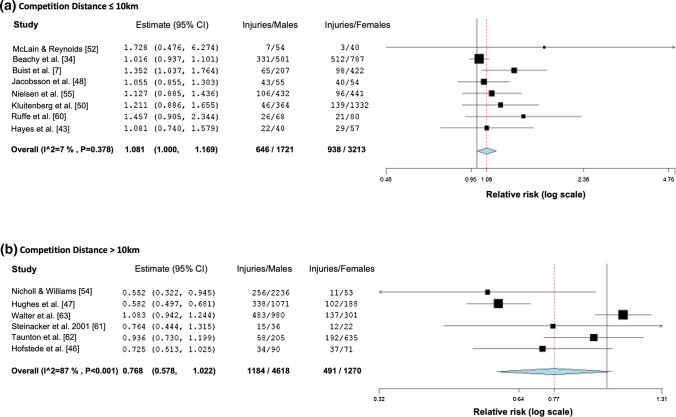
After removal of duplicates, 12,215 articles were screened. Thirty-eight studies were included and the OR of 31 could be pooled in the quantitative analysis. The overall injury rate was 20.8 (95% CI 19.9-21.7) injuries per 100 female runners and 20.4 (95% CI 19.7-21.1) injuries per 100 male runners. Meta-analysis revealed no differences between sexes for overall injuries reported per 100 runners (RR 0.99, 95% CI 0.90-1.10, n = 24) and per hours or athlete exposure (RR 0.94, 95% CI 0.69-1.27, n = 6). Female sex was associated with a more frequent occurrence of bone stress injury (RR (for males) 0.52, 95% CI 0.36-0.76, n = 5) while male runners had higher risk for Achilles tendinopathies (RR 1. 86, 95% CI 1.25-2.79, n = 2). Meta-regression showed an association between a higher injury risk and competition distances of 10 km and shorter in female runners (RR 1.08, 95% CI 1.00-1.69).
Differences between female and male runners in specific injury diagnoses should be considered in the development of individualised and sex-specific prevention and rehabilitation strategies to manage running-related injuries.
跑步是一项流行的运动,受伤率很高。尽管已经深入研究了风险因素,但关于女性和男性跑步者受伤率差异的综合知识仍然很少。
系统研究女性和男性跑步者受伤率和受伤特征的差异。
根据 PRISMA 指南,使用“跑步和损伤*”等关键词在数据库(PubMed、Web of Science、PEDro、SPORTDiscus)中进行检索,纳入报告两性跑步者相关受伤率的前瞻性研究。使用随机效应荟萃分析来汇总女性与男性跑步者发生损伤的风险比 (RR)。使用 meta 回归分析潜在的调节因素(效应修饰因素)。
去除重复项后,共筛选出 12215 篇文章。纳入 38 项研究,其中 31 项的 OR 可进行定量分析。女性跑步者的总体受伤率为 20.8(95%CI 19.9-21.7)/100 人,男性跑步者为 20.4(95%CI 19.7-21.1)/100 人。荟萃分析显示,男女报告的每 100 名跑步者的总体受伤率(RR 0.99,95%CI 0.90-1.10,n=24)和每小时或运动员暴露的受伤率(RR 0.94,95%CI 0.69-1.27,n=6)之间无差异。女性发生骨应力性损伤的频率更高(RR(男性)0.52,95%CI 0.36-0.76,n=5),而男性发生跟腱病变的风险更高(RR 1.86,95%CI 1.25-2.79,n=2)。meta 回归显示,女性跑步者在 10km 及更短的比赛距离中受伤风险更高(RR 1.08,95%CI 1.00-1.69)。
在制定针对特定个体和性别的预防和康复策略以管理与跑步相关的损伤时,应考虑女性和男性跑步者在特定损伤诊断方面的差异。