From the Departments of Radiology (X.L., T.W., Y.Q., B.L., Y.Y.) and Cardiology (R.Z.), The First Affiliated Hospital of Anhui Medical University, No. 218 Jixi Rd, Hefei 230022, China; Department of Radiology, No. 2 People's Hospital of Fuyang City, Fuyang, China (H.W.); Anhui Province Clinical Image Quality Control Center, Hefei, China (X.L., H.W., Y.Q., B.L., Y.Y.); Department of Radiology, The First Affiliated Hospital of Nanjing Medical University, Nanjing, China (Y.Z.); and Division of Cardiovascular Medicine, Department of Medicine, and Department of Radiology, Perelman School of Medicine, University of Pennsylvania, Philadelphia, Pa (Y.H.).
Radiology. 2021 May;299(2):E230-E240. doi: 10.1148/radiol.2021203998. Epub 2021 Jan 12.
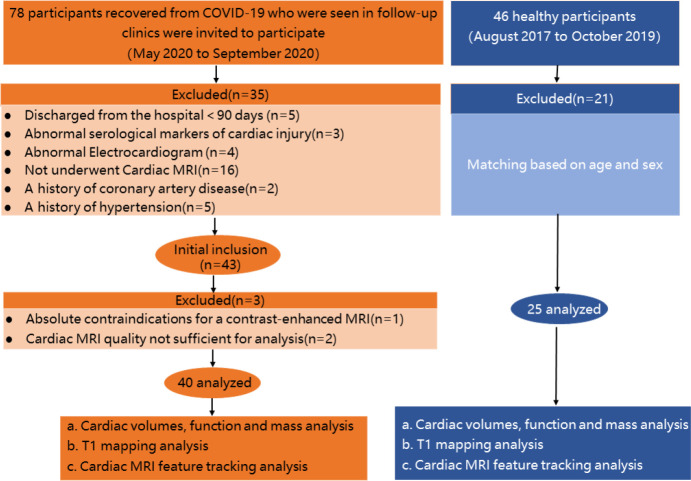
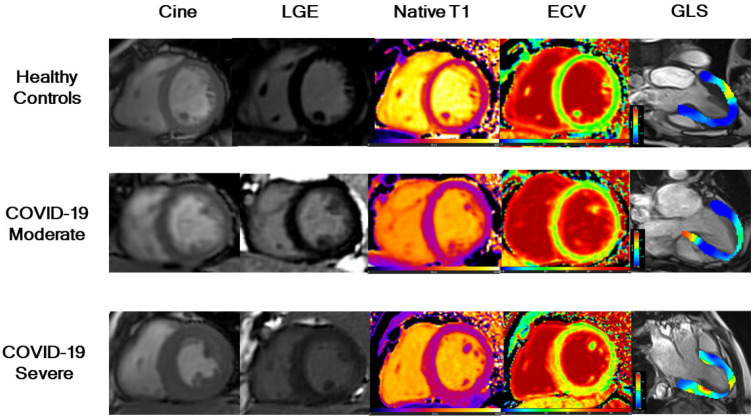
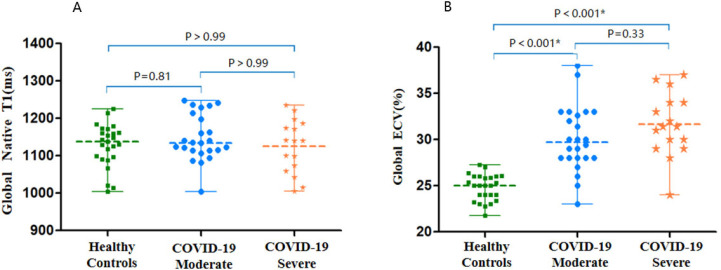
Background It is unknown if there are cardiac abnormalities in persons who have recovered from coronavirus disease 2019 (COVID-19) without cardiac symptoms or in those who have normal biomarkers and normal electrocardiograms. Purpose To evaluate cardiac involvement in participants who had recovered from COVID-19 without clinical evidence of cardiac involvement by using cardiac MRI. Materials and Methods This prospective observational cohort study included 40 participants who had recovered from COVID-19 with moderate ( = 24) or severe ( = 16) pneumonia and who had no cardiovascular medical history, were without cardiac symptoms, had normal electrocardiograms, had normal serologic cardiac enzyme levels, and had been discharged for more than 90 days between May and September 2020. Demographic characteristics were recorded, serum cardiac enzyme levels were measured, and cardiac MRI was performed. Cardiac function, native T1, extracellular volume fraction (ECV), and two-dimensional (2D) strain were quantitatively evaluated and compared with values in control subjects ( = 25). Comparisons among the three groups were performed by using one-way analysis of variance with Bonferroni-corrected post hoc comparisons (for normal distribution) or Kruskal-Wallis tests with post hoc pairwise comparisons (for nonnormal distribution). Results Forty participants (mean age, 54 years ± 12 [standard deviation]; 24 men) were enrolled; participants had a mean time between admission and cardiac MRI of 158 days ± 18 and between discharge and cardiac MRI examination of 124 days ± 17. There were no left or right ventricular size or functional differences between participants who had recovered from COVID-19 and healthy control subjects. Only one (3%) participant had positive late gadolinium enhancement located at the mid inferior wall. Global ECV values were elevated in participants who had recovered from COVID-19 with moderate or severe pneumonia compared with those in healthy control subjects (median ECV, 29.7% vs 31.4% vs 25.0%, respectively; interquartile range, 28.0%-32.9% vs 29.3%-34.0% vs 23.7%-26.0%, respectively; < .001 for both). The 2D global left ventricular longitudinal strain was reduced in both groups of participants (moderate COVID-19 group, -12.5% [interquartile range, -15.5% to -10.7%]; severe COVID-19 group, -12.5% [interquartile range, -15.4% to -8.7%]) compared with the healthy control group (-15.4% [interquartile range, -17.6% to -14.6%]) ( = .002 and = .001, respectively). Conclusion Cardiac MRI myocardial tissue and strain imaging parameters suggest that a proportion of participants who had recovered from COVID-19 had subclinical myocardial abnormalities detectable months after recovery. © RSNA, 2021
背景 目前尚不清楚在没有心脏症状的情况下从 2019 年冠状病毒病(COVID-19)中康复的患者或在那些具有正常生物标志物和正常心电图的患者中是否存在心脏异常。目的 用心脏 MRI 评估从 COVID-19 中康复且无临床证据表明有心脏受累的患者的心脏受累情况。材料与方法 本前瞻性观察性队列研究纳入了 40 名从 COVID-19 中康复的患者,其中中度(=24 例)或重度(=16 例)肺炎,无心血管病史,无心脏症状,心电图正常,血清心脏酶水平正常,且在 2020 年 5 月至 9 月间出院超过 90 天。记录患者的人口统计学特征,测量血清心脏酶水平,并进行心脏 MRI。对心功能、原生 T1、细胞外容积分数(ECV)和二维(2D)应变进行定量评估,并与对照组(=25 例)的值进行比较。采用单因素方差分析比较三组间的差异,并用 Bonferroni 校正后进行组间两两比较(正态分布)或 Kruskal-Wallis 检验后进行组间两两比较(非正态分布)。结果 共纳入 40 名患者(平均年龄,54 岁±12[标准差];24 名男性);患者入院至心脏 MRI 的平均时间为 158 天±18,出院至心脏 MRI 检查的平均时间为 124 天±17。与健康对照组相比,从 COVID-19 中康复的患者左、右心室大小或功能无差异。仅有 1 名(3%)患者在中下部壁有阳性延迟钆增强。与健康对照组相比,中重度肺炎患者从 COVID-19 中康复后 ECV 值整体升高(中位数 ECV,分别为 29.7%、31.4%和 25.0%;四分位间距,分别为 28.0%-32.9%、29.3%-34.0%和 23.7%-26.0%;均<.001)。两组患者的 2D 整体左心室纵向应变均降低(中度 COVID-19 组,-12.5%[四分位间距,-15.5%至-10.7%];重度 COVID-19 组,-12.5%[四分位间距,-15.4%至-8.7%]),与健康对照组相比[-15.4%(四分位间距,-17.6%至-14.6%)](=.002 和 =.001)。结论 心脏 MRI 心肌组织和应变成像参数提示,一部分从 COVID-19 中康复的患者在康复后数月可检测到亚临床心肌异常。