García-Ortiz Almudena, Rodríguez-García Yaiza, Encinas Jessica, Maroto-Martín Elena, Castellano Eva, Teixidó Joaquín, Martínez-López Joaquín
Hematology Department, Hospital 12 de Octubre, i+12, CNIO, CIBERONC, ES 28041 Madrid, Spain.
Department of Molecular Biomedicine, Centro de Investigaciones Biológicas, CSIC, ES 28040 Madrid, Spain.
Cancers (Basel). 2021 Jan 9;13(2):217. doi: 10.3390/cancers13020217.
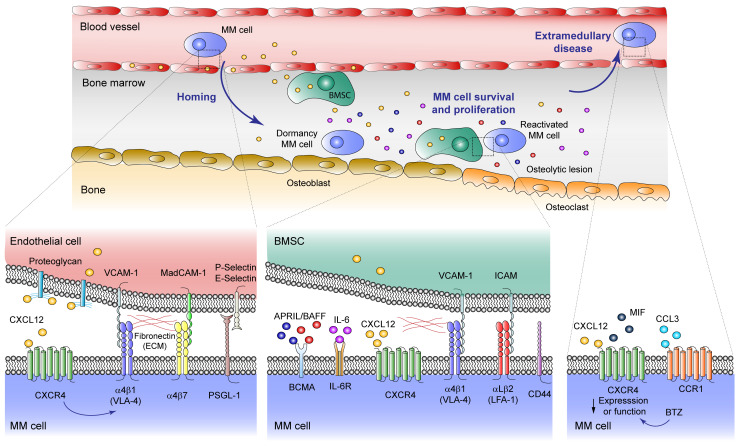
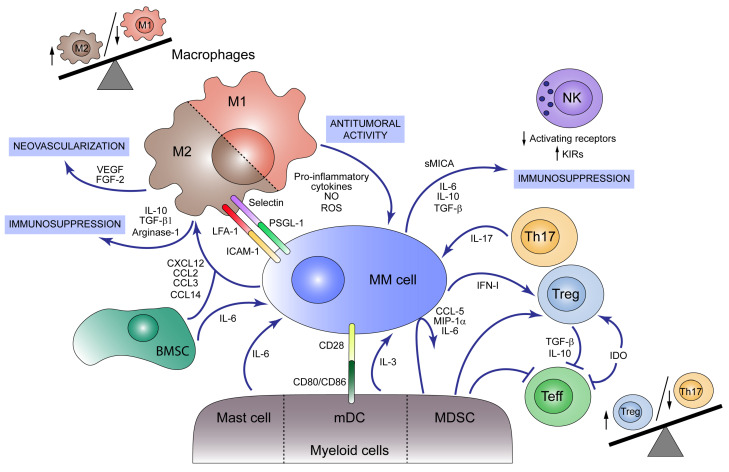
Multiple myeloma (MM) is a hematologic cancer characterized by clonal proliferation of plasma cells in the bone marrow (BM). The progression, from the early stages of the disease as monoclonal gammopathy of undetermined significance (MGUS) and smoldering multiple myeloma (SMM) to MM and occasionally extramedullary disease, is drastically affected by the tumor microenvironment (TME). Soluble factors and direct cell-cell interactions regulate MM plasma cell trafficking and homing to the BM niche. Mesenchymal stromal cells, osteoclasts, osteoblasts, myeloid and lymphoid cells present in the BM create a unique milieu that favors MM plasma cell immune evasion and promotes disease progression. Moreover, TME is implicated in malignant cell protection against anti-tumor therapy. This review describes the main cellular and non-cellular components located in the BM, which condition the immunosuppressive environment and lead the MM establishment and progression.
多发性骨髓瘤(MM)是一种血液系统癌症,其特征是骨髓(BM)中浆细胞的克隆性增殖。从疾病早期的意义未明的单克隆丙种球蛋白病(MGUS)和冒烟型多发性骨髓瘤(SMM)发展到MM,偶尔还会发展为髓外疾病,这一过程受到肿瘤微环境(TME)的显著影响。可溶性因子和直接的细胞间相互作用调节MM浆细胞向骨髓龛的迁移和归巢。骨髓中存在的间充质基质细胞、破骨细胞、成骨细胞、髓系和淋巴细胞创造了一个独特的环境,有利于MM浆细胞逃避免疫监视并促进疾病进展。此外,TME与恶性细胞对抗肿瘤治疗的保护作用有关。本综述描述了骨髓中主要的细胞和非细胞成分,它们构成了免疫抑制环境并导致MM的发生和进展。