Department of Public Health, Graduate School, Yonsei University, 50 Yonsei-ro, Seodaemun-gu, Seoul, 03722, Republic of Korea.
The Institute for Occupational Health, Yonsei University College of Medicine, Seoul, 03722, Republic of Korea.
Environ Health Prev Med. 2021 Jan 12;26(1):6. doi: 10.1186/s12199-020-00930-0.
One effective way to improve return-to-work (RTW) performance may be to convince the employer that the worker has the necessary skills. The aim of this paper is to investigate the effect of having a professional certification among workers injured in occupational injuries on their return to work.
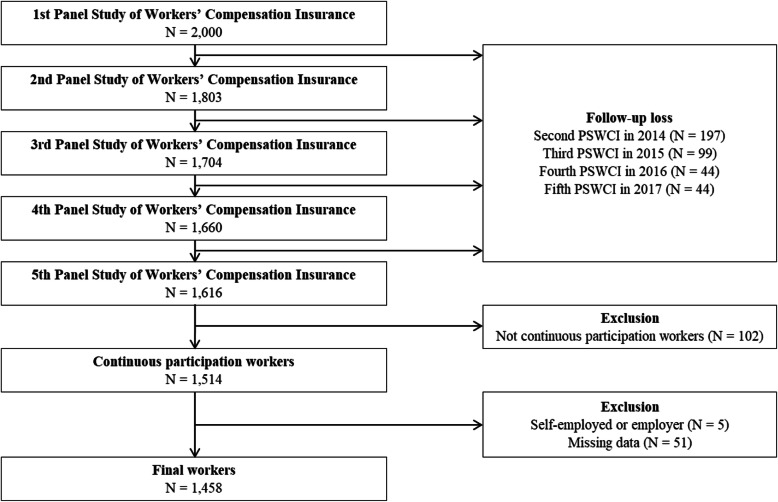
The Panel Study of Workers' Compensation Insurance (PSWCI) targets workers who completed medical care in 2012 after an occupational injury. The study population (n = 2000) was stratified by gender, age, region, disability grade, and rehabilitation service use. A total of 1458 workers were finally selected for this study. The effect of having a certification on RTW status was calculated with an odds ratio and 95% confidence intervals using binomial and multinomial logistic regression analyses. In the binomial logistic regression analysis, the RTW group was made up as a combination of the return to original work and the reemployment groups.
The ORs of RTW among those with a certification compared to those without certification were 1.38 (1.16-1.65) in Model 1, 1.25 (1.05-1.50) in Model 2, and 1.22 (1.01-1.47) in Model 3. Among female workers with a certification, the OR of RTW was 4.60 (2.68-7.91), that of return to original work was 3.21 (1.74-5.91), and that of reemployment was 5.85 (3.34-10.27). Among daily workers with a certification, the OR of RTW was 1.32 (1.03-1.69) and that of reemployment was 1.37 (1.07-1.76).
In conclusion, injured workers with a certification generally had a higher RTW rate. In particular, the RTW rate was higher among female workers and daily workers with a certification than among those without.
提高重返工作岗位(RTW)表现的一种有效方法可能是让雇主相信工人具备必要的技能。本文旨在调查在职业伤害中受伤的工人获得专业认证对其重返工作岗位的影响。
工人赔偿保险面板研究(PSWCI)针对在职业伤害后于 2012 年完成医疗护理的工人。研究人群(n=2000)按性别、年龄、地区、残疾等级和康复服务使用情况分层。最终共有 1458 名工人被选入本研究。使用二项和多项逻辑回归分析,使用比值比和 95%置信区间计算拥有认证对 RTW 状态的影响。在二项逻辑回归分析中,将 RTW 组组合为恢复原始工作和重新就业组。
与无认证者相比,认证者的 RTW 比值比(OR)在模型 1 中为 1.38(1.16-1.65),在模型 2 中为 1.25(1.05-1.50),在模型 3 中为 1.22(1.01-1.47)。在拥有认证的女性工人中,RTW 的 OR 为 4.60(2.68-7.91),恢复原始工作的 OR 为 3.21(1.74-5.91),重新就业的 OR 为 5.85(3.34-10.27)。在拥有认证的日常工人中,RTW 的 OR 为 1.32(1.03-1.69),重新就业的 OR 为 1.37(1.07-1.76)。
总的来说,拥有认证的受伤工人通常具有更高的 RTW 率。特别是,拥有认证的女性工人和日常工人的 RTW 率高于没有认证的工人。