• 文献检索
  • 文档翻译
  • 深度研究
  • 学术资讯
  • Suppr Zotero 插件Zotero 插件
  • 邀请有礼
  • 套餐&价格
  • 历史记录
应用&插件
Suppr Zotero 插件Zotero 插件浏览器插件Mac 客户端Windows 客户端微信小程序
定价
高级版会员购买积分包购买API积分包
服务
文献检索文档翻译深度研究API 文档MCP 服务
关于我们
关于 Suppr公司介绍联系我们用户协议隐私条款
关注我们

Suppr 超能文献

核心技术专利:CN118964589B侵权必究
粤ICP备2023148730 号-1Suppr @ 2026

文献检索

告别复杂PubMed语法,用中文像聊天一样搜索,搜遍4000万医学文献。AI智能推荐,让科研检索更轻松。

立即免费搜索

文件翻译

保留排版,准确专业,支持PDF/Word/PPT等文件格式,支持 12+语言互译。

免费翻译文档

深度研究

AI帮你快速写综述,25分钟生成高质量综述,智能提取关键信息,辅助科研写作。

立即免费体验

宏基因组下一代测序在感染性疾病中的诊断价值。

The diagnostic value of metagenomic next⁃generation sequencing in infectious diseases.

机构信息

Department of Respiratory Medicine, Shanghai 10th People's Hospital, Tongji University School of Medicine, #301, Mid Yanchang Rd, Shanghai, 200072, China.

Department of Emergency, Shanghai 10th People's Hospital, Tongji University School of Medicine, Shanghai, 200072, China.

出版信息

BMC Infect Dis. 2021 Jan 13;21(1):62. doi: 10.1186/s12879-020-05746-5.

DOI:10.1186/s12879-020-05746-5
PMID:33435894
原文链接:https://pmc.ncbi.nlm.nih.gov/articles/PMC7805029/
Abstract

BACKGROUND

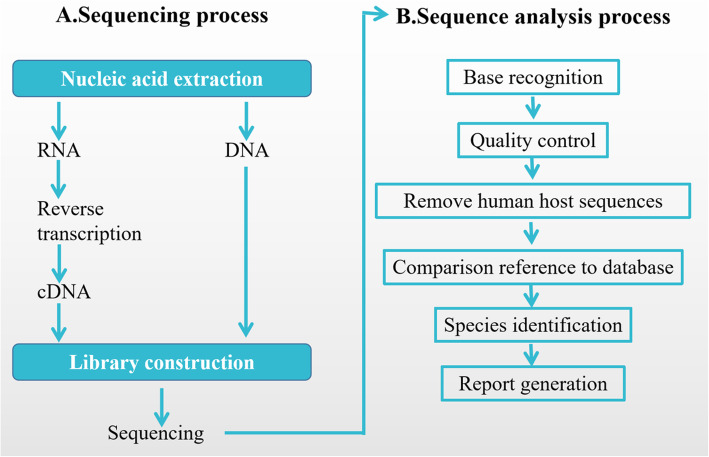
Although traditional diagnostic techniques of infection are mature and price favorable at present, most of them are time-consuming and with a low positivity. Metagenomic next⁃generation sequencing (mNGS) was studied widely because of identification and typing of all pathogens not rely on culture and retrieving all DNA without bias. Based on this background, we aim to detect the difference between mNGS and traditional culture method, and to explore the relationship between mNGS results and the severity, prognosis of infectious patients.

METHODS

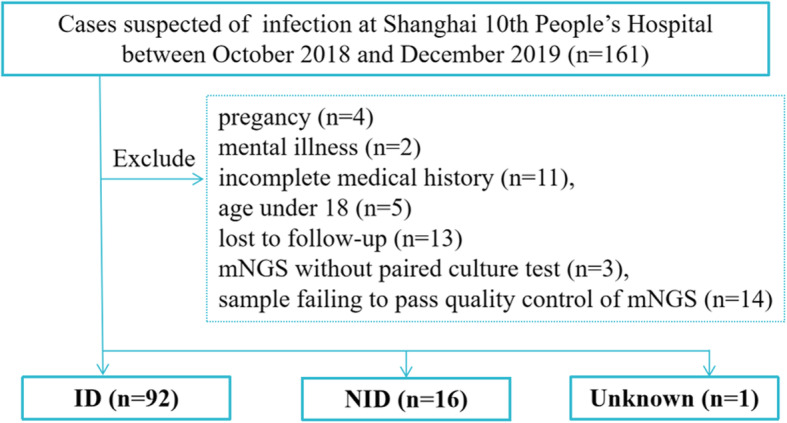
109 adult patients were enrolled in our study in Shanghai Tenth People's Hospital from October 2018 to December 2019. The diagnostic results, negative predictive values, positive predictive values, false positive rate, false negative rate, pathogen and sample types were analyzed by using both traditional culture and mNGS methods. Then, the samples and clinical information of 93 patients in the infected group (ID) were collected. According to whether mNGS detected pathogens, the patients in ID group were divided into the positive group of 67 cases and the negative group of 26 cases. Peripheral blood leukocytes, C-reactive protein (CRP), procalcitonin (PCT) and neutrophil counts were measured, and the concentrations of IL-2, IL-4, IL-6, TNF-α, IL-17A, IL-10 and INF-γ in the serum were determined by ELISA. The correlation between the positive detection of pathogens by mNGS and the severity of illness, hospitalization days, and mortality were analyzed.

RESULTS

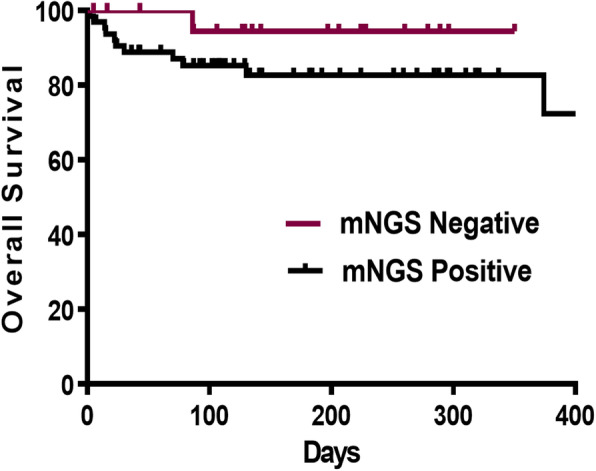
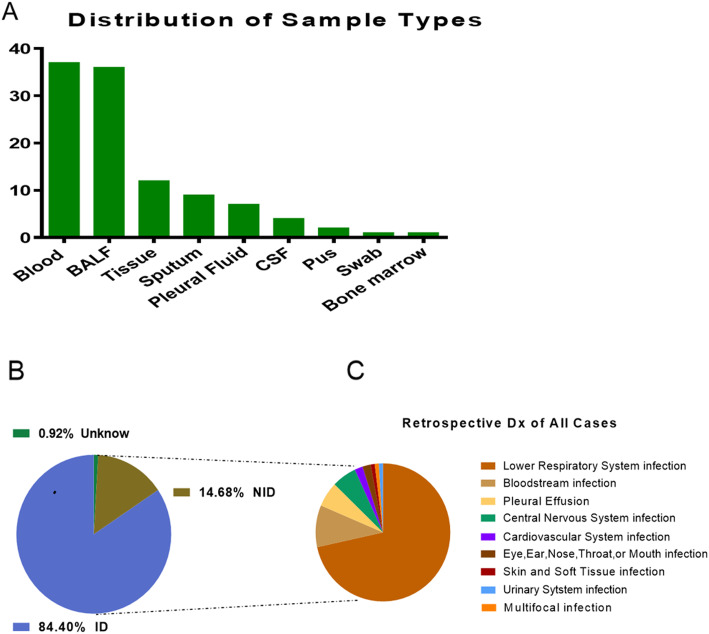
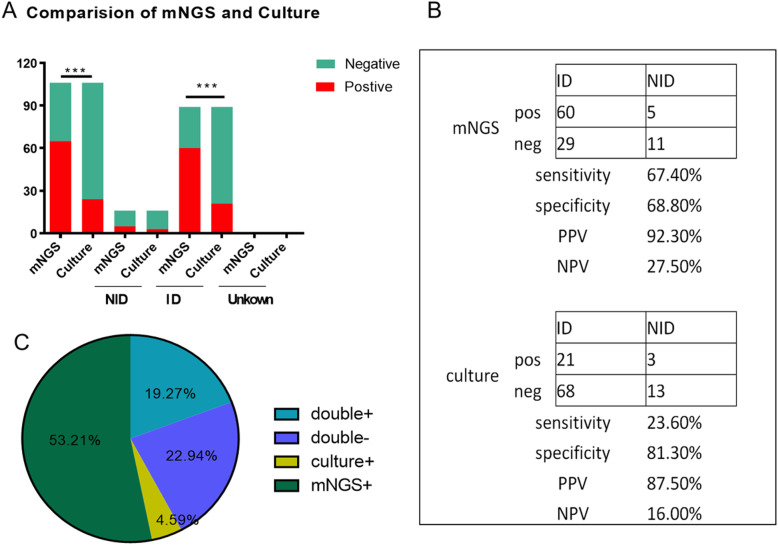
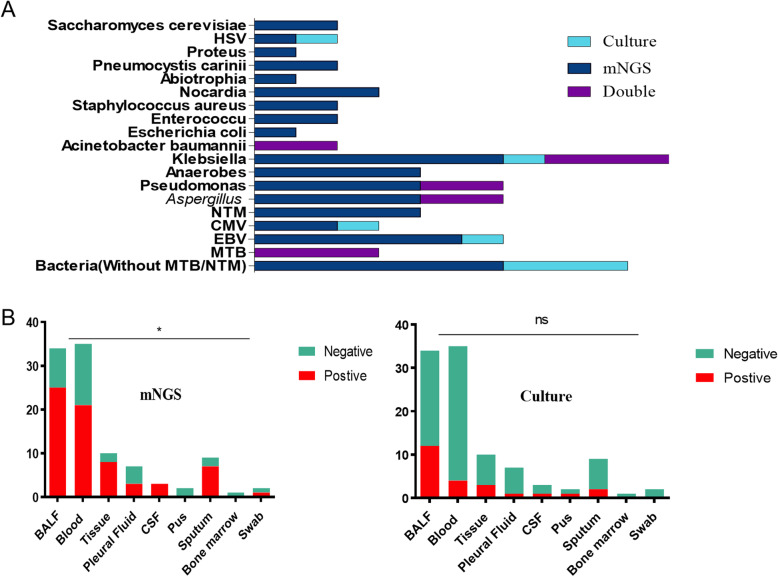
109 samples were assigned into infected group (ID, 92/109, 84.4%), non-infected group (NID, 16/109, 14.7%), and unknown group (1/109, 0.9%). Blood was the most abundant type of samples with 37 cases, followed by bronchoalveolar lavage fluid in 36 cases, tissue, sputum, pleural effusion, cerebrospinal fluid (CSF), pus, bone marrow and nasal swab. In the ID group, the majority of patients were diagnosed with lower respiratory system infections (73/109, 67%), followed by bloodstream infections, pleural effusion and central nervous system infections. The sensitivity of mNGS was significantly higher than that of culture method (67.4% vs 23.6%; P < 0.001), especially in sample types of bronchoalveolar lavage fluid (P = 0.002), blood (P < 0.001) and sputum (P = 0.037), while the specificity of mNGS was not significantly different from culture method (68.8% vs 81.3%; P = 0.41). The number of hospitals stays and 28-day-motality in the positive mNGS group were significantly higher than those in the negative group, and the difference was statistically significant (P < 0.05). Age was significant in multivariate logistic analyses of positive results of mNGS.

CONCLUSIONS

The study found that mNGS had a higher sensitivity than the traditional method, especially in blood, bronchoalveolar lavage fluid and sputum samples. And positive mNGS group had a higher hospital stay, 28-day-mortality, which means the positive of pathogen nucleic acid sequences detection may be a potential high-risk factor for poor prognosis of adult patients and has significant clinical value. MNGS should be used more in early pathogen diagnosis in the future.

摘要

背景

尽管传统的感染诊断技术目前已经成熟且价格合理,但大多数技术都需要花费大量时间,且阳性率较低。宏基因组下一代测序(mNGS)因其不依赖培养和无偏检索所有 DNA 而能够鉴定和分型所有病原体而受到广泛研究。基于此背景,我们旨在检测 mNGS 与传统培养方法的差异,并探讨 mNGS 结果与感染患者严重程度和预后的关系。

方法

2018 年 10 月至 2019 年 12 月,我们在上海第十人民医院招募了 109 例成年患者。使用传统培养和 mNGS 方法分析诊断结果、阴性预测值、阳性预测值、假阳性率、假阴性率、病原体和样本类型。然后,收集感染组(ID)93 例患者的样本和临床信息。根据 mNGS 是否检测到病原体,将 ID 组患者分为阳性组 67 例和阴性组 26 例。测量外周血白细胞、C 反应蛋白(CRP)、降钙素原(PCT)和中性粒细胞计数,并通过 ELISA 测定血清中 IL-2、IL-4、IL-6、TNF-α、IL-17A、IL-10 和 INF-γ 的浓度。分析 mNGS 检测到病原体的阳性与疾病严重程度、住院天数和死亡率的相关性。

结果

109 份样本分为感染组(ID,92/109,84.4%)、非感染组(NID,16/109,14.7%)和未知组(1/109,0.9%)。血液是样本中最丰富的类型,有 37 例,其次是支气管肺泡灌洗液 36 例,组织、痰、胸腔积液、脑脊液(CSF)、脓液、骨髓和鼻拭子。在 ID 组中,大多数患者被诊断为下呼吸道感染(73/109,67%),其次是血流感染、胸腔积液和中枢神经系统感染。mNGS 的灵敏度明显高于培养方法(67.4% vs 23.6%;P < 0.001),尤其是在支气管肺泡灌洗液(P = 0.002)、血液(P <0.001)和痰(P = 0.037)样本类型中,而 mNGS 的特异性与培养方法无显著差异(68.8% vs 81.3%;P = 0.41)。阳性 mNGS 组的住院天数和 28 天死亡率明显高于阴性组,差异有统计学意义(P < 0.05)。年龄在 mNGS 阳性结果的多因素逻辑分析中具有统计学意义。

结论

本研究发现 mNGS 比传统方法具有更高的灵敏度,尤其是在血液、支气管肺泡灌洗液和痰样本中。阳性 mNGS 组的住院时间、28 天死亡率更高,这意味着病原体核酸序列检测阳性可能是成年患者预后不良的潜在高危因素,具有显著的临床价值。未来应更多地将 mNGS 应用于早期病原体诊断。
https://cdn.ncbi.nlm.nih.gov/pmc/blobs/ba27/7805029/f28af92d2788/12879_2020_5746_Fig6_HTML.jpg
https://cdn.ncbi.nlm.nih.gov/pmc/blobs/ba27/7805029/43c9a927c38d/12879_2020_5746_Fig1_HTML.jpg
https://cdn.ncbi.nlm.nih.gov/pmc/blobs/ba27/7805029/9ff5e2a4270b/12879_2020_5746_Fig2_HTML.jpg
https://cdn.ncbi.nlm.nih.gov/pmc/blobs/ba27/7805029/b35794b3121c/12879_2020_5746_Fig3_HTML.jpg
https://cdn.ncbi.nlm.nih.gov/pmc/blobs/ba27/7805029/aeb77f9c4c59/12879_2020_5746_Fig4_HTML.jpg
https://cdn.ncbi.nlm.nih.gov/pmc/blobs/ba27/7805029/20b4149d8137/12879_2020_5746_Fig5_HTML.jpg
https://cdn.ncbi.nlm.nih.gov/pmc/blobs/ba27/7805029/f28af92d2788/12879_2020_5746_Fig6_HTML.jpg
https://cdn.ncbi.nlm.nih.gov/pmc/blobs/ba27/7805029/43c9a927c38d/12879_2020_5746_Fig1_HTML.jpg
https://cdn.ncbi.nlm.nih.gov/pmc/blobs/ba27/7805029/9ff5e2a4270b/12879_2020_5746_Fig2_HTML.jpg
https://cdn.ncbi.nlm.nih.gov/pmc/blobs/ba27/7805029/b35794b3121c/12879_2020_5746_Fig3_HTML.jpg
https://cdn.ncbi.nlm.nih.gov/pmc/blobs/ba27/7805029/aeb77f9c4c59/12879_2020_5746_Fig4_HTML.jpg
https://cdn.ncbi.nlm.nih.gov/pmc/blobs/ba27/7805029/20b4149d8137/12879_2020_5746_Fig5_HTML.jpg
https://cdn.ncbi.nlm.nih.gov/pmc/blobs/ba27/7805029/f28af92d2788/12879_2020_5746_Fig6_HTML.jpg

相似文献

1
The diagnostic value of metagenomic next⁃generation sequencing in infectious diseases.宏基因组下一代测序在感染性疾病中的诊断价值。
BMC Infect Dis. 2021 Jan 13;21(1):62. doi: 10.1186/s12879-020-05746-5.
2
The Application of Metagenomic Next-Generation Sequencing in Detection of Pathogen in Bronchoalveolar Lavage Fluid and Sputum Samples of Patients with Pulmonary Infection.宏基因组下一代测序在检测肺部感染患者支气管肺泡灌洗液和痰液样本中的病原体中的应用。
Comput Math Methods Med. 2021 Nov 8;2021:7238495. doi: 10.1155/2021/7238495. eCollection 2021.
3
The etiological diagnostic value of metagenomic next-generation sequencing in suspected community-acquired pneumonia.宏基因组下一代测序在疑似社区获得性肺炎中的病因诊断价值。
BMC Infect Dis. 2024 Jun 24;24(1):626. doi: 10.1186/s12879-024-09507-6.
4
A single-center, retrospective study of hospitalized patients with lower respiratory tract infections: clinical assessment of metagenomic next-generation sequencing and identification of risk factors in patients.一项关于下呼吸道感染住院患者的单中心回顾性研究:宏基因组下一代测序的临床评估及患者风险因素的识别。
Respir Res. 2024 Jun 20;25(1):250. doi: 10.1186/s12931-024-02887-y.
5
Metagenomic next-generation sequencing targeted and metagenomic next-generation sequencing for pulmonary infection in HIV-infected and non-HIV-infected individuals.宏基因组下一代测序靶向检测与宏基因组下一代测序在 HIV 感染和非 HIV 感染个体肺部感染中的应用。
Front Cell Infect Microbiol. 2024 Aug 19;14:1438982. doi: 10.3389/fcimb.2024.1438982. eCollection 2024.
6
The clinical value of mNGS of bronchoalveolar lavage fluid versus traditional microbiological tests for pathogen identification and prognosis of severe pneumonia (NT-BALF):study protocol for a prospective multi-center randomized clinical trial.支气管肺泡灌洗液宏基因组下一代测序与传统微生物学检测对重症肺炎病原体鉴定及预后的临床价值(NT-BALF):一项前瞻性多中心随机临床试验研究方案。
Trials. 2024 Apr 22;25(1):276. doi: 10.1186/s13063-024-08112-x.
7
Improving Suspected Pulmonary Infection Diagnosis by Bronchoalveolar Lavage Fluid Metagenomic Next-Generation Sequencing: a Multicenter Retrospective Study.通过支气管肺泡灌洗液宏基因组下一代测序提高疑似肺部感染诊断:一项多中心回顾性研究。
Microbiol Spectr. 2022 Aug 31;10(4):e0247321. doi: 10.1128/spectrum.02473-21. Epub 2022 Aug 9.
8
Application of metagenomic next-generation sequencing for bronchoalveolar lavage diagnostics in critically ill patients.宏基因组下一代测序在危重症患者支气管肺泡灌洗诊断中的应用。
Eur J Clin Microbiol Infect Dis. 2020 Feb;39(2):369-374. doi: 10.1007/s10096-019-03734-5. Epub 2019 Dec 7.
9
The diagnostic value of bronchoalveolar lavage fluid metagenomic next-generation sequencing in critically ill patients with respiratory tract infections.支气管肺泡灌洗液体宏基因组下一代测序在重症呼吸道感染患者中的诊断价值
Microbiol Spectr. 2024 Aug 6;12(8):e0045824. doi: 10.1128/spectrum.00458-24. Epub 2024 Jun 25.
10
The clinical significance of simultaneous detection of pathogens from bronchoalveolar lavage fluid and blood samples by metagenomic next-generation sequencing in patients with severe pneumonia.宏基因组下一代测序同时检测重症肺炎患者支气管肺泡灌洗液和血液样本中的病原体的临床意义。
J Med Microbiol. 2021 Jan;70(1). doi: 10.1099/jmm.0.001259.

引用本文的文献

1
Positive Metagenomic Next-Generation Sequencing of Renal Lavage Fluid Associates with Delayed Graft Function in Kidney Transplants from Donors After Circulatory Death: A Retrospective Study.肾灌洗液宏基因组下一代测序阳性与心脏死亡供体肾移植术后移植肾功能延迟相关:一项回顾性研究
Infect Drug Resist. 2025 Aug 30;18:4579-4592. doi: 10.2147/IDR.S541861. eCollection 2025.
2
vPro-MS enables identification of human-pathogenic viruses from patient samples by untargeted proteomics.vPro-MS可通过非靶向蛋白质组学从患者样本中鉴定出人类致病病毒。
Nat Commun. 2025 Jul 31;16(1):7041. doi: 10.1038/s41467-025-62469-4.
3
Comparative diagnostic performance of metagenomic and two targeted sequencing methods in lower respiratory infection.

本文引用的文献

1
Laboratory validation of a clinical metagenomic sequencing assay for pathogen detection in cerebrospinal fluid.临床宏基因组测序检测脑脊液病原体的实验室验证。
Genome Res. 2019 May;29(5):831-842. doi: 10.1101/gr.238170.118. Epub 2019 Apr 16.
2
Clinical metagenomics.临床宏基因组学。
Nat Rev Genet. 2019 Jun;20(6):341-355. doi: 10.1038/s41576-019-0113-7.
3
Analytical and clinical validation of a microbial cell-free DNA sequencing test for infectious disease.微生物无细胞 DNA 测序检测用于感染性疾病的分析和临床验证。
宏基因组学和两种靶向测序方法在下呼吸道感染中的比较诊断性能
Sci Rep. 2025 Jul 27;15(1):27365. doi: 10.1038/s41598-025-11834-w.
4
Metagenomic Next-Generation Sequencing for the Diagnosis of Infectious Uveitis: A Comprehensive Systematic Review.宏基因组二代测序在感染性葡萄膜炎诊断中的应用:一项全面的系统评价
Viruses. 2025 May 26;17(6):757. doi: 10.3390/v17060757.
5
Application value of metagenomic next-generation sequencing based on protective bronchoalveolar lavage in nonresponding pneumonia.基于保护性支气管肺泡灌洗的宏基因组下一代测序在无反应性肺炎中的应用价值
Microbiol Spectr. 2025 Jul;13(7):e0313824. doi: 10.1128/spectrum.03138-24. Epub 2025 May 29.
6
Liver abscess and septic shock due to infection: a case report and literature review.感染所致肝脓肿及感染性休克:一例病例报告及文献综述
Front Med (Lausanne). 2025 Apr 30;12:1575454. doi: 10.3389/fmed.2025.1575454. eCollection 2025.
7
Application of Metagenomic Next-Generation Sequencing in HIV-Infected Patients with Bloodstream Infections.宏基因组下一代测序在HIV感染血流感染患者中的应用。
Infect Drug Resist. 2025 May 8;18:2389-2399. doi: 10.2147/IDR.S509665. eCollection 2025.
8
Community-acquired pneumonia associated with influenza co-infection caused by fusobacterium necrophorum: a case report and literature review.坏死梭杆菌引起的社区获得性肺炎合并流感病毒共感染:一例报告及文献复习
BMC Infect Dis. 2025 May 9;25(1):686. doi: 10.1186/s12879-025-11079-y.
9
Enhancing bloodstream infection diagnostics: a novel filtration and targeted next-generation sequencing approach for precise pathogen identification.增强血流感染诊断:一种用于精确病原体鉴定的新型过滤和靶向新一代测序方法。
Front Microbiol. 2025 Mar 20;16:1538265. doi: 10.3389/fmicb.2025.1538265. eCollection 2025.
10
Diagnostic value of metagenomic next-generation sequencing combined by medical thoracoscopy surgery among infectious pleural effusion patients.宏基因组下一代测序联合内科胸腔镜手术在感染性胸腔积液患者中的诊断价值
BMC Infect Dis. 2025 Mar 25;25(1):407. doi: 10.1186/s12879-025-10806-9.
Nat Microbiol. 2019 Apr;4(4):663-674. doi: 10.1038/s41564-018-0349-6. Epub 2019 Feb 11.
4
Metagenomic next-generation sequencing as a diagnostic tool for toxoplasmic encephalitis.宏基因组下一代测序作为弓形虫脑炎的诊断工具。
Ann Clin Microbiol Antimicrob. 2018 Dec 26;17(1):45. doi: 10.1186/s12941-018-0298-1.
5
Microbiological Diagnostic Performance of Metagenomic Next-generation Sequencing When Applied to Clinical Practice.宏基因组下一代测序在临床应用中的微生物诊断性能。
Clin Infect Dis. 2018 Nov 13;67(suppl_2):S231-S240. doi: 10.1093/cid/ciy693.
6
Identification of sparganosis based on next-generation sequencing.基于下一代测序的曼氏裂头蚴鉴定。
Infect Genet Evol. 2018 Dec;66:256-261. doi: 10.1016/j.meegid.2018.10.005. Epub 2018 Oct 11.
7
The advantages of next-generation sequencing technology in the detection of different sources of abscess.新一代测序技术在检测不同来源脓肿方面的优势。
J Infect. 2019 Jan;78(1):75-86. doi: 10.1016/j.jinf.2018.08.002. Epub 2018 Aug 8.
8
Detection of Pulmonary Infectious Pathogens From Lung Biopsy Tissues by Metagenomic Next-Generation Sequencing.宏基因组下一代测序检测肺活检组织中的肺部感染病原体。
Front Cell Infect Microbiol. 2018 Jun 25;8:205. doi: 10.3389/fcimb.2018.00205. eCollection 2018.
9
Diagnosis of local hepatic tuberculosis through next-generation sequencing: Smarter, faster and better.通过下一代测序诊断局部肝结核:更智能、更快速、更出色。
Clin Res Hepatol Gastroenterol. 2018 Jun;42(3):178-181. doi: 10.1016/j.clinre.2018.04.007.
10
Next-generation sequencing of the cerebrospinal fluid in the diagnosis of neurobrucellosis.脑脊液下一代测序在神经型布氏菌病诊断中的应用。
Int J Infect Dis. 2018 Feb;67:20-24. doi: 10.1016/j.ijid.2017.11.028. Epub 2017 Nov 28.