Department of Clinical Laboratory, Peking University People's Hospital, Beijing, China.
BGI Genomics, Beijing Genomics Institute-Shenzhen, Shenzhen, China.
Front Cell Infect Microbiol. 2018 Jun 25;8:205. doi: 10.3389/fcimb.2018.00205. eCollection 2018.
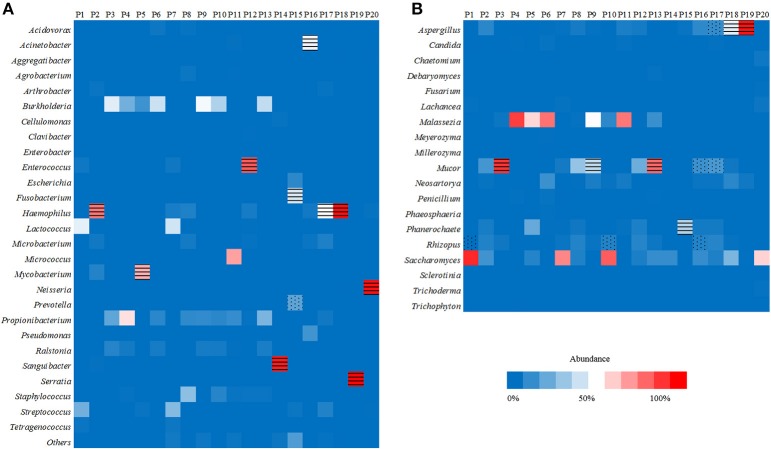
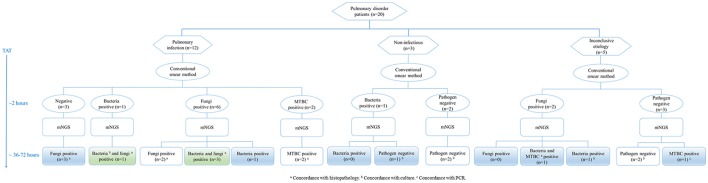
Metagenomic next-generation sequencing (mNGS) is a comprehensive approach for sequence-based identification of pathogenic microbes. However, reports on the use of mNGS in pulmonary infection applied to lung biopsy tissues remain scarce. In this study, we applied mNGS to detect the presence of pathogenic microbes in lung biopsy tissues from 20 patients with pulmonary disorders indicating possible infection. We applied a new data management for identifying pathogen species based on mNGS data. We determined the thresholds for the unique reads and relative abundance required to identify the infectious pathogens. Potential pathogens of pulmonary infections in 15 patients were identified by mNGS. The comparison between mNGS and culture method resulted that the sensitivity and specificity were 100.0% (95% CI: 31.0-100.0%) and 76.5% (95% CI: 49.8-92.2%) for bacteria, 57.1% (95% CI: 20.2-88.2%) and 61.5% (95% CI: 32.2-84.9%) for fungi. The positive predictive value (PPV) (42.9% for bacteria, 44.4% for fungi) was much lower than negative predictive value (NPV) (100% for bacteria, 72.7% for fungi) in mNGS vs. culture method. The mNGS showed the highest specificity (100.0 and 94.1%) and PPV (100.0 and 75.0%) in the evaluation of fungi and MTBC respectively, when compared with histopathology method. The study indicated that mNGS of lung biopsy tissues can be used to detect the presence (or absence) of pulmonary pathogens in patients, with potential benefits in speed and sensitivity. However, accurate data management and interpretation of mNGS are required, and should be combined with observations of clinical manifestations and conventional laboratory-based diagnostic methods.
宏基因组下一代测序(mNGS)是一种基于序列的病原微生物鉴定的综合方法。然而,关于 mNGS 在用于肺活检组织的肺部感染中的应用的报告仍然很少。在这项研究中,我们应用 mNGS 检测 20 名疑似肺部感染的肺部疾病患者的肺活检组织中是否存在病原体。我们应用了一种新的数据管理方法,根据 mNGS 数据识别病原体种类。我们确定了识别传染性病原体所需的独特读取数和相对丰度的阈值。mNGS 鉴定了 15 名患者的肺部感染潜在病原体。mNGS 与培养方法的比较结果显示,细菌的敏感性和特异性分别为 100.0%(95%CI:31.0-100.0%)和 76.5%(95%CI:49.8-92.2%),真菌的敏感性和特异性分别为 57.1%(95%CI:20.2-88.2%)和 61.5%(95%CI:32.2-84.9%)。mNGS 与培养方法相比,阳性预测值(PPV)(细菌为 42.9%,真菌为 44.4%)明显低于阴性预测值(NPV)(细菌为 100%,真菌为 72.7%)。与组织病理学方法相比,mNGS 在真菌和 MTBC 的评估中显示出最高的特异性(100.0%和 94.1%)和 PPV(100.0%和 75.0%)。研究表明,mNGS 可用于检测疑似肺部感染患者肺活检组织中是否存在(或不存在)病原体,在速度和敏感性方面具有潜在优势。然而,需要准确的数据管理和解释,并且应该与临床表现和常规实验室诊断方法相结合。