Department of Cell Biology and Biophysics, Faculty of Biology, National and Kapodistrian University of Athens, 15784, Athens, Greece.
Department of Clinical Therapeutics, School of Medicine, National and Kapodistrian University of Athens, 11528, Athens, Greece.
J Biomed Sci. 2021 Jan 12;28(1):9. doi: 10.1186/s12929-020-00703-5.
Gaining further insights into SARS-CoV-2 routes of infection and the underlying pathobiology of COVID-19 will support the design of rational treatments targeting the life cycle of the virus and/or the adverse effects (e.g., multi-organ collapse) that are triggered by COVID-19-mediated adult respiratory distress syndrome (ARDS) and/or other pathologies.
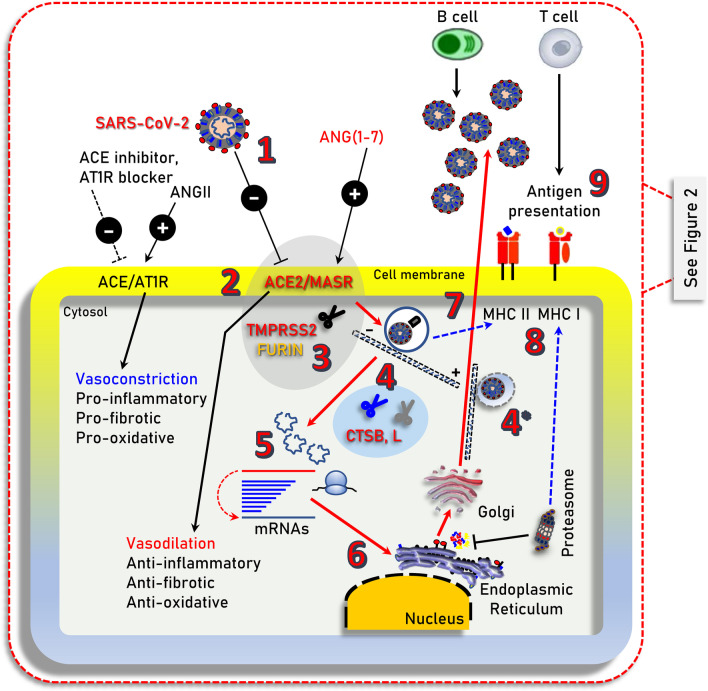
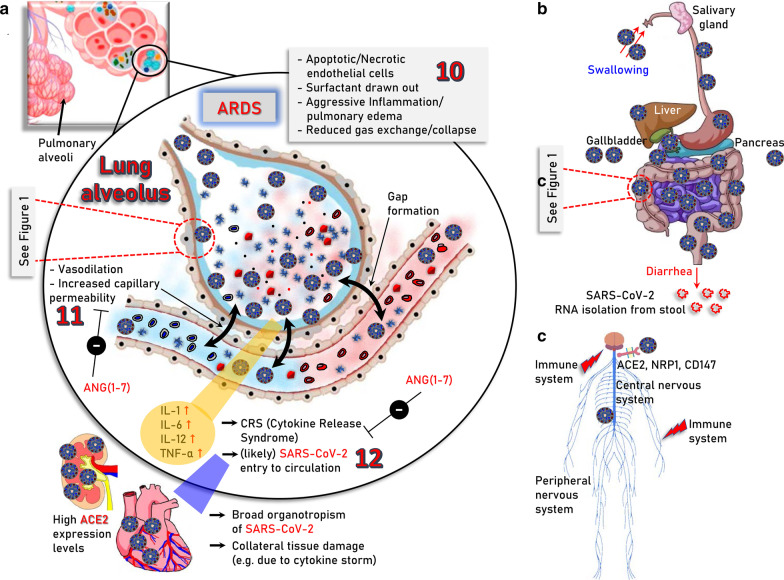
COVID-19 is a two-phase disease being marked by (phase 1) increased virus transmission and infection rates due to the wide expression of the main infection-related ACE2, TMPRSS2 and CTSB/L human genes in tissues of the respiratory and gastrointestinal tract, as well as by (phase 2) host- and probably sex- and/or age-specific uncontrolled inflammatory immune responses which drive hyper-cytokinemia, aggressive inflammation and (due to broad organotropism of SARS-CoV-2) collateral tissue damage and systemic failure likely because of imbalanced ACE/ANGII/AT1R and ACE2/ANG(1-7)/MASR axes signaling.
Here we discuss SARS-CoV-2 life cycle and a number of approaches aiming to suppress viral infection rates or propagation; increase virus antigen presentation in order to activate a robust and durable adaptive immune response from the host, and/or mitigate the ARDS-related "cytokine storm" and collateral tissue damage that triggers the severe life-threatening complications of COVID-19.
深入了解 SARS-CoV-2 的感染途径和 COVID-19 的发病机制,将有助于设计针对病毒生命周期和/或 COVID-19 引起的成人呼吸窘迫综合征(ARDS)和/或其他病理引起的不良后果(如多器官衰竭)的合理治疗方法。
COVID-19 是一种双相疾病,其特征是(第 1 阶段)由于主要感染相关的 ACE2、TMPRSS2 和 CTSB/L 人类基因在呼吸道和胃肠道组织中的广泛表达,导致病毒传播和感染率增加,以及(第 2 阶段)宿主,可能是性别和/或年龄特异性的不受控制的炎症免疫反应,导致高细胞因子血症、侵袭性炎症和(由于 SARS-CoV-2 的广泛器官嗜性)继发组织损伤和全身衰竭,可能是由于 ACE/ANGII/AT1R 和 ACE2/ANG(1-7)/MASR 轴信号失衡。
在这里,我们讨论了 SARS-CoV-2 的生命周期和一些旨在抑制病毒感染率或传播的方法;增加病毒抗原呈递,以激活宿主产生强大和持久的适应性免疫反应,和/或减轻与 ARDS 相关的“细胞因子风暴”和继发组织损伤,从而引发 COVID-19 的严重危及生命的并发症。