Johnston Venerina, Chen Xiaoqi, Welch Alyssa, Sjøgaard Gisela, Comans Tracy A, McStea Megan, Straker Leon, Melloh Markus, Pereira Michelle, O'Leary Shaun
The University of Queensland, School of Health and Rehabilitation Sciences, St Lucia, Brisbane, Queensland, 4067, Australia.
The University of Queensland, Centre for Health Services Research, Brisbane, Australia.
BMC Musculoskelet Disord. 2021 Jan 12;22(1):68. doi: 10.1186/s12891-021-03945-y.
Neck pain is prevalent among office workers. This study evaluated the impact of an ergonomic and exercise training (EET) intervention and an ergonomic and health promotion (EHP) intervention on neck pain intensity among the All Workers and a subgroup of Neck Pain cases at baseline.
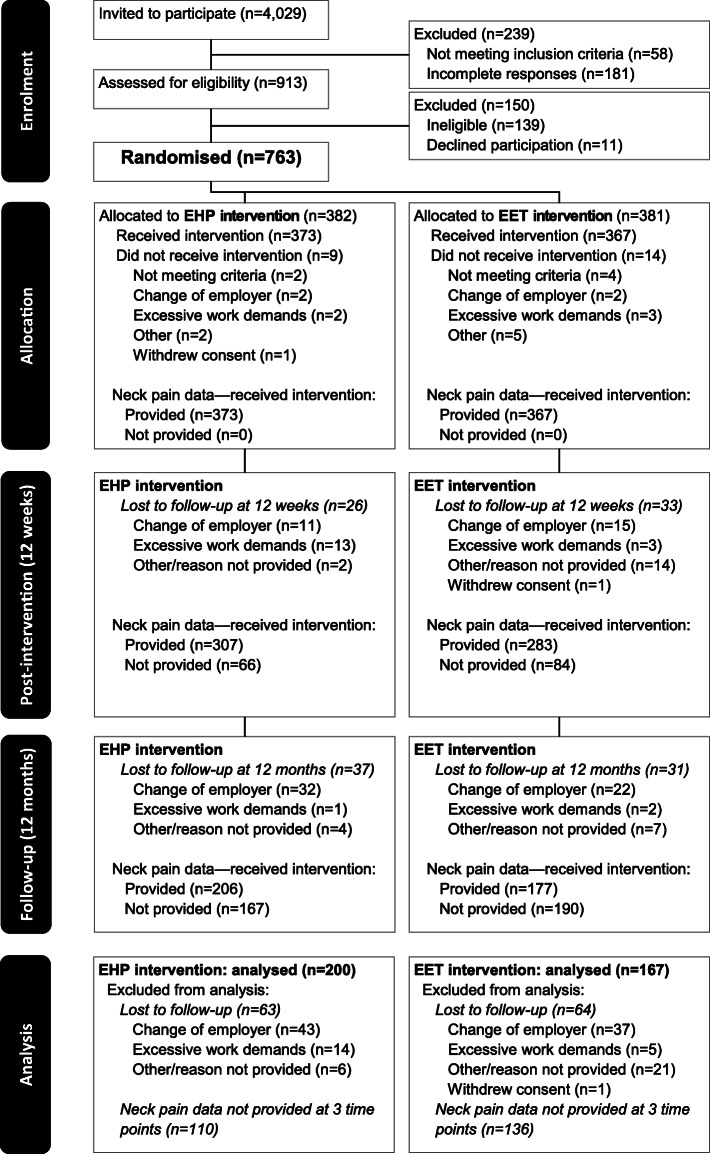
A 12-month cluster-randomized trial was conducted in 14 public and private organisations. Office workers aged ≥18 years working ≥30 h per week (n = 740) received an individualised workstation ergonomic intervention, followed by 1:1 allocation to the EET group (neck-specific exercise training), or the EHP group (health promotion) for 12 weeks. Neck pain intensity (scale: 0-9) was recorded at baseline, 12 weeks, and 12 months. Participants with data at these three time points were included for analysis (n = 367). Intervention group differences were analysed using generalized estimating equation models on an intention-to-treat basis and adjusted for potential confounders. Subgroup analysis was performed on neck cases reporting pain ≥3 at baseline (n = 96).
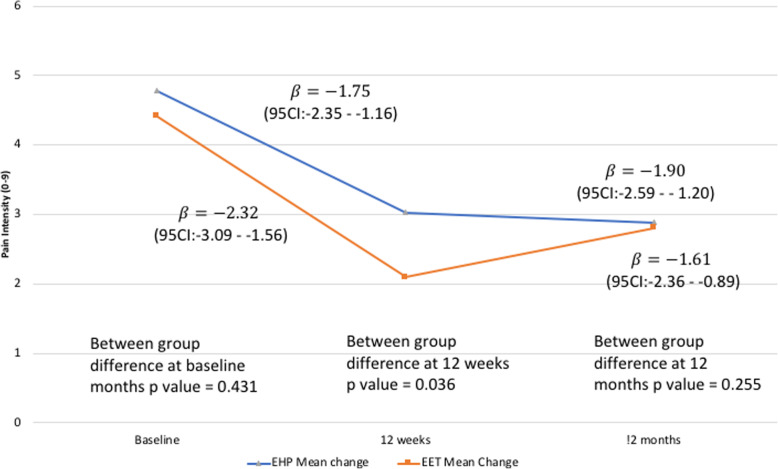
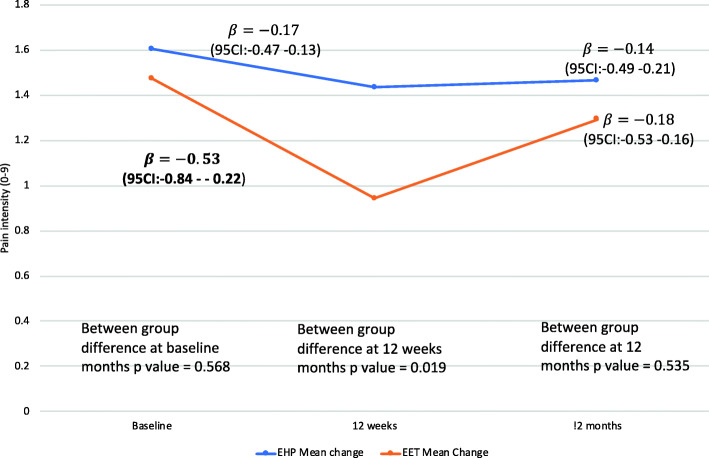
The EET group demonstrated significantly greater reductions in neck pain intensity at 12 weeks compared to the EHP group for All Workers (EET: β = - 0.53 points 95% CI: - 0.84- - 0.22 [36%] and EHP: β = - 0.17 points 95% CI: - 0.47-0.13 [10.5%], p-value = 0.02) and the Neck Cases (EET: β = - 2.32 points 95% CI: - 3.09- - 1.56 [53%] and EHP: β = - 1.75 points 95% CI: - 2.35- - 1.16 [36%], p = 0.04). Reductions in pain intensity were not maintained at 12 months with no between-group differences observed in All Workers (EET: β = - 0.18, 95% CI: - 0.53-0.16 and EHP: β = - 0.14 points 95% CI: - 0.49-0.21, p = 0.53) or Neck Cases, although in both groups an overall reduction was found (EET: β = - 1.61 points 95% CI: - 2.36- - 0.89 and EHP: β = - 1.9 points 95% CI: - 2.59- - 1.20, p = 0.26).
EET was more effective than EHP in reducing neck pain intensity in All Workers and Neck Cases immediately following the intervention period (12 weeks) but not at 12 months, with changes at 12 weeks reaching clinically meaningful thresholds for the Neck Cases. Findings suggest the need for continuation of exercise to maintain benefits in the longer term.
hACTRN12612001154897 Date of Registration: 31/10/2012.
颈部疼痛在办公室职员中很普遍。本研究评估了人体工程学与运动训练(EET)干预措施以及人体工程学与健康促进(EHP)干预措施对所有职员以及基线时颈部疼痛病例亚组的颈部疼痛强度的影响。
在14家公共和私人机构中进行了一项为期12个月的整群随机试验。年龄≥18岁、每周工作≥30小时的办公室职员(n = 740)接受了个性化的工作站人体工程学干预,随后被1:1分配到EET组(颈部特定运动训练)或EHP组(健康促进),为期12周。在基线、12周和12个月时记录颈部疼痛强度(范围:0 - 9)。纳入在这三个时间点有数据的参与者进行分析(n = 367)。干预组差异在意向性分析基础上使用广义估计方程模型进行分析,并对潜在混杂因素进行了调整。对基线时报告疼痛≥3的颈部病例亚组(n = 96)进行了亚组分析。
在12周时,与EHP组相比,EET组在所有职员中颈部疼痛强度的降低幅度显著更大(EET:β = - 0.53分,95%置信区间:- 0.84 - - 0.22 [36%];EHP:β = - 0.17分,95%置信区间:- 0.47 - 0.13 [10.5%],p值 = 0.02),在颈部病例亚组中也是如此(EET:β = - 2.32分,95%置信区间:- 3.09 - - 1.56 [53%];EHP:β = - 1.75分,95%置信区间:- 2.35 - - 1.16 [36%],p = 0.04)。在12个月时,疼痛强度的降低未得到维持,在所有职员中未观察到组间差异(EET:β = - 0.18,95%置信区间:- 0.53 - 0.16;EHP:β = - 0.14分,95%置信区间:- 0.49 - 0.21,p = 0.53),在颈部病例亚组中也未观察到组间差异,尽管两组均发现有总体降低(EET:β = - 1.61分,95%置信区间:- 2.36 - - 0.89;EHP:β = - 1.9分,95%置信区间:- 2.59 - - 1.20,p = 0.26)。
在干预期(12周)结束后立即进行的干预中,EET在降低所有职员和颈部病例亚组的颈部疼痛强度方面比EHP更有效,但在12个月时并非如此,12周时的变化对颈部病例亚组达到了具有临床意义的阈值。研究结果表明需要持续进行运动以长期维持益处。
hACTRN12612001154897 注册日期:2012年10月31日。