Han Shiguo, Li Maofan, Liu Yi, Guo Wuqian, Hong Mao-Chun, Sun Zhihua, Luo Junhua
State Key Laboratory of Structural Chemistry, Fujian Institute of Research on the Structure of Matter, Chinese Academy of Sciences, 155 Yangqiao West Road, Fuzhou, Fujian, 350002, PR China.
Fujian Science & Technology Innovation Laboratory for Optoelectronic Information of China, 155 Yangqiao West Road, Fuzhou, Fujian, 350002, PR China.
Nat Commun. 2021 Jan 12;12(1):284. doi: 10.1038/s41467-020-20530-4.
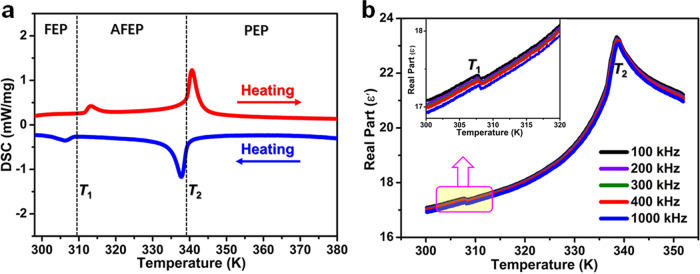
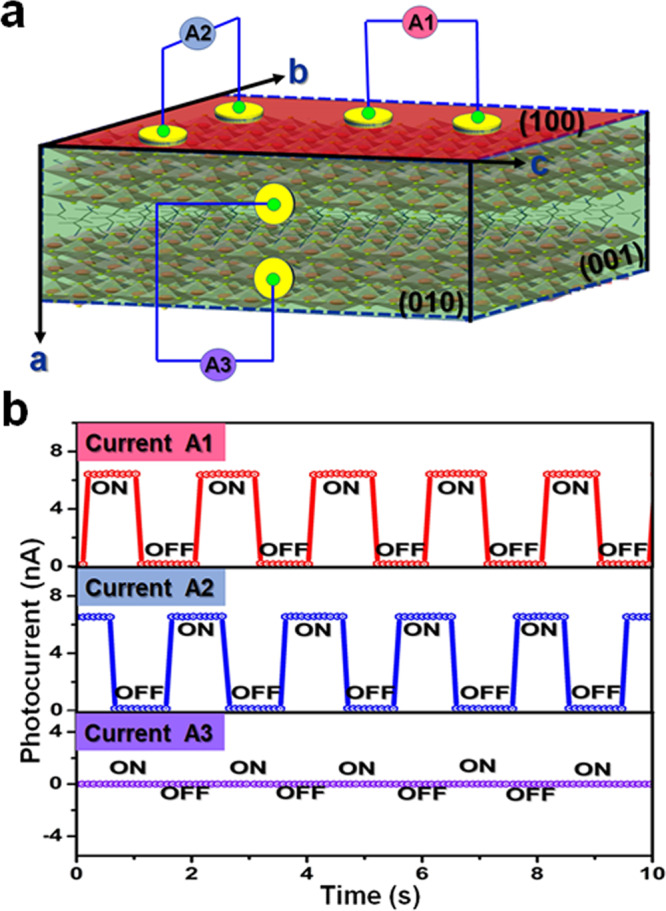
In terms of strong light-polarization coupling, ferroelectric materials with bulk photovoltaic effects afford a promising avenue for optoelectronic devices. However, due to severe polarization deterioration caused by leakage current of photoexcited carriers, most of ferroelectrics are merely capable of absorbing 8-20% of visible-light spectra. Ferroelectrics with the narrow bandgap (<2.0 eV) are still scarce, hindering their practical applications. Here, we present a lead-iodide hybrid biaxial ferroelectric, (isopentylammonium)(ethylammonium)PbI, which shows large spontaneous polarization (5.2 μC/cm) and a narrow direct bandgap (1.80 eV). Particularly, the symmetry breaking of 4/mmmFmm2 species results in its biaxial attributes, which has four equivalent polar directions. Accordingly, exceptional in-plane photovoltaic effects are exploited along the crystallographic [001] and [010] axes directions inside the crystallographic bc-plane. The coupling between ferroelectricity and photovoltaic effects endows great possibility toward self-driven photodetection. This study sheds light on future optoelectronic device applications.
就强光偏振耦合而言,具有体光伏效应的铁电材料为光电器件提供了一条有前景的途径。然而,由于光激发载流子的漏电流导致严重的极化劣化,大多数铁电体仅能吸收8% - 20%的可见光谱。窄带隙(<2.0 eV)的铁电体仍然稀缺,这阻碍了它们的实际应用。在此,我们展示了一种碘化铅混合双轴铁电体,(异戊基铵)(乙铵)PbI,它表现出大的自发极化(5.2 μC/cm²)和窄的直接带隙(1.80 eV)。特别地,4/mmmFmm2物种的对称性破缺导致其双轴属性,具有四个等效的极化方向。相应地,在晶体bc平面内沿晶体学[001]和[010]轴方向利用了异常的面内光伏效应。铁电性与光伏效应之间的耦合为自驱动光探测赋予了极大的可能性。这项研究为未来光电器件的应用提供了启示。