Division of Remote Sensing, National Institute for Space Research, São José dos Campos, 12227-010, Brazil.
National Energy Technology Laboratory, Albany, OR, 97321, USA.
Sci Rep. 2021 Jan 12;11(1):497. doi: 10.1038/s41598-020-79386-9.
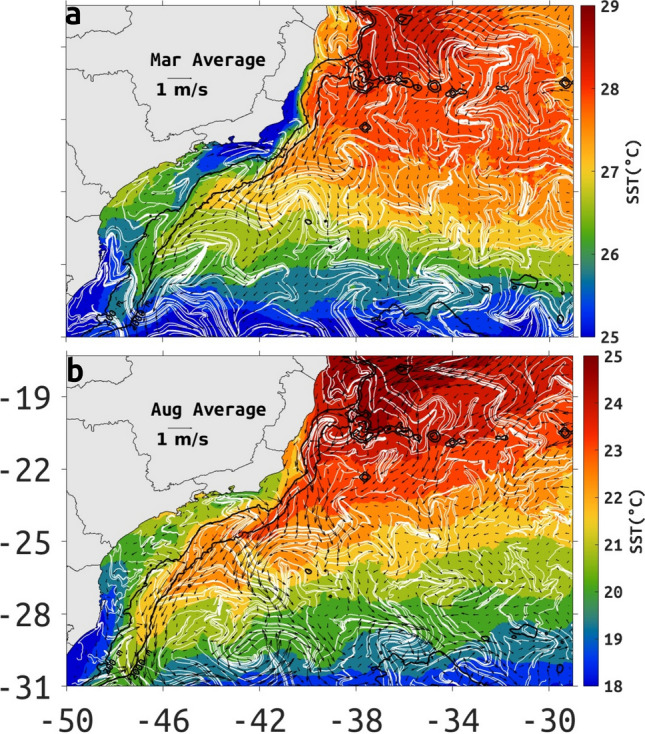
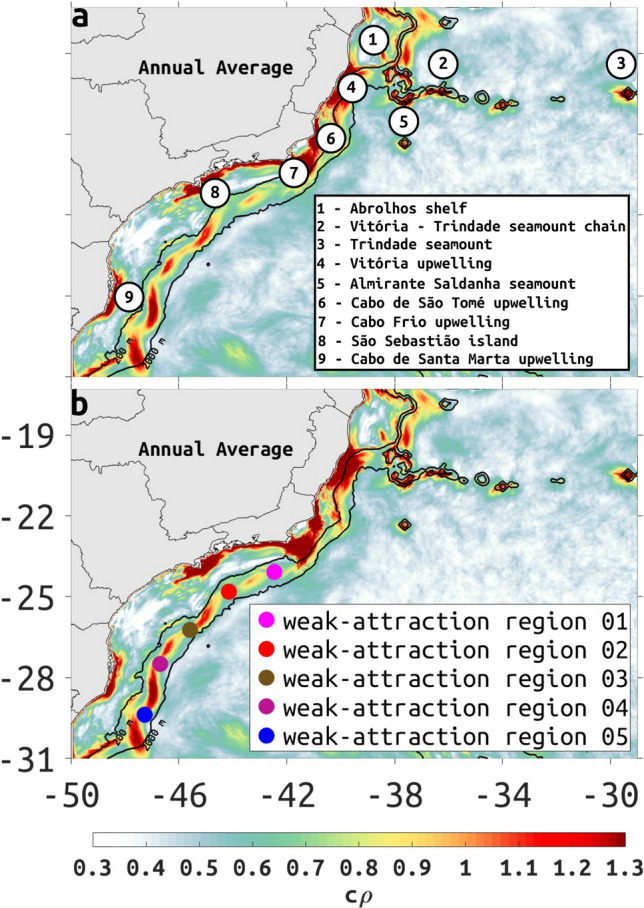
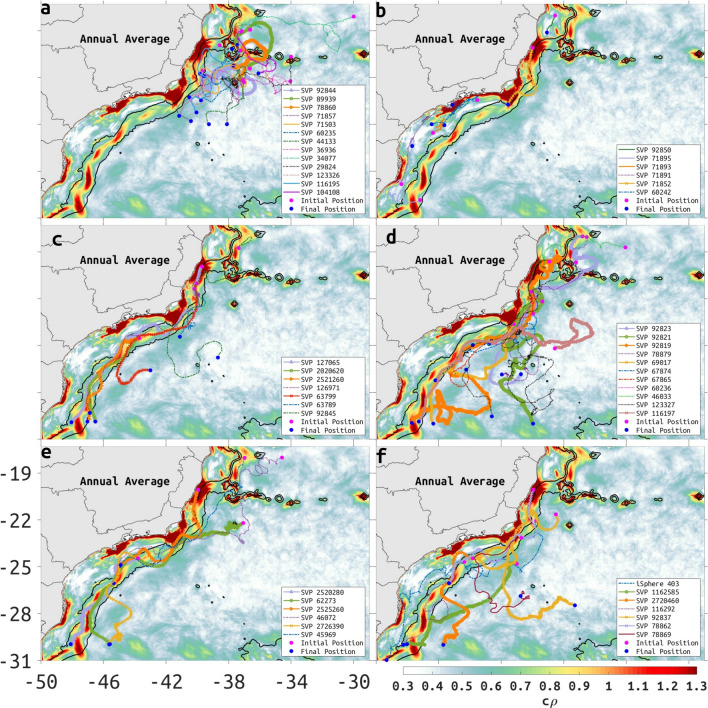
The Brazil Current (BC) is a weak western boundary current flowing along the Southwestern Atlantic Ocean. It is frequently described as a flow with intense mesoscale activity and relatively low volume transport between 5.0 and 10.0 Sv. We use a 13-year eddy-resolving primitive-equation simulation to show that the presence of persistent meanders and eddies leads to characteristic quasi-steady Lagrangian transport patterns, aptly extracted through climatological Lagrangian Coherent Structures (cLCS). The cLCS position the surface expression of the BC core along the 2000-m isobath, in excellent visual agreement with high resolution satellite sea-surface temperature and the model Eulerian mean velocity. The cLCS deformation pattern also responds to zonally persistent cross-shelf SSH transition from positive (high) values near coastline to low (negative) values between 200- and 2000-m and back to positive (high) offshore from the 2000-m isobath. Zonally-paired cyclonic and anticyclonic structures are embedded in this transition, also causing the cLCS to deform into chevrons. An efficient transport barrier is identified close to the 200-m isobath confirmed by limited inshore movement of drogued drifters and accurately indicated by an along slope maxima of climatological strength of attraction. We also show that the persistent cyclonic and anticyclonic structures may induce localized cross-shelf transport. Regions of low climatological strength of attraction coincide with large shelves and with stagnant synthetic trajectories. We also show that cLCS accurately depict trajectories initiated at the location of Chevron's spill (November 2011) as compared to synthetic and satellite-tracked trajectories, and the outline of the oil from that accident. There is also an agreement between the large-scale oil slicks reaching the Brazilian beaches (from August 2019 to February 2020) and the strength of climatological attraction at the coast. Our work also clarifies the influence of persistent mesoscale structures on the regional circulation. The identification and quantitative description of climatological Lagrangian coherent structures is expected to improve the effectiveness of future emergency response to oil spills, contingency planning, rescue operations, larval and fish connectivity assessment, drifter launch strategies, waste pollutant and marine debris dispersion and destination.
巴西海流(BC)是一股沿着西南大西洋流动的弱西边界流。它通常被描述为一股具有强烈中尺度活动和相对低体积输送的流动,输送量在 5.0 到 10.0 Sv 之间。我们使用了一个为期 13 年的具有解析涡度的原始方程模拟,以展示持久的弯曲和涡旋的存在导致了特征准稳态拉格朗日输运模式,这些模式通过气候学拉格朗日相干结构(cLCS)很好地提取出来。cLCS 将 BC 核心的表面表达定位在 2000 米等深线处,与高分辨率卫星海表温度和模型欧拉平均速度具有极好的视觉一致性。cLCS 的变形模式也对从海岸线附近的正(高)值到 200-2000 米之间的低值(负)值的沿纬向持续的跨陆架 SSH 跃变做出响应,然后从 2000 米等深线向外海恢复正(高)值。这种跃变中嵌入了成对的气旋和反气旋结构,也导致 cLCS 变形为 V 字形。在靠近 200 米等深线处识别出一个有效的输运屏障,这一屏障通过限制近海漂移浮标和准确指示气候学吸引力强度的沿坡最大值来确认。我们还表明,持久的气旋和反气旋结构可能会引起局部的跨陆架输运。气候学吸引力强度小的区域与大的陆架和停滞的合成轨迹相对应。我们还表明,与合成轨迹和卫星跟踪轨迹相比,cLCS 可以准确地描绘 Chevron 溢油事件(2011 年 11 月)发生地点的轨迹,以及该事故的油污轮廓。从 2019 年 8 月到 2020 年 2 月,到达巴西海滩的大规模浮油与沿海地区气候学吸引力强度之间也存在一致性。我们的工作还澄清了持久的中尺度结构对区域环流的影响。气候学拉格朗日相干结构的识别和定量描述有望提高未来对溢油事故的应急响应、应急计划、救援行动、幼虫和鱼类连通性评估、漂移器发射策略、废物污染物和海洋碎片扩散和目的地的有效性。