Institute for Microbiology and Immunology, Medical Faculty, University of Belgrade, Dr Subotica No. 1, 11000, Belgrade, Serbia.
Institute of Molecular Genetics and Genetic Engineering, University of Belgrade, 11000, Belgrade, Serbia.
Sci Rep. 2021 Jan 12;11(1):540. doi: 10.1038/s41598-020-79354-3.
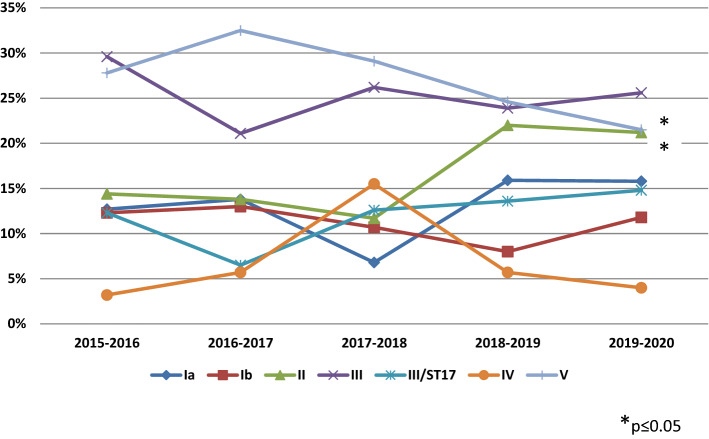
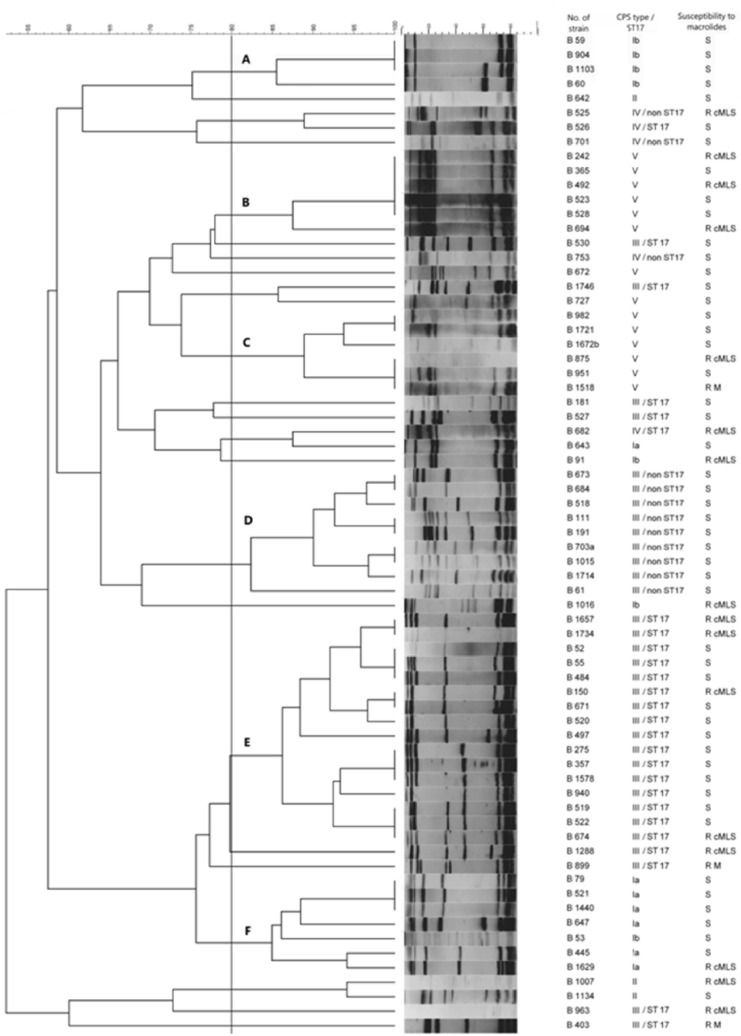
Group B Streptococcus (GBS) is a major cause of neonatal morbidity and mortality. Serbia has not fully implemented preventive measures against GBS neonatal diseases. Therefore, we aimed to assess the maternal GBS colonisation and invasive neonatal disease rate, to reveal the trends of antimicrobial resistance and serotype distribution of GBS from various patient groups. Randomly selected non-invasive (n = 991) and all invasive GBS (n = 80) collected throughout Serbia from 2015 to 2020 were tested for antimicrobial susceptibility, capsular typing, and hvgA detection. Overall, 877/5621 (15.6%) pregnant women were colonised with GBS. Invasive GBS infections incidence in infants (0.18/1000 live births) showed a decreasing trend (0.3 to 0.1/1000 live births). Type III was overrepresented in infants with invasive infections (n = 35, 58.3%), whereas type V predominated among colonised adults (n = 224, 25.5%) and those with noninvasive (n = 37, 32.5%) and invasive infections (n = 8, 40%). The hypervirulent clone III/ST17 was highly associated with invasive infections (n = 28, 35%), particularly late-onset disease (n = 9, 47.4%), showing an increase from 12.3 to 14.8%. The GBS resistance to erythromycin and clindamycin was 26.7% and 22.1%, respectively, with an upward trend. The emergence of the hypervirulent clone III/ST17 and the escalation in GBS resistance highlight an urgent need for continuous monitoring of GBS infections.
B 群链球菌(GBS)是导致新生儿发病和死亡的主要原因。塞尔维亚尚未全面实施针对 GBS 新生儿疾病的预防措施。因此,我们旨在评估母体 GBS 定植和侵袭性新生儿疾病的发生率,揭示不同患者群体中 GBS 的抗生素耐药性和血清型分布趋势。我们对 2015 年至 2020 年期间在塞尔维亚各地随机选择的非侵袭性(n=991)和所有侵袭性 GBS(n=80)进行了抗生素敏感性、荚膜分型和 hvgA 检测。总体而言,5621 名孕妇中有 877 名(15.6%)定植了 GBS。婴儿侵袭性 GBS 感染的发生率(0.18/1000 活产儿)呈下降趋势(0.3 至 0.1/1000 活产儿)。侵袭性感染婴儿中 III 型占优势(n=35,58.3%),而成人定植者(n=224,25.5%)和非侵袭性(n=37,32.5%)及侵袭性感染(n=8,40%)者以 V 型为主。高毒力克隆 III/ST17 与侵袭性感染高度相关(n=28,35%),特别是晚发性疾病(n=9,47.4%),从 12.3%增加到 14.8%。GBS 对红霉素和克林霉素的耐药率分别为 26.7%和 22.1%,呈上升趋势。高毒力克隆 III/ST17 的出现和 GBS 耐药性的升级突显了持续监测 GBS 感染的迫切需要。