Department of Neurology, Uijeongbu St. Mary's Hospital, College of Medicine, The Catholic University of Korea, Seoul, Republic of Korea.
Department of Neurology, St. Vincent's hospital, College of Medicine, The Catholic University of Korea, Seoul, Republic of Korea.
Sci Rep. 2021 Jan 12;11(1):577. doi: 10.1038/s41598-020-80094-7.
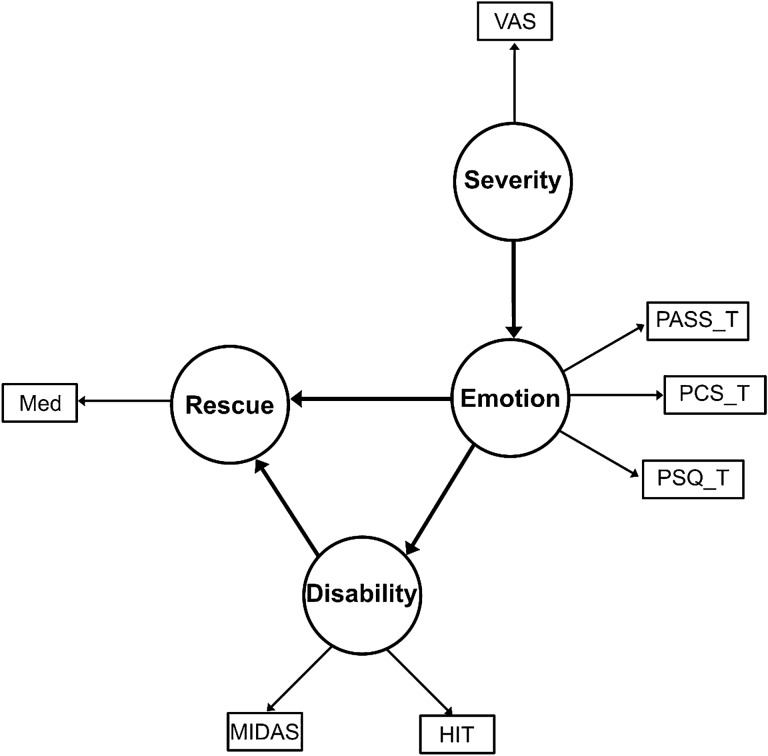
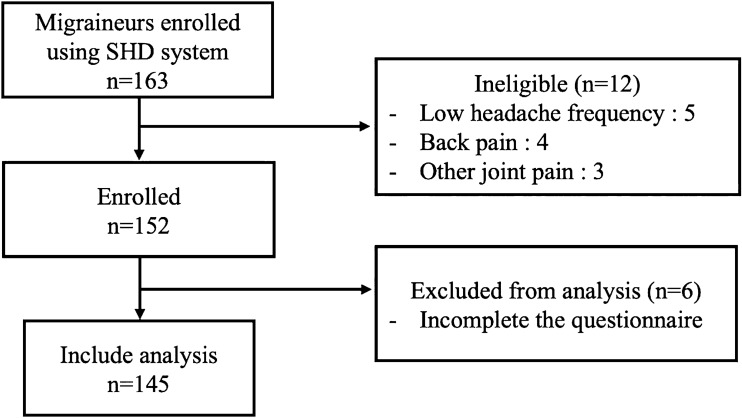
The response to pain is highly individual and can be influenced by complex emotional perception. This study aims to investigate the status of the pain-related emotional response, and the influence on headache characteristics and disability in migraine. We studied the pain-related emotional response in 145 consecutive migraine patients using the Pain Anxiety Symptoms Scale (PASS), the Pain Catastrophizing Scale (PCS), and the Pain Sensitivity Questionnaire (PSQ) and compared them with 106 healthy controls. We investigated the relationship between emotional factors and migraine characteristics. The effect of pain-related emotion on migraine-related disability assessed with the Headache Impact Test-6 (HIT-6) and the Migraine Disability Assessment (MIDAS). Migraine patients showed significantly higher scores on total PASS (p < 0.001), PCS (p < 0.001) and PSQ (p = 0.002) compared to the healthy controls. The HIT-6 was weakly correlated with PASS (r = 0.390, p < 0.001) and PCS (r = 0.354, p < 0.001). PASS-Total (p = 0.001), headache frequency (p = 0.003), and HADS-Anxiety (p = 0.028) were independent variables associated with HIT-6. Headache frequency (p < 0.001) was an independent variable associated with MIDAS. The structural equation model indicated that headache severity has direct loading on emotion and subsequently influenced migraine-related disability. Disability has a significant effect on the frequency of abortive medication use. Migraine patients have altered emotional responses to pain perception. Pain-related anxiety made an important contribution to headache-related disability. The present results suggest that the management of disability by considering various pain-related emotional factors may be necessary for the therapeutic aspects of migraine.
疼痛反应具有高度个体差异,并可能受到复杂情绪感知的影响。本研究旨在调查偏头痛患者疼痛相关情绪反应的现状,以及其对头痛特征和残疾的影响。我们使用疼痛焦虑症状量表(PASS)、疼痛灾难化量表(PCS)和疼痛敏感性问卷(PSQ)对 145 例连续偏头痛患者进行了疼痛相关情绪反应研究,并将其与 106 例健康对照者进行了比较。我们研究了情绪因素与偏头痛特征之间的关系。使用头痛影响测试-6 (HIT-6)和偏头痛残疾评估 (MIDAS)评估疼痛相关情绪对偏头痛相关残疾的影响。偏头痛患者在 PASS 总分(p<0.001)、PCS(p<0.001)和 PSQ(p=0.002)上的得分明显高于健康对照组。HIT-6 与 PASS(r=0.390,p<0.001)和 PCS(r=0.354,p<0.001)呈弱相关。PASS 总分(p=0.001)、头痛频率(p=0.003)和 HADS 焦虑(p=0.028)是与 HIT-6 相关的独立变量。头痛频率(p<0.001)是与 MIDAS 相关的独立变量。结构方程模型表明,头痛严重程度对情绪有直接影响,进而影响偏头痛相关残疾。残疾对预防性药物使用频率有显著影响。偏头痛患者对疼痛感知的情绪反应发生改变。与疼痛相关的焦虑对头痛相关残疾有重要贡献。本研究结果表明,考虑到各种与疼痛相关的情绪因素来管理残疾可能是偏头痛治疗的必要方面。