Park Jeong-Wook, Chu Min Kyung, Kim Jae-Moon, Park Sang-Gue, Cho Soo-Jin
Department of Neurology, the Catholic University of Korea College of Medicine, Seoul, Korea.
Department of Neurology, Sacred Heart Hospital, Hallym University College of Medicine, Anyang, Korea.
PLoS One. 2016 Feb 22;11(2):e0149577. doi: 10.1371/journal.pone.0149577. eCollection 2016.
Various stimuli can trigger migraines in susceptible individuals. We examined migraine trigger factors by using a smartphone headache diary application.
Episodic migraineurs who agreed to participate in our study downloaded smartphone headache diary application, which was designed to capture the details regarding headache trigger factors and characteristics for 3 months. The participants were asked to access the smartphone headache diary application daily and to confirm the presence of a headache and input the types of trigger factors.
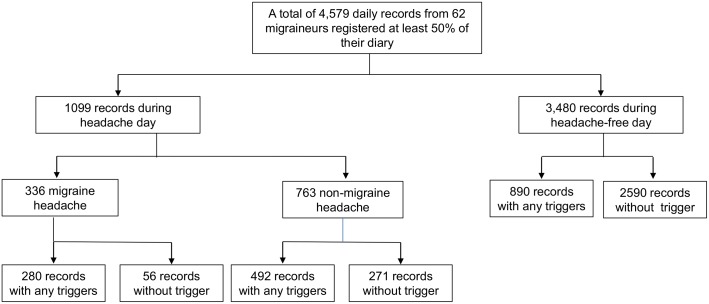
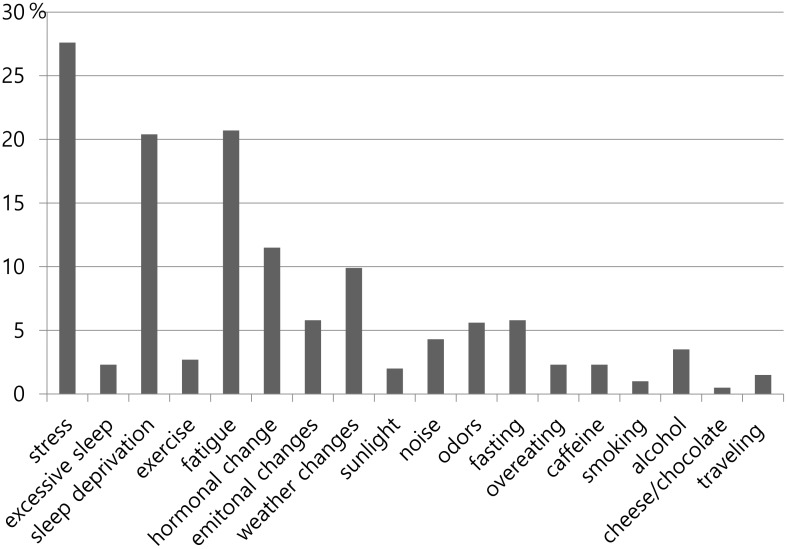
Sixty-two participants kept diary entries until the end of the study. The diary data for 4,579 days were analyzed. In this data set, 1,099 headache days (336 migraines, 763 non-migraine headaches) were recorded; of these, 772 headache events had with trigger factors, and 327 events did not have trigger factors. The common trigger factors that were present on headache days included stress, fatigue, sleep deprivation, hormonal changes, and weather changes. The likelihood of a headache trigger was 57.7% for stress, 55.1% for sleep deprivation, 48.5% for fatigue, and 46.5% for any trigger. The headaches with trigger factors were associated with greater pain intensity (p<0.001), headache-related disability (p<0.001), abortive medication use (p = 0.02), and the proportion of migraine (p < 0.001), relative to those without trigger factors. Traveling (odd ratios [OR]: 6.4), hormonal changes (OR: 3.5), noise (OR: 2.8), alcohol (OR: 2.5), overeating (OR: 2.4), and stress (OR:1.8) were significantly associated with migraines compared to non-migraine headaches. The headaches that were associated with hormonal changes or noise were more often migraines, regardless of the preventive medication. The headaches due to stress, overeating, alcohol, and traveling were more often migraines without preventive medication, but it was not evident with preventive medication.
Smartphone headache diary application is an effective tool to assess migraine trigger factors. The headaches with trigger factors had greater severity or migraine features. The type of triggers and the presence of preventive medication influenced the headache characteristics; hence, an investigation of trigger factors would be helpful in understanding migraine occurrences.
多种刺激因素可触发易感个体的偏头痛。我们使用一款智能手机头痛日记应用程序来研究偏头痛触发因素。
同意参与本研究的发作性偏头痛患者下载智能手机头痛日记应用程序,该程序旨在记录3个月内有关头痛触发因素和特征的详细信息。参与者被要求每天访问智能手机头痛日记应用程序,确认是否头痛并输入触发因素类型。
62名参与者持续记录日记直至研究结束。分析了4579天的日记数据。在该数据集中,记录了1099个头痛日(336次偏头痛,763次非偏头痛性头痛);其中,772次头痛事件有触发因素,327次事件无触发因素。头痛日出现的常见触发因素包括压力、疲劳、睡眠剥夺、激素变化和天气变化。压力引发头痛的可能性为57.7%,睡眠剥夺为55.1%,疲劳为48.5%,任何触发因素引发头痛的可能性为46.5%。与无触发因素的头痛相比,有触发因素的头痛与更强烈的疼痛强度(p<0.001)、与头痛相关的残疾(p<0.001)、使用缓解药物(p = 0.02)以及偏头痛比例(p < 0.001)相关。与非偏头痛性头痛相比,旅行(比值比[OR]:6.4)、激素变化(OR:3.5)、噪音(OR:2.8)、酒精(OR:2.5)、暴饮暴食(OR:2.4)和压力(OR:1.8)与偏头痛显著相关。与激素变化或噪音相关的头痛更常为偏头痛,无论是否使用预防性药物。由压力、暴饮暴食、酒精和旅行引起的头痛在未使用预防性药物时更常为偏头痛,但使用预防性药物时则不明显。
智能手机头痛日记应用程序是评估偏头痛触发因素的有效工具。有触发因素的头痛具有更高的严重程度或偏头痛特征。触发因素的类型和预防性药物的使用会影响头痛特征;因此,对触发因素的调查有助于理解偏头痛的发作情况。