Li Huaping, Fan Jiahui, Chen Chen, Wang Dao Wen
Division of Cardiology, Department of Internal Medicine, Tongji Hospital, Tongji Medical College, Huazhong University of Science and Technology, Wuhan, China.
Hubei Key Laboratory of Genetics and Molecular Mechanisms of Cardiological Disorders, Wuhan, China.
Ann Transl Med. 2020 Dec;8(23):1602. doi: 10.21037/atm-20-2205.
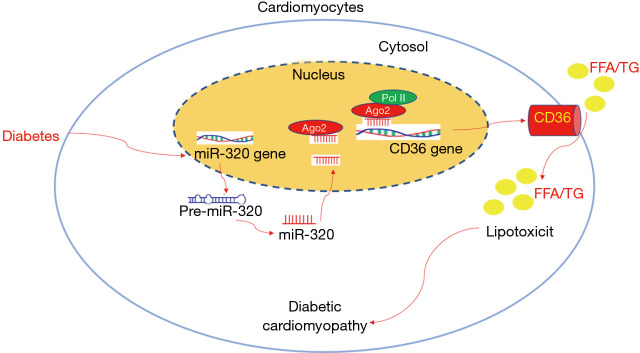
Cardiovascular complications are the leading causes of diabetes-related morbidity and mortality. The high incidence and poor prognosis of heart failure in diabetic patients have been associated, in part, to the presence of an underlying cardiomyopathy characterized by cardiac hypertrophy, cardiomyocytes apoptosis, and fibrosis. It has been unclear about the mechanism that connects diabetes mellitus to the development of cardiovascular dysfunction. Micro(mi)RNAs represent a class of small, 18- to 28-nucleotide-long, non-coding RNA molecules. MiRNAs typically suppress gene expression at the post-transcriptional levels by binding directly to the 3'-UTR of the target mRNAs in the cytoplasm. Interestingly, recent studies suggest that miRNAs may also regulate gene expression in a positive manner. Our recent studies have shown that subcellular miRNAs, such as cytosol-, mitochondria- and nucleus-localized miRNAs, were dramatically dysregulated in diabetic cardiomyopathy. Specifically, cytoplasm localized miRNAs regulate genes expression in a post-transcriptional manner. Nuclear localized miRNAs regulate gene transcription or chromosomal reconstruction through the non-canonical mechanism. Mitochondrial miRNAs stimulate, rather than repress, the translation of specific mitochondrial genome-encoded transcripts. By reviewing these latest discovered functions of subcellular miRNAs in diabetic animal models, we identified new mechanistic insights for diabetic cardiomyopathy. Understanding the nature of subcellular miRNAs will provide new therapeutic targets against diabetes-associated cardiac complications in the near future.
心血管并发症是糖尿病相关发病和死亡的主要原因。糖尿病患者心力衰竭的高发病率和不良预后,部分与潜在的心肌病有关,其特征为心脏肥大、心肌细胞凋亡和纤维化。糖尿病与心血管功能障碍发展之间的联系机制尚不清楚。微小(mi)RNA是一类长度为18至28个核苷酸的小型非编码RNA分子。miRNA通常通过在细胞质中直接结合靶mRNA的3'-UTR,在转录后水平抑制基因表达。有趣的是,最近的研究表明,miRNA也可能以积极的方式调节基因表达。我们最近的研究表明,亚细胞miRNA,如定位于细胞质、线粒体和细胞核的miRNA,在糖尿病心肌病中显著失调。具体而言,定位于细胞质的miRNA以转录后方式调节基因表达。定位于细胞核的miRNA通过非经典机制调节基因转录或染色体重建。线粒体miRNA刺激而非抑制特定线粒体基因组编码转录本的翻译。通过回顾在糖尿病动物模型中这些最新发现的亚细胞miRNA的功能,我们确定了糖尿病心肌病的新机制见解。了解亚细胞miRNA的本质将在不久的将来为对抗糖尿病相关心脏并发症提供新的治疗靶点。