Institute of Social Medicine, Occupational Health and Public Health, Medical Faculty, University of Leipzig, Leipzig, Germany.
Global Brain Health Institute, Trinity College Dublin, Dublin, Ireland.
JMIR Mhealth Uhealth. 2021 Jan 13;9(1):e24807. doi: 10.2196/24807.
Syrian refugees residing in Germany often develop posttraumatic stress as a result of the Syrian civil war, their escape, and postmigration stressors. At the same time, there is a lack of adequate treatment options. The smartphone-based app Sanadak was developed to provide cognitive behavioral therapy-based self-help in the Arabic language for Syrian refugees with posttraumatic stress.
The aim of this study was to evaluate the effectiveness and cost-effectiveness of the app.
In a randomized controlled trial, eligible individuals were randomly allocated to the intervention group (IG; app use) or control group (CG; psychoeducational reading material). Data were collected during structured face-to-face interviews at 3 assessments (preintervention/baseline, postintervention/after 4 weeks, follow-up/after 4 months). Using adjusted mixed-effects linear regression models, changes in posttraumatic stress and secondary outcomes were investigated as intention-to-treat (ITT) and per-protocol (PP) analysis. Cost-effectiveness was evaluated based on adjusted mean total costs, quality-adjusted life years (QALYs), and cost-effectiveness acceptability curves using the net benefit approach.
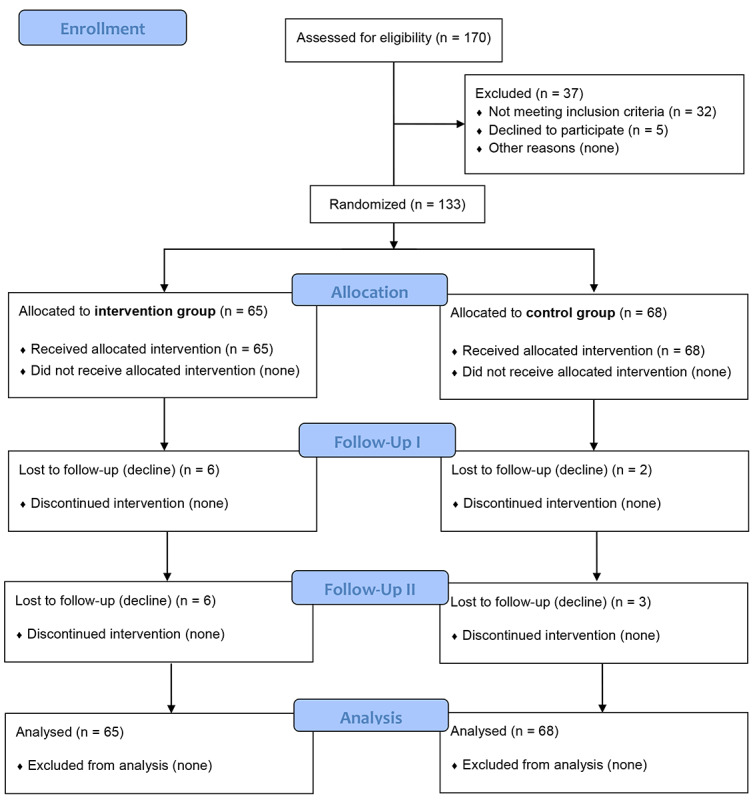
Of 170 screened individuals (aged 18 to 65 years), 133 were eligible and randomized to the IG (n=65) and CG (n=68). Although there was a pre-post reduction in posttraumatic stress, ITT showed no significant differences between the IG and CG after 4 weeks (Posttraumatic Diagnostic Scale for DSM-5, Diff -0.90, 95% CI -0.24 to 0.47; P=.52) and after 4 months (Diff -0.39, 95% CI -3.24 to 2.46; P=.79). The same was true for PP. Regarding secondary outcomes, ITT indicated a treatment effect for self-stigma: after 4 weeks (Self-Stigma of Mental Illness Scale/SSMIS-stereotype agreement: d=0.86, 95% CI 0.46 to 1.25; stereotype application: d=0.60, 95% CI 0.22 to 0.99) and after 4 months (d=0.52, 95% CI 0.12 to 0.92; d=0.50, 95% CI 0.10 to 0.90), the IG showed significantly lower values in self-stigma than the CG. ITT showed no significant group differences in total costs and QALYs. The probability of cost-effectiveness was 81% for a willingness-to-pay of €0 per additional QALY but decreased with increasing willingness-to-pay.
Sanadak was not more effective in reducing mild to moderate posttraumatic stress in Syrian refugees than the control condition nor was it likely to be cost-effective. Therefore, Sanadak is not suitable as a standalone treatment. However, as the app usability was very good, no harms detected, and stigma significantly reduced, Sanadak has potential as a bridging aid within a stepped and collaborative care approach.
German Clinical Trials Register DRKS00013782; https://www.drks.de/drks_web/navigate.do?navigationId=trial.HTML&TRIAL_ID=DRKS00013782.
INTERNATIONAL REGISTERED REPORT IDENTIFIER (IRRID): RR2-10.1186/s12888-019-2110-y.
居住在德国的叙利亚难民由于叙利亚内战、逃亡和后移民压力经常患有创伤后应激。同时,缺乏足够的治疗选择。基于智能手机的应用程序 Sanadak 是为了为患有创伤后应激的叙利亚难民提供基于认知行为疗法的阿拉伯语自助服务而开发的。
本研究旨在评估该应用程序的有效性和成本效益。
在一项随机对照试验中,符合条件的个体被随机分配到干预组(IG;应用程序使用)或对照组(CG;心理教育阅读材料)。在 3 次评估(干预前/基线、干预后/4 周后、随访/4 个月后)期间通过结构化面对面访谈收集数据。使用调整后的混合效应线性回归模型,根据意向治疗(ITT)和方案(PP)分析,调查创伤后应激和次要结果的变化。根据调整后的平均总费用、质量调整生命年(QALY)和净收益方法的成本效益接受曲线,评估成本效益。
在 170 名筛查个体(年龄 18 至 65 岁)中,有 133 名符合条件并随机分配到 IG(n=65)和 CG(n=68)。尽管创伤后应激有预后降低,但 ITT 在 4 周后(DSM-5 创伤后诊断量表,差异-0.90,95%置信区间-0.24 至 0.47;P=.52)和 4 个月后(差异-0.39,95%置信区间-3.24 至 2.46;P=.79)IG 和 CG 之间没有显著差异。PP 也是如此。关于次要结果,IT 表明自我污名化有治疗效果:4 周后(精神疾病自我污名量表/SSMIS 刻板印象认同:d=0.86,95%置信区间 0.46 至 1.25;刻板印象应用:d=0.60,95%置信区间 0.22 至 0.99)和 4 个月后(d=0.52,95%置信区间 0.12 至 0.92;d=0.50,95%置信区间 0.10 至 0.90)IG 自我污名化的得分明显低于 CG。IT 显示总费用和 QALY 两组之间没有显著差异。对于每增加一个 QALY 愿意支付 0 欧元的意愿支付,成本效益的概率为 81%,但随着意愿支付的增加而降低。
Sanadak 在减轻叙利亚难民轻度至中度创伤后应激方面并不比对照组更有效,也不太可能具有成本效益。因此,Sanadak 不适合作为独立的治疗方法。然而,由于应用程序的可用性非常好,没有发现任何危害,并且耻辱感明显减轻,因此 Sanadak 在分阶段和协作护理方法中作为桥梁辅助手段具有潜力。
德国临床试验注册处 DRKS00013782;https://www.drks.de/drks_web/navigate.do?navigationId=trial.HTML&TRIAL_ID=DRKS00013782.
国际注册报告标识符(IRRID):RR2-10.1186/s12888-019-2110-y.