Swim Across America and Ludwig Collaborative Laboratory, Immunology Program, Parker Institute for Cancer Immunotherapy at Memorial Sloan Kettering Cancer Center, New York, NY 10065, USA.
Swim Across America and Ludwig Collaborative Laboratory, Immunology Program, Parker Institute for Cancer Immunotherapy at Memorial Sloan Kettering Cancer Center, New York, NY 10065, USA; Department of Surgery, Memorial Sloan Kettering Cancer Center, New York, NY 10065, USA.
Cell Rep. 2021 Jan 12;34(2):108620. doi: 10.1016/j.celrep.2020.108620.
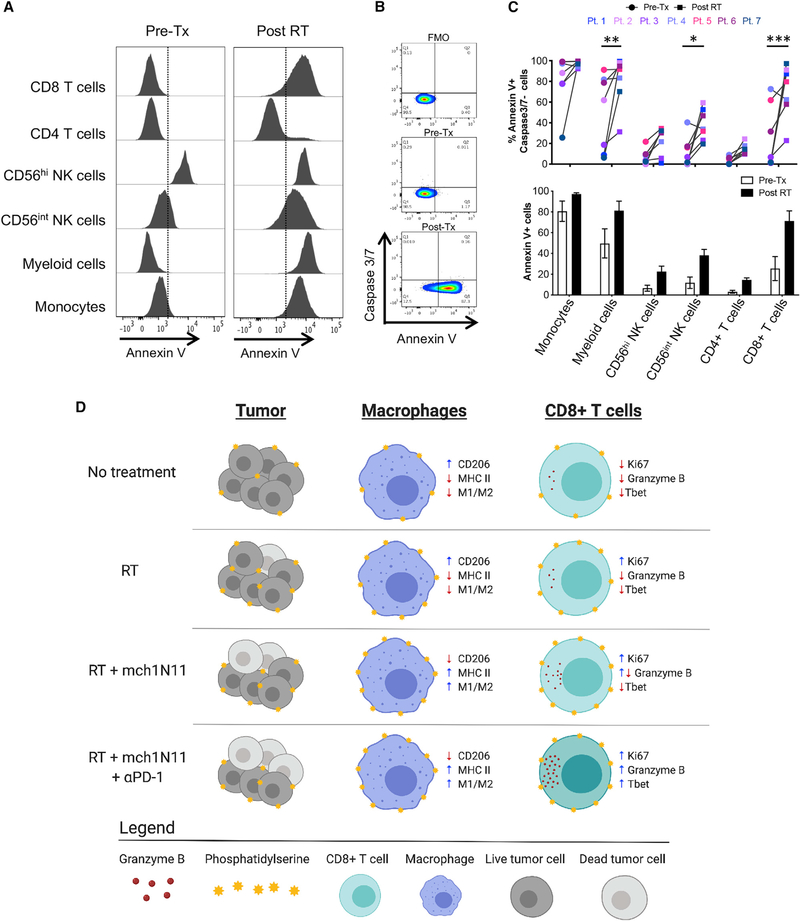
Phosphatidylserine (PS) is exposed on the surface of apoptotic cells and is known to promote immunosuppressive signals in the tumor microenvironment (TME). Antibodies that block PS interaction with its receptors have been shown to repolarize the TME into a proinflammatory state. Radiation therapy (RT) is an effective focal treatment of isolated solid tumors but is less effective at controlling metastatic cancers. We found that tumor-directed RT caused an increase in expression of PS on the surface of viable immune infiltrates in mouse B16 melanoma. We hypothesize that PS expression on immune cells may provide negative feedback to immune cells in the TME. Treatment with an antibody that targets PS (mch1N11) enhanced the anti-tumor efficacy of tumor-directed RT and improved overall survival. This combination led to an increase in proinflammatory tumor-associated macrophages. The addition of anti-PD-1 to RT and mch1N11 led to even greater anti-tumor efficacy and overall survival. We found increased PS expression on several immune subsets in the blood of patients with metastatic melanoma after receiving tumor-directed RT. These findings highlight the potential of combining PS targeting with RT and PD-1 pathway blockade to improve outcomes in patients with advanced-stage cancers.
磷脂酰丝氨酸(PS)暴露在凋亡细胞的表面,已知可在肿瘤微环境(TME)中促进免疫抑制信号。已证明阻断 PS 与其受体相互作用的抗体可将 TME 重新极化到促炎状态。放射治疗(RT)是孤立性实体瘤的有效局部治疗方法,但在控制转移性癌症方面效果较差。我们发现,针对肿瘤的 RT 导致存活的免疫浸润物表面 PS 表达增加在小鼠 B16 黑色素瘤中。我们假设免疫细胞上的 PS 表达可能为 TME 中的免疫细胞提供负反馈。用靶向 PS 的抗体(mch1N11)治疗可增强针对肿瘤的 RT 的抗肿瘤功效并改善总生存期。这种组合导致促炎肿瘤相关巨噬细胞增加。将抗 PD-1 添加到 RT 和 mch1N11 中可提高抗肿瘤功效和总生存期。我们发现接受肿瘤定向 RT 后转移性黑色素瘤患者血液中的几种免疫亚群 PS 表达增加。这些发现强调了将 PS 靶向与 RT 和 PD-1 途径阻断相结合以改善晚期癌症患者预后的潜力。