• 文献检索
  • 文档翻译
  • 深度研究
  • 学术资讯
  • Suppr Zotero 插件Zotero 插件
  • 邀请有礼
  • 套餐&价格
  • 历史记录
应用&插件
Suppr Zotero 插件Zotero 插件浏览器插件Mac 客户端Windows 客户端微信小程序
定价
高级版会员购买积分包购买API积分包
服务
文献检索文档翻译深度研究API 文档MCP 服务
关于我们
关于 Suppr公司介绍联系我们用户协议隐私条款
关注我们

Suppr 超能文献

核心技术专利:CN118964589B侵权必究
粤ICP备2023148730 号-1Suppr @ 2026

文献检索

告别复杂PubMed语法,用中文像聊天一样搜索,搜遍4000万医学文献。AI智能推荐,让科研检索更轻松。

立即免费搜索

文件翻译

保留排版,准确专业,支持PDF/Word/PPT等文件格式,支持 12+语言互译。

免费翻译文档

深度研究

AI帮你快速写综述,25分钟生成高质量综述,智能提取关键信息,辅助科研写作。

立即免费体验

体外受精合并中重度卵巢过度刺激综合征患者与匹配的体外受精对照组相比,血栓形成、妊娠期糖尿病和新生儿 NICU 入院的风险增加,但孕龄略短:一项回顾性中国队列研究。

Patients with IVF complicated by moderate-to-critical OHSS experience increased thrombosis, GDM and neonatal NICU admission but slightly shorter gestation compared with matched IVF counterparts: A retrospective Chinese cohort study.

机构信息

Center for Reproductive Medicine, Henan Key Laboratory of Reproduction and Genetics, The First Affiliated Hospital of Zhengzhou University, Jianshe Dong Road, Henan, 450052, Zhengzhou, People's Republic of China.

Center for Reproductive Medicine, Affiliated Shenzhen Maternity and Child Healthcare Hospital, Southern Medical University, Fuqiang Road, Guangdong, 518000, Shenzhen, People's Republic of China.

出版信息

Reprod Biol Endocrinol. 2021 Jan 13;19(1):8. doi: 10.1186/s12958-020-00678-w.

DOI:10.1186/s12958-020-00678-w
PMID:33441149
原文链接:https://pmc.ncbi.nlm.nih.gov/articles/PMC7805069/
Abstract

BACKGROUND

Ovarian hyperstimulation syndrome (OHSS) is a common disease during controlled ovarian hyperstimulation treatment. However, the obstetric and neonatal outcomes of this group of patients are unknown. The aim of this study was to explore the effects of late moderate-to-critical OHSS on obstetric and neonatal outcomes.

METHODS

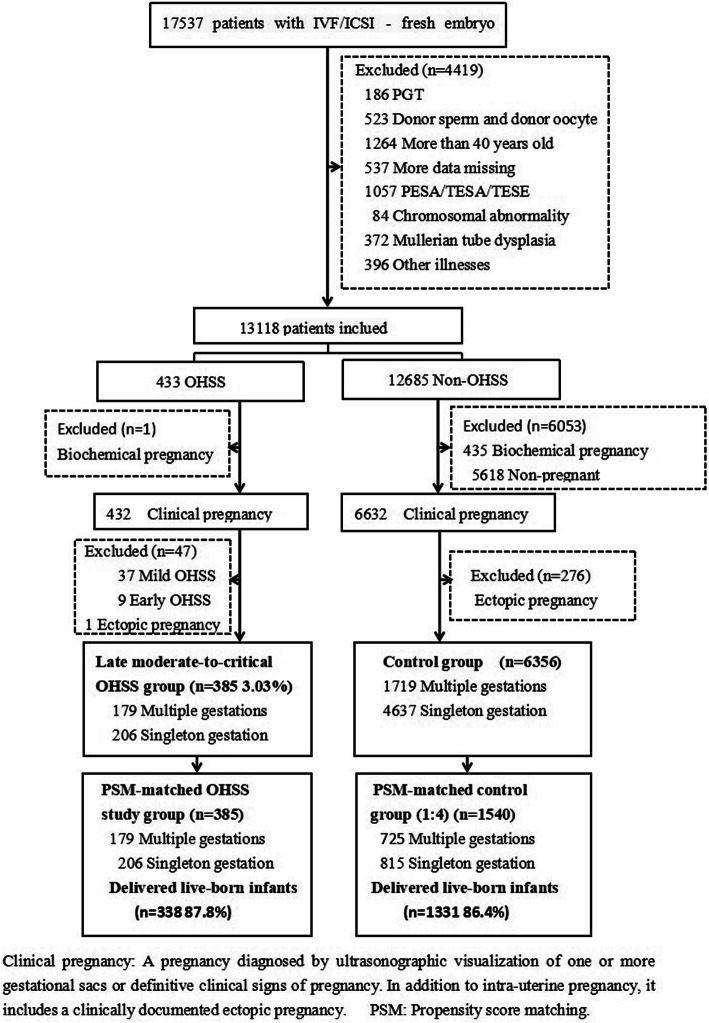
This prospective observational study included 17,537 patients who underwent IVF/ICSI-fresh embryo transfer (ET) between June 2012 and July 2016 and met the inclusion criteria, including 7,064 eligible patients diagnosed with clinical pregnancy. Ultimately, 6,356 patients were allocated to the control group, and 385 patients who were hospitalized and treated at the center for late moderate-to-critical OHSS were allocated to the OHSS group. Then, propensity score matching analysis was performed, matching nine maternal baseline covariates and the number of multiple gestations; 385 patients with late moderate-to-critical OHSS were compared with a matched control group of 1,540 patients. The primary outcomes were the live birth rate, preterm delivery rate, miscarriage rate, gestational age at birth (weeks), obstetric complications and neonatal complications.

RESULTS

The duration of gestation in the matched control group was significantly higher than that in the OHSS group. The live birth delivery rate did not significantly differ between the OHSS and matched control groups. The incidence rates of the obstetric complications venous thrombosis (VT) and gestational diabetes mellitus (GDM), neonatal complications and the number of neonates admitted to the NICU were significantly higher in the OHSS group than in the matched control group.

CONCLUSIONS

Pregnant women undergoing IVF with fresh ET whose course is complicated by late moderate-to-critical OHSS appear to experience shortened gestation and increased obstetrical and neonatal complications compared with matched controls whose course is not complicated by OHSS. However, the live birth rate, average neonatal weight, and incidence rates of premature delivery, miscarriage, early abortion, hypertensive disorder of pregnancy (HDP), placenta previa (PP), intrahepatic cholestasis of pregnancy (ICP), and low neonatal birth weight (LBW) did not differ significantly between the two groups.

摘要

背景

卵巢过度刺激综合征(OHSS)是控制性卵巢过度刺激治疗期间的一种常见疾病。然而,这组患者的产科和新生儿结局尚不清楚。本研究旨在探讨晚期中重度 OHSS 对产科和新生儿结局的影响。

方法

本前瞻性观察研究纳入了 2012 年 6 月至 2016 年 7 月期间接受 IVF/ICSI-新鲜胚胎移植(ET)的 17537 名患者,并符合纳入标准,包括 7064 名符合临床妊娠诊断的患者。最终,6356 名患者被分配到对照组,385 名因晚期中重度 OHSS 住院并在中心接受治疗的患者被分配到 OHSS 组。然后,进行倾向评分匹配分析,匹配 9 个母体基线协变量和多胎妊娠数量;将 385 例晚期中重度 OHSS 患者与 1540 例匹配对照组进行比较。主要结局为活产率、早产率、流产率、出生时孕周(周)、产科并发症和新生儿并发症。

结果

匹配对照组的妊娠持续时间明显长于 OHSS 组。OHSS 组和匹配对照组的活产分娩率无显著差异。OHSS 组静脉血栓形成(VT)和妊娠期糖尿病(GDM)、新生儿并发症和入住新生儿重症监护病房(NICU)的新生儿数量的产科并发症发生率明显高于匹配对照组。

结论

与未发生 OHSS 的匹配对照组相比,接受新鲜 ET 的 IVF 妊娠患者在病程中发生晚期中重度 OHSS 似乎会导致妊娠时间缩短,并增加产科和新生儿并发症。然而,两组间的活产率、平均新生儿体重以及早产、流产、早期流产、妊娠高血压疾病(HDP)、前置胎盘(PP)、妊娠肝内胆汁淤积症(ICP)和低出生体重儿(LBW)的发生率均无显著差异。
https://cdn.ncbi.nlm.nih.gov/pmc/blobs/04b1/7805069/0e7d427544a1/12958_2020_678_Fig1_HTML.jpg

相似文献

1
Patients with IVF complicated by moderate-to-critical OHSS experience increased thrombosis, GDM and neonatal NICU admission but slightly shorter gestation compared with matched IVF counterparts: A retrospective Chinese cohort study.体外受精合并中重度卵巢过度刺激综合征患者与匹配的体外受精对照组相比,血栓形成、妊娠期糖尿病和新生儿 NICU 入院的风险增加,但孕龄略短:一项回顾性中国队列研究。
Reprod Biol Endocrinol. 2021 Jan 13;19(1):8. doi: 10.1186/s12958-020-00678-w.
2
Pregnancy outcomes in patients with late-onset severe OHSS following different methods of ascetic fluid drainage and a comparison with non-OHSS IVF patients.不同腹水引流方法对晚发型重度卵巢过度刺激综合征患者妊娠结局的影响,并与非 OHSS IVF 患者进行比较。
Arch Gynecol Obstet. 2022 Jun;305(6):1587-1594. doi: 10.1007/s00404-021-06326-x. Epub 2022 Jan 21.
3
Obstetric outcomes following ovarian hyperstimulation syndrome in IVF - a comparison with uncomplicated fresh and frozen transfer cycles.体外受精中卵巢过度刺激综合征后的产科结局——与单纯新鲜和冷冻移植周期的比较。
BMC Pregnancy Childbirth. 2022 Jul 18;22(1):573. doi: 10.1186/s12884-022-04903-9.
4
Perinatal outcomes of singleton live births after late moderate-to-severe ovarian hyperstimulation syndrome: A propensity score-matched study.中重度卵巢过度刺激综合征后单胎活产的围产结局:一项倾向评分匹配研究。
Front Endocrinol (Lausanne). 2022 Dec 1;13:1063066. doi: 10.3389/fendo.2022.1063066. eCollection 2022.
5
The association between the number of oocytes retrieved for IVF, perinatal outcome and obstetric complications.取卵数与 IVF 围产结局及产科并发症的关系。
Hum Reprod. 2018 Oct 1;33(10):1939-1947. doi: 10.1093/humrep/dey266.
6
The Association between Ovarian Hyperstimulation Syndrome and Pregnancy Complications following Fertility Treatments.卵巢过度刺激综合征与生育治疗后的妊娠并发症之间的关联。
Am J Perinatol. 2023 Jul;40(10):1088-1095. doi: 10.1055/s-0041-1732458. Epub 2021 Jul 29.
7
Severe ovarian hyperstimulation syndrome modifies early maternal serum beta-human chorionic gonadotropin kinetics, but obstetrical and neonatal outcomes are not impacted.重度卵巢过度刺激综合征会改变孕早期母体血清β-人绒毛膜促性腺激素的动力学,但产科和新生儿结局不受影响。
Fertil Steril. 2017 Oct;108(4):650-658.e2. doi: 10.1016/j.fertnstert.2017.07.1160. Epub 2017 Sep 11.
8
Risk of severe ovarian hyperstimulation syndrome in GnRH antagonist versus GnRH agonist protocol: RCT including 1050 first IVF/ICSI cycles.促性腺激素释放激素(GnRH)拮抗剂方案与GnRH激动剂方案中严重卵巢过度刺激综合征的风险:一项纳入1050个首次体外受精/卵胞浆内单精子注射周期的随机对照试验
Hum Reprod. 2016 Jun;31(6):1253-64. doi: 10.1093/humrep/dew051. Epub 2016 Apr 8.
9
[Perinatal outcome among women undergoing in vitro fertilization procedures complicated by ovarian hyperstimulation syndrome].[接受体外受精程序并并发卵巢过度刺激综合征的女性的围产期结局]
Ginekol Pol. 2012 Feb;83(2):104-10.
10
Pregnancy Outcomes of In Vitro Fertilization with or without Ovarian Hyperstimulation Syndrome: A Retrospective Cohort Study in Chinese Patients.有或无卵巢过度刺激综合征的体外受精妊娠结局:一项针对中国患者的回顾性队列研究
Chin Med J (Engl). 2015 Dec 5;128(23):3167-72. doi: 10.4103/0366-6999.170280.

引用本文的文献

1
Curcumin alleviates ovarian hyperstimulation syndrome in the rat model via inhibiting the nuclear factor kappa B/hypoxia-inducible factor-1α signaling pathway.姜黄素通过抑制核因子κB/缺氧诱导因子-1α信号通路减轻大鼠模型中的卵巢过度刺激综合征。
Histochem Cell Biol. 2025 Jul 12;163(1):75. doi: 10.1007/s00418-025-02403-3.
2
Association between ovarian hyperstimulation syndrome and adverse obstetric and neonatal outcomes in Korea: a nationwide health insurance database study.韩国卵巢过度刺激综合征与不良产科及新生儿结局的关联:一项全国性健康保险数据库研究
J Assist Reprod Genet. 2025 Jun 17. doi: 10.1007/s10815-025-03542-1.
3

本文引用的文献

1
Association Between Alendronate Use and Hip Fracture Risk in Older Patients Using Oral Prednisolone.使用口服泼尼松龙的老年患者中阿仑膦酸盐的使用与髋部骨折风险之间的关联
JAMA. 2017 Jul 11;318(2):146-155. doi: 10.1001/jama.2017.8040.
2
Chlorhexidine-Alcohol Compared With Povidone-Iodine for Preoperative Topical Antisepsis for Abdominal Hysterectomy.氯己定-酒精与聚维酮碘用于腹部子宫切除术术前局部消毒的比较
Obstet Gynecol. 2017 Aug;130(2):319-327. doi: 10.1097/AOG.0000000000002130.
3
Prevention and treatment of moderate and severe ovarian hyperstimulation syndrome: a guideline.
Global and regional incidence of intrahepatic cholestasis of pregnancy: a systematic review and meta-analysis.
妊娠期肝内胆汁淤积症的全球及区域发病率:一项系统评价与荟萃分析
BMC Med. 2025 Feb 28;23(1):129. doi: 10.1186/s12916-025-03935-0.
4
Severe Early-Onset Intrahepatic Cholestasis of Pregnancy Following Ovarian Hyperstimulation Syndrome with Pulmonary Presentation after In Vitro Fertilization: Case Report and Systematic Review of Case Reports.体外受精后卵巢过度刺激综合征伴肺部表现的严重早发型妊娠肝内胆汁淤积症:病例报告及病例报告系统评价
Life (Basel). 2024 Jan 16;14(1):129. doi: 10.3390/life14010129.
5
Clinical Features of Severe Ovarian Hyperstimulation Syndrome with Hydrothorax.重度卵巢过度刺激综合征合并胸腔积液的临床特征
J Clin Med. 2023 Sep 26;12(19):6210. doi: 10.3390/jcm12196210.
6
Elevated estradiol levels on hCG trigger day adversely effects on the clinical pregnancy rates of blastocyst embryo transfer but not cleavage-stage embryo transfer in fresh cycles: a retrospective cohort study.促黄体生成素日血清雌二醇水平升高对新鲜周期囊胚移植而非卵裂期胚胎移植的临床妊娠率有不良影响:一项回顾性队列研究。
PeerJ. 2023 Jul 18;11:e15709. doi: 10.7717/peerj.15709. eCollection 2023.
7
Perinatal outcomes of singleton live births after late moderate-to-severe ovarian hyperstimulation syndrome: A propensity score-matched study.中重度卵巢过度刺激综合征后单胎活产的围产结局:一项倾向评分匹配研究。
Front Endocrinol (Lausanne). 2022 Dec 1;13:1063066. doi: 10.3389/fendo.2022.1063066. eCollection 2022.
8
E2 level > 2950 pg/ml on hCG trigger day is an independent predictor for birthweight loss of full-term singletons born after fresh embryo transfers in non-PCOS patients.人绒毛膜促性腺激素(hCG)扳机日 E2 水平>2950 皮克/毫升是预测非多囊卵巢综合征(PCOS)患者新鲜胚胎移植后足月单胎出生体重减轻的独立因素。
Reprod Biol Endocrinol. 2022 Nov 21;20(1):162. doi: 10.1186/s12958-022-01027-9.
9
Obstetric outcomes following ovarian hyperstimulation syndrome in IVF - a comparison with uncomplicated fresh and frozen transfer cycles.体外受精中卵巢过度刺激综合征后的产科结局——与单纯新鲜和冷冻移植周期的比较。
BMC Pregnancy Childbirth. 2022 Jul 18;22(1):573. doi: 10.1186/s12884-022-04903-9.
10
Additional Adverse Perinatal Outcomes With No Effect on Neonatal Mortality and Birth Defects in Pregnancies Conceived by Assisted Reproductive Technology.辅助生殖技术受孕的妊娠中出现的其他不良围产期结局,对新生儿死亡率和出生缺陷无影响。
Front Pediatr. 2022 Mar 24;10:809259. doi: 10.3389/fped.2022.809259. eCollection 2022.
中重度卵巢过度刺激综合征的预防和治疗:指南。
Fertil Steril. 2016 Dec;106(7):1634-1647. doi: 10.1016/j.fertnstert.2016.08.048. Epub 2016 Sep 24.
4
Fresh versus Frozen Embryos for Infertility in the Polycystic Ovary Syndrome.新鲜胚胎与冷冻胚胎在多囊卵巢综合征不孕中的应用。
N Engl J Med. 2016 Aug 11;375(6):523-33. doi: 10.1056/NEJMoa1513873.
5
Risk of severe ovarian hyperstimulation syndrome in GnRH antagonist versus GnRH agonist protocol: RCT including 1050 first IVF/ICSI cycles.促性腺激素释放激素(GnRH)拮抗剂方案与GnRH激动剂方案中严重卵巢过度刺激综合征的风险:一项纳入1050个首次体外受精/卵胞浆内单精子注射周期的随机对照试验
Hum Reprod. 2016 Jun;31(6):1253-64. doi: 10.1093/humrep/dew051. Epub 2016 Apr 8.
6
Trends in Severe Maternal Morbidity After Assisted Reproductive Technology in the United States, 2008-2012.2008 - 2012年美国辅助生殖技术后严重孕产妇发病率的趋势
Obstet Gynecol. 2016 Jan;127(1):59-66. doi: 10.1097/AOG.0000000000001197.
7
Pregnancy Outcomes of In Vitro Fertilization with or without Ovarian Hyperstimulation Syndrome: A Retrospective Cohort Study in Chinese Patients.有或无卵巢过度刺激综合征的体外受精妊娠结局:一项针对中国患者的回顾性队列研究
Chin Med J (Engl). 2015 Dec 5;128(23):3167-72. doi: 10.4103/0366-6999.170280.
8
Maternal and Neonatal Morbidity After Attempted Operative Vaginal Delivery According to Fetal Head Station.根据胎儿头部位置进行阴道助产术后的孕产妇和新生儿发病率
Obstet Gynecol. 2015 Sep;126(3):521-529. doi: 10.1097/AOG.0000000000001000.
9
Risk of poor neonatal outcome at term after medically assisted reproduction: a propensity score-matched study.医学辅助生殖后足月新生儿不良结局的风险:一项倾向评分匹配研究。
Fertil Steril. 2015 Aug;104(2):384-90.e1. doi: 10.1016/j.fertnstert.2015.04.035. Epub 2015 May 28.
10
Can you ever collect too many oocytes?卵母细胞收集得会过多吗?
Hum Reprod. 2015 Jan;30(1):81-7. doi: 10.1093/humrep/deu272. Epub 2014 Oct 31.