Reproductive Medicine Center, the Third Affiliated Hospital of Sun Yat-Sen University, Guangzhou, Guangdong province, China.
Reproductive Medicine Center, the First People's Hospital of Kashi Prefecture, Affiliated Kashi Hospital of Sun Yat-Sen University, Kashi, China.
PeerJ. 2023 Jul 18;11:e15709. doi: 10.7717/peerj.15709. eCollection 2023.
Elevated estradiol (E) levels are an inevitable outcome of the controlled ovulation hyperstimulation. However, the effect of this change on pregnancy is still uncertain. Our study aimed to analyze the impact of increased serum E at the day of human chorionic gonadotropin (hCG) administration on the clinical outcomes of women with fresh embryo transfer (ET) cycles.
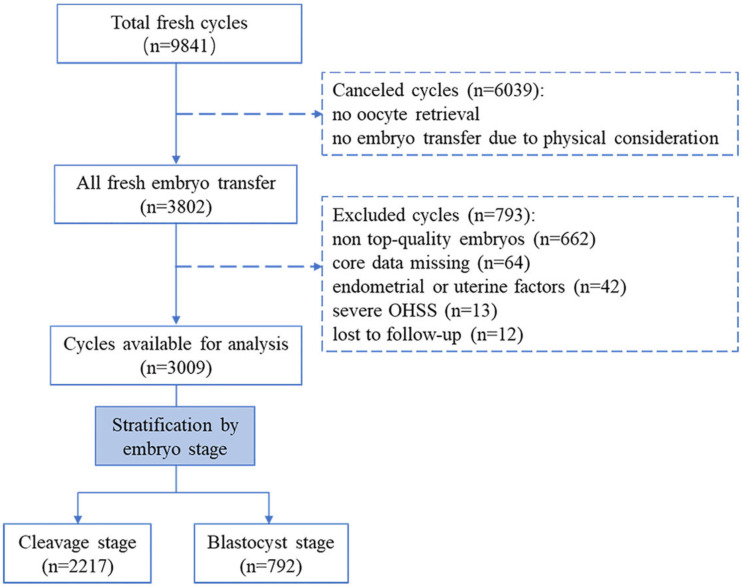
This study included 3,009 fresh ET cycles from October 2015 to September 2021. Based on the stage of embryos transferred, these cycles were categorized into the cleavage group and blastocyst group. Both groups were then divided into four sets according to E levels when hCG was administered: set 1 (E ≤ 2,000 pg/ml), set 2 (E = 2,001-3,000 pg/ml), set 3 (E = 3,001-4,000 pg/ml), and set 4 (E > 4,000 pg/ml). The primary outcome was the clinical pregnancy rate (CPR). Binary logistics regression analysis was established to explore the association between CPR and E2 levels. Specifically, the threshold effect of serum E2 on CPR was revealed using the two-piecewise linear regression analyses.
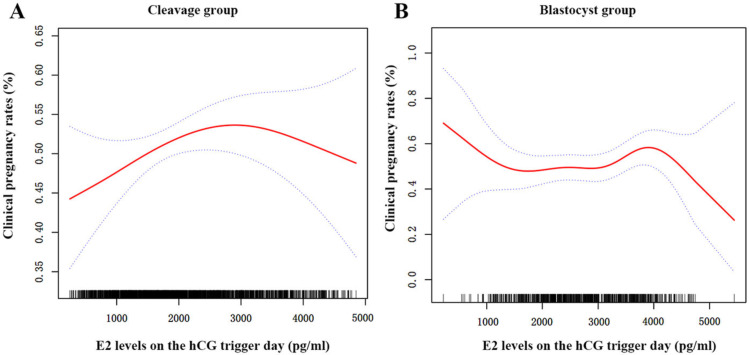
The multivariate regression model in the cleavage group showed that patients' CPR in set 4 was 1.59 times higher than those in reference set 1, but the statistical difference was insignificant ( = 0.294). As for the blastocyst group, patients in set 4 had a lower CPR with adjusted ORs of 0.43 ( = 0.039) compared to patients in set 1. The inflection point for the blastocyst group was 39.7 pg/dl according to the results of the two-piecewise linear regression model. When E levels were over the point, the CPR decreased by 17% with every 1 pg/dl increases in serum E (adjusted OR = 0.83, 95% CI [0.72-0.96], = 0.012).
Elevated E levels (>39.7 pg/dl) on hCG trigger day were associated with decreased CPR in patients with fresh blastocyst ET. However, it had no similar effect on the CPR of patients with fresh cleavage-stage ET.
在控制性排卵超刺激下,雌二醇(E)水平升高是不可避免的结果。然而,这种变化对妊娠的影响尚不确定。我们的研究旨在分析人绒毛膜促性腺激素(hCG)给药日血清 E 升高对新鲜胚胎移植(ET)周期妇女临床结局的影响。
本研究纳入了 2015 年 10 月至 2021 年 9 月的 3009 个新鲜 ET 周期。根据胚胎移植阶段,这些周期分为卵裂期组和囊胚期组。两组均根据 hCG 给药时的 E 水平分为四组:第 1 组(E≤2000pg/ml)、第 2 组(E=2001-3000pg/ml)、第 3 组(E=3001-4000pg/ml)和第 4 组(E>4000pg/ml)。主要结局是临床妊娠率(CPR)。建立二元逻辑回归分析探讨 CPR 与 E2 水平之间的关系。具体来说,使用两段线性回归分析揭示了血清 E2 对 CPR 的阈值效应。
卵裂期组的多变量回归模型显示,第 4 组患者的 CPR 是参考组 1 的 1.59 倍,但统计学差异不显著(=0.294)。对于囊胚期组,第 4 组患者的 CPR 较低,调整后的 OR 为 0.43(=0.039),与第 1 组患者相比。两段线性回归模型的结果显示,囊胚期组的拐点为 39.7pg/dl。当 E 水平超过该点时,血清 E 每增加 1pg/dl,CPR 下降 17%(调整后的 OR=0.83,95%CI[0.72-0.96],=0.012)。
新鲜囊胚 ET 患者 hCG 触发日 E 水平升高(>39.7pg/dl)与 CPR 降低相关。然而,它对新鲜卵裂期 ET 患者的 CPR 没有类似的影响。