Department of Respiratory Medicine, Comprehensive Cancer Center, International Medical Center, Saitama Medical University, Saitama University Hospital, 1397-1 Yamane, Hidaka-City, Saitama, 350-1298, Japan.
Department of Nuclear Medicine, International Medical Center, Saitama Medical University, Saitama, Japan.
Cancer Imaging. 2021 Jan 13;21(1):11. doi: 10.1186/s40644-021-00381-y.
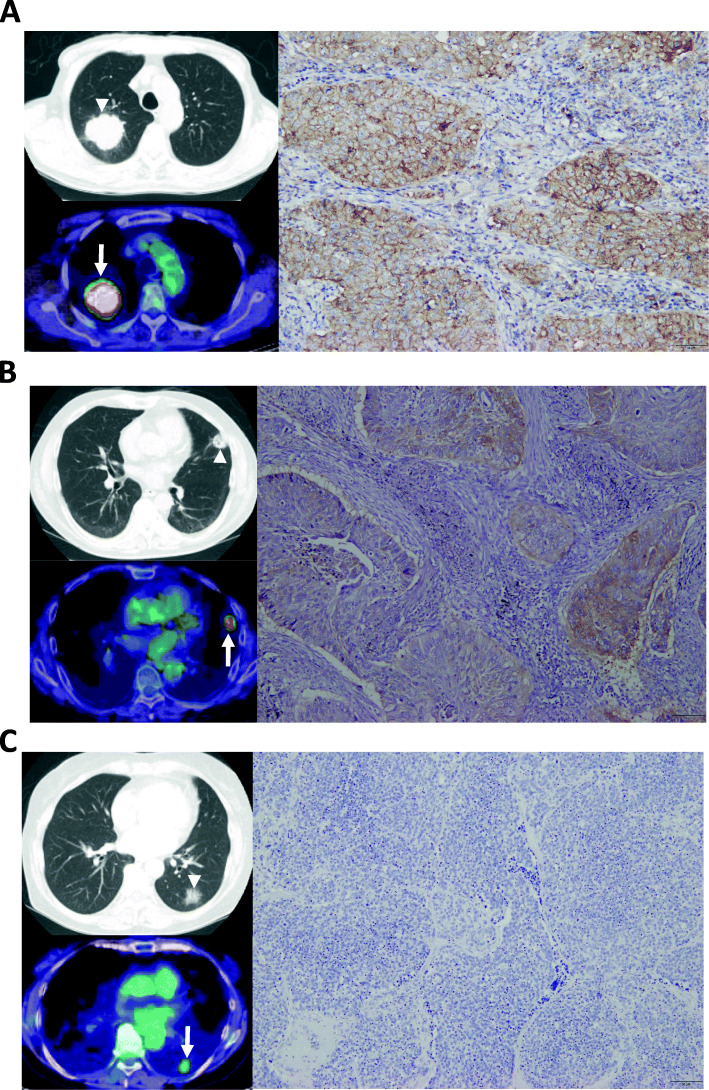
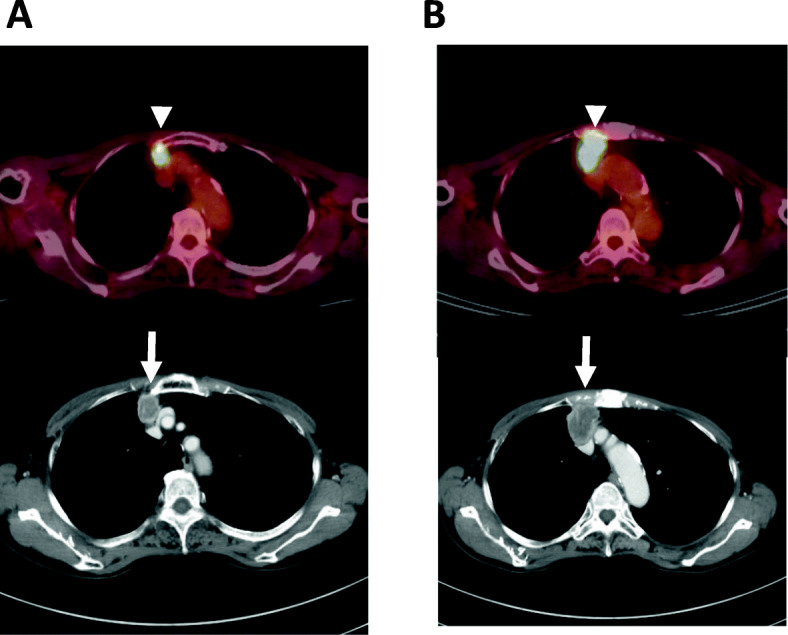
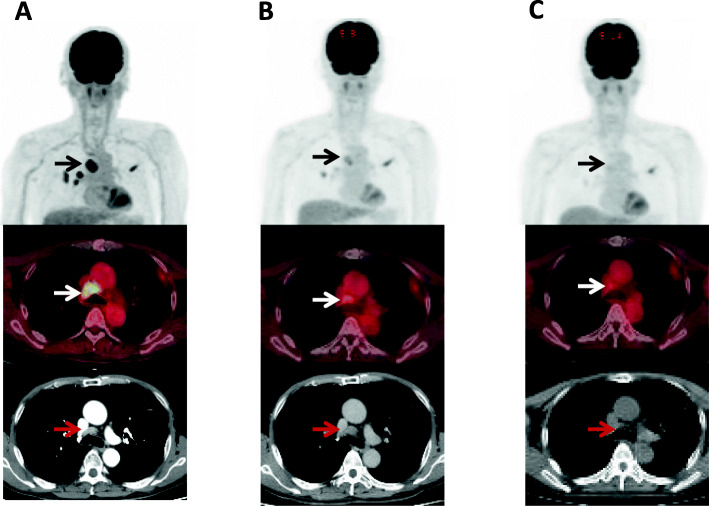
Anti-programmed cell death-1 (PD-1)/programmed death ligand-1 (PD-L1) antibodies are administered in varied human cancer types. The expression of PD-L1 within tumor cells has been identified as a predictive marker, although assessing its expression has benefitted only patients with non-small cell lung cancer (NSCLC) or head and neck cancer. Whereas, more than 75% of the patients with NSCLC showing partial response to PD-1 blockade therapy experienced long-term survival for more than 5-years Thus, identifying the responders to PD-1 blockade at early phase after its initiation is of clinical importance. The 2-deoxy-2-[fluorine-18] fluoro-D-glucose (F-FDG) on positron emission tomography (PET) can evaluate any tumor shrinkage by assessing the metabolic tumor volume at an earlier phase than conventional modalities such as computed tomography (CT). While several reports describe the correlation of PD-L1 expression with F-FDG uptake rate in the tumor cells, it remains to be delineated whether this rate determined by the glucose metabolism and hypoxia is associated with the status of immune microenvironment, including the expression of PD-L1. Moreover, details of the relationship between expression of PD-L1 and F-FDG uptake is still unclear. Therefore, we reviewed the clinical significance of F-FDG uptake on PET as a predictor of the efficacy of PD-1 blockade therapy, by correlating with the expression of PD-L1, in patients with several neoplasms.
抗程序性细胞死亡蛋白-1(PD-1)/程序性死亡配体-1(PD-L1)抗体在多种人类癌症类型中得到应用。肿瘤细胞内 PD-L1 的表达已被确定为一种预测标志物,尽管评估其表达仅有益于非小细胞肺癌(NSCLC)或头颈部癌症患者。然而,超过 75%的 NSCLC 患者对 PD-1 阻断治疗有部分反应,其长期生存时间超过 5 年。因此,在 PD-1 阻断治疗开始后的早期阶段识别出应答者具有重要的临床意义。正电子发射断层扫描(PET)上的 2-脱氧-2-[氟-18]氟-D-葡萄糖(F-FDG)可以通过在比计算机断层扫描(CT)等常规方式更早的阶段评估代谢肿瘤体积来评估任何肿瘤缩小。虽然有几项报告描述了 PD-L1 表达与肿瘤细胞中 F-FDG 摄取率之间的相关性,但仍需要确定该速率是由葡萄糖代谢和缺氧决定的,与包括 PD-L1 表达在内的免疫微环境状态相关。此外,PD-L1 表达与 F-FDG 摄取之间的关系的细节仍不清楚。因此,我们通过与 PD-L1 表达相关,回顾了 PET 上 F-FDG 摄取作为 PD-1 阻断治疗疗效预测指标的临床意义,在几种肿瘤患者中进行了评估。