Department of Biostatistics, School of Public Health, Cheeloo College of Medicine, Shandong University.
Institute for Medical Dataology, Shandong University.
J Epidemiol. 2022 May 5;32(5):205-214. doi: 10.2188/jea.JE20200305. Epub 2021 Jul 10.
Causal evidence of circulating lipids especially the remnant cholesterol with cardiovascular and cerebrovascular disease (CVD) is lacking. This research aimed to explore the causal roles of extensive lipid traits especially the remnant lipids in CVD.
Two-sample Mendelian randomization (TSMR) analysis was performed based on large-scale meta-analysis datasets in European ancestry. The causal effect of 15 circulating lipid profiles including 6 conventional lipids and 9 remnant lipids on coronary heart disease (CHD) and ischemic stroke (IS), as well as the subtypes, was assessed.
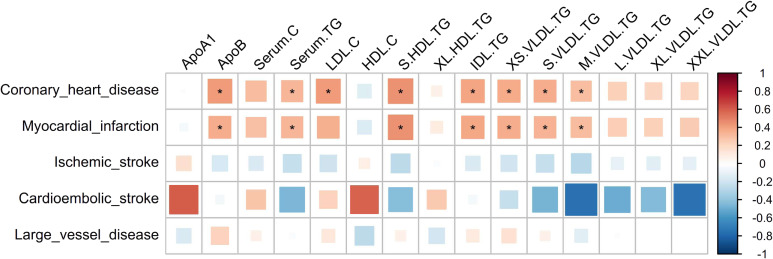
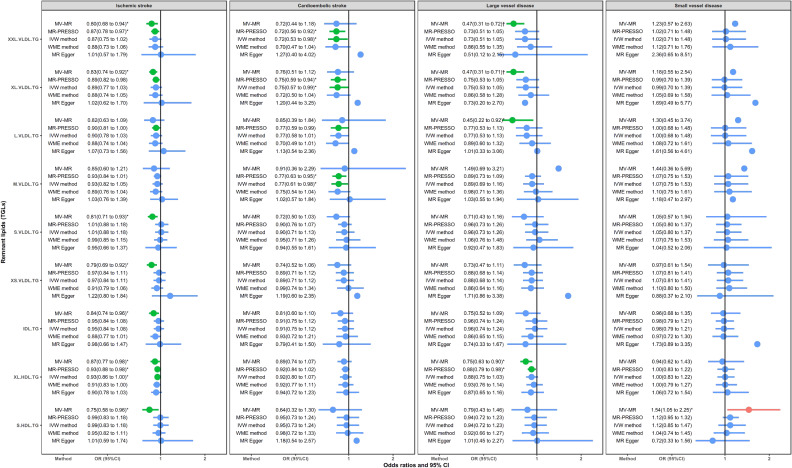
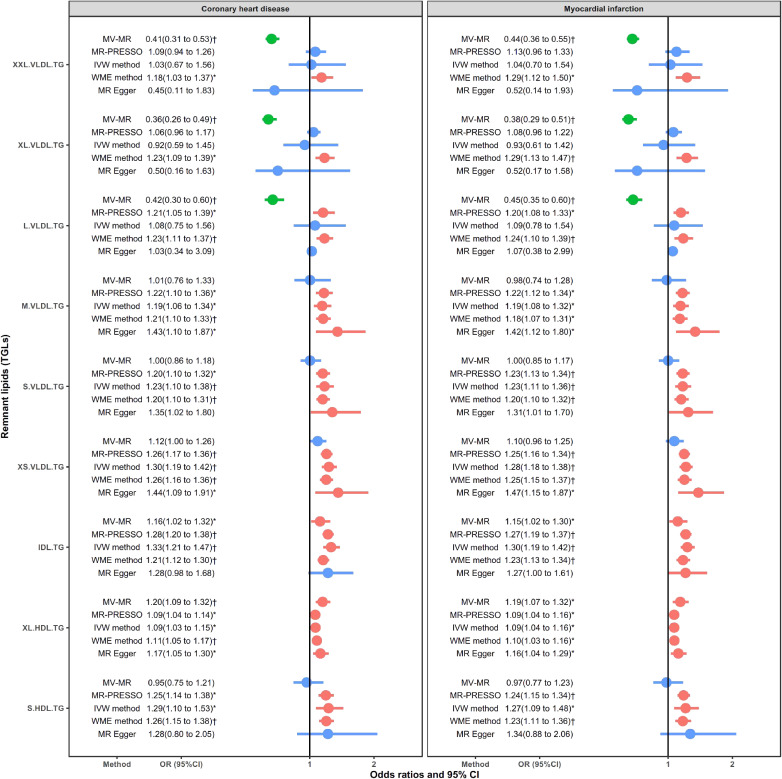
Apolipoprotein B (Apo B), total cholesterol (TC), low-density lipoprotein cholesterol (LDL-C), and triglyceride (TG) were still important risk factors for CHD and myocardial infarction (MI) but not for IS. Apo B is the strongest which increased the CHD and MI risk by 44% and 41%, respectively. The odds ratios (ORs) of total TG on CHD and MI were 1.25 (95% confidence interval [CI], 1.13-1.38) and 1.24 (95% CI, 1.11-1.38), respectively. A one standard deviation difference increased TG in medium very-low-density lipoproteins (M.VLDL.TG), TG in small VLDL (S.VLDL.TG), TG in very small VLDL (XS.VLDL.TG), TG in intermediate-density lipoproteins (IDL.TG), TG in very large HDL (XL.HDL.TG), and TG in small HDL (S.HDL.TG) particles also robustly increased the risk of CHD and MI by 9-28% and 9-27%, respectively. TG in very/extremely large VLDL (XXL.VLDL.TG and XL.VLDL.TG) were insignificant or even negatively associated with CHD (in multivariable TSMR), and negatively associated with IS as well.
The remnant lipids presented heterogeneity and two-sided effects for the risk of CHD and IS that may partially rely on the particle size. The findings suggested that the remnant lipids were required to be intervened according to specific components. This research confirms the importance of remnant lipids and provides causal evidence for potential targets for intervention.
循环脂质,特别是富含胆固醇的残余物与心血管和脑血管疾病(CVD)之间的因果关系证据尚不足。本研究旨在探讨广泛的脂质特征,尤其是残余脂质在 CVD 中的因果作用。
基于欧洲血统的大型荟萃分析数据集进行两样本 Mendelian 随机化(TSMR)分析。评估了 15 种循环脂质谱(包括 6 种常规脂质和 9 种残余脂质)对冠心病(CHD)和缺血性中风(IS)以及亚型的因果作用。
载脂蛋白 B(Apo B)、总胆固醇(TC)、低密度脂蛋白胆固醇(LDL-C)和甘油三酯(TG)仍然是 CHD 和心肌梗死(MI)的重要危险因素,但不是 IS 的危险因素。Apo B 是最强的危险因素,分别使 CHD 和 MI 的风险增加 44%和 41%。总 TG 对 CHD 和 MI 的比值比(OR)分别为 1.25(95%置信区间 [CI],1.13-1.38)和 1.24(95% CI,1.11-1.38)。标准偏差差异增加中等极低密度脂蛋白(M.VLDL.TG)中的 TG、小 VLDL(S.VLDL.TG)中的 TG、非常小 VLDL(XS.VLDL.TG)中的 TG、中间密度脂蛋白(IDL.TG)中的 TG、非常大的高密度脂蛋白(XL.HDL.TG)中的 TG 和小高密度脂蛋白(S.HDL.TG)中的 TG 也分别使 CHD 和 MI 的风险增加 9%-28%和 9%-27%。非常/特大 VLDL(XXL.VLDL.TG 和 XL.VLDL.TG)中的 TG 对 CHD 无显著性或甚至呈负相关(多变量 TSMR),与 IS 也呈负相关。
残余脂质对 CHD 和 IS 的风险表现出异质性和双向作用,这可能部分取决于颗粒大小。研究结果表明,需要根据特定成分对残余脂质进行干预。本研究证实了残余脂质的重要性,并为潜在的干预靶点提供了因果关系证据。