Centre for Brain Research, SID Complex, Indian Institute of Science, Bangalore, 560 012, India.
Sci Rep. 2021 Jan 13;11(1):870. doi: 10.1038/s41598-020-79487-5.
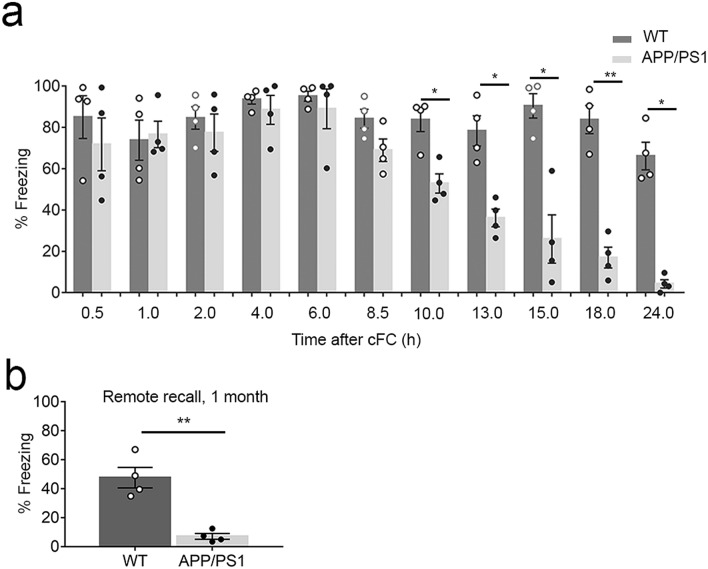
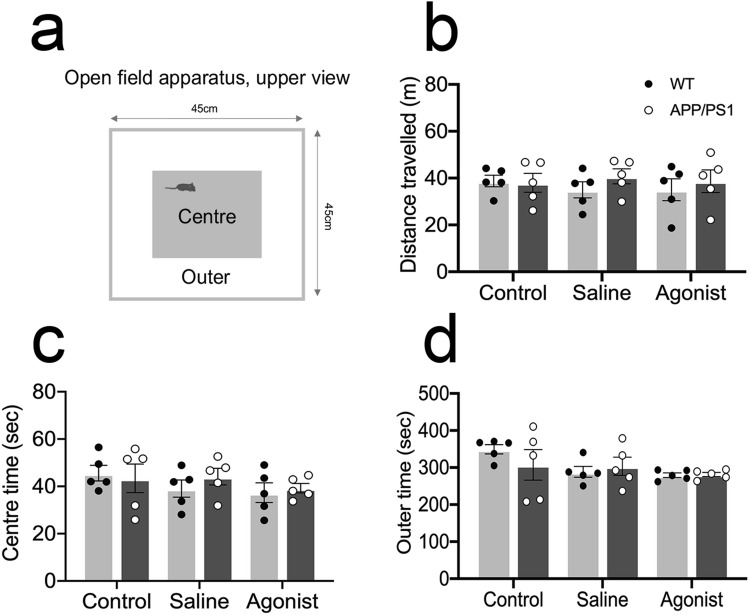
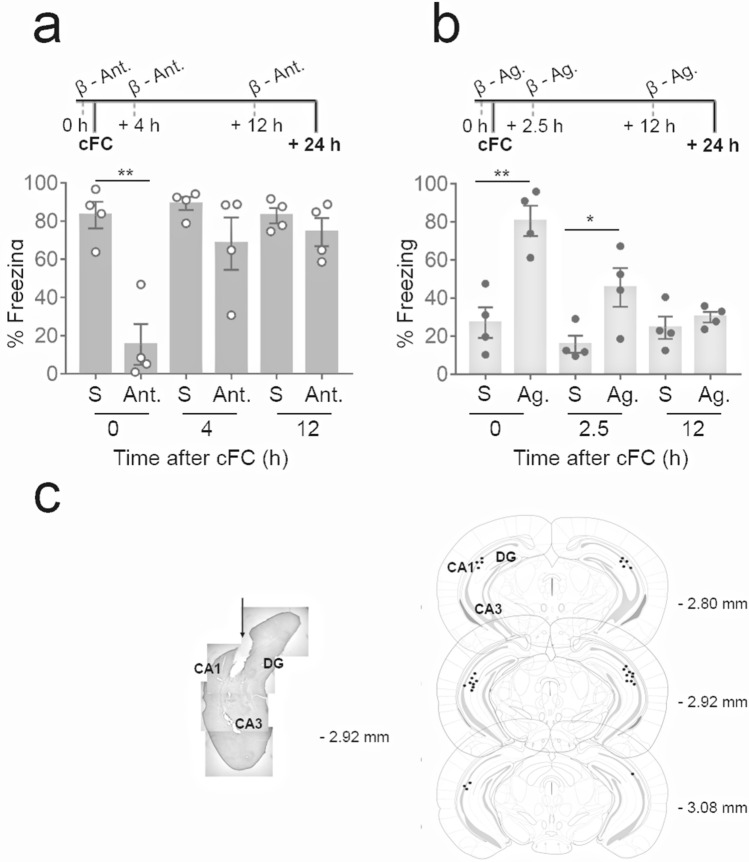
In this study we demonstrate that 2 month old APPswe/PS1dE9 mice, a transgenic model of Alzheimer's disease, exhibited intact short-term memory in Pavlovian hippocampal-dependent contextual fear learning task. However, their long-term memory was impaired. Intra-CA1 infusion of isoproterenol hydrochloride, the β-adrenoceptor agonist, to the ventral hippocampus of APPswe/PS1dE9 mice immediately before fear conditioning restored long-term contextual fear memory. Infusion of the β-adrenoceptor agonist + 2.5 h after fear conditioning only partially rescued the fear memory, whereas infusion at + 12 h post conditioning did not interfere with long-term memory persistence in this mouse model. Furthermore, Intra-CA1 infusion of propranolol, the β-adrenoceptor antagonist, administered immediately before conditioning to their wildtype counterpart impaired long-term fear memory, while it was ineffective when administered + 4 h and + 12 h post conditioning. Our results indicate that, long-term fear memory persistence is determined by a unique β-adrenoceptor sensitive time window between 0 and + 2.5 h upon learning acquisition, in the ventral hippocampal CA1 of APPswe/PS1dE9 mice. On the contrary, β-adrenoceptor agonist delivery to ventral hippocampal CA1 per se did not enhance innate anxiety behaviour in open field test. Thus we conclude that, activation of learning dependent early β-adrenoceptor modulation underlies and is necessary to promote long-term fear memory persistence in APPswe/PS1dE9.
在这项研究中,我们证明了 2 个月大的 APPswe/PS1dE9 小鼠(阿尔茨海默病的转基因模型)在 Pavlovian 海马依赖性情景恐惧学习任务中表现出完整的短期记忆,但长期记忆受损。在恐惧条件化之前,立即向 APPswe/PS1dE9 小鼠的海马 CA1 内输注盐酸异丙肾上腺素(β-肾上腺素受体激动剂),可恢复其长期情景恐惧记忆。在恐惧条件化后 2.5 小时输注β-肾上腺素受体激动剂仅部分挽救了恐惧记忆,而在条件化后 12 小时输注则不能干扰该小鼠模型中的长期记忆持久性。此外,在条件化之前,向其野生型对照动物的海马 CA1 内输注普萘洛尔(β-肾上腺素受体拮抗剂)会损害长期恐惧记忆,而在条件化后 4 小时和 12 小时输注时则无效。我们的结果表明,在 APPswe/PS1dE9 小鼠的海马 CA1 内,学习获得期间 0 到+2.5 小时之间存在一个独特的β-肾上腺素受体敏感时间窗口,决定了长期恐惧记忆的持久性。相反,β-肾上腺素受体激动剂向海马 CA1 的输送本身并没有增加在开阔场测试中的先天焦虑行为。因此,我们得出结论,学习依赖性早期β-肾上腺素受体调节的激活是促进 APPswe/PS1dE9 中长时恐惧记忆持久的基础和必要条件。