Molecular Carcinogenesis Program (PCM), Research Coordination (CPQ), Brazilian National Cancer Institute (INCA), Rua André Cavalcanti, 37-Centro, 6º andar, Rio de Janeiro, RJ, CEP 20231-050, Brazil.
Laboratory of Immunopharmacology, Oswaldo Cruz Institute-FIOCRUZ, Av. Brasil 4365, Manguinhos, Rio de Janeiro, RJ, CEP 21040-360, Brazil.
Sci Rep. 2021 Jan 13;11(1):981. doi: 10.1038/s41598-020-80035-4.
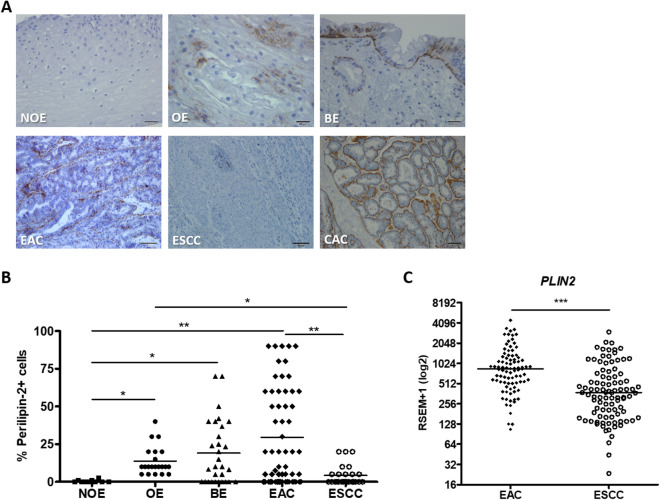
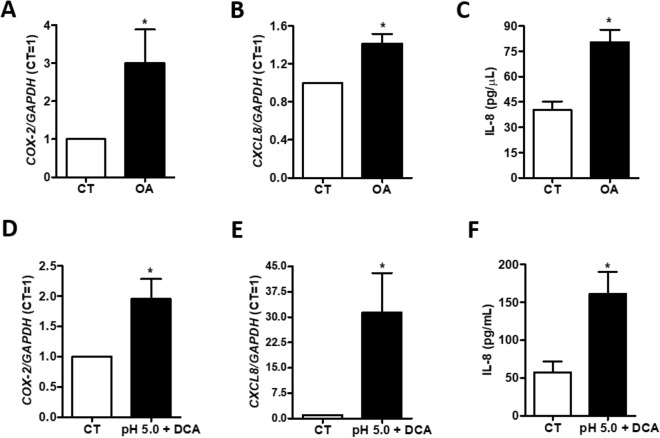
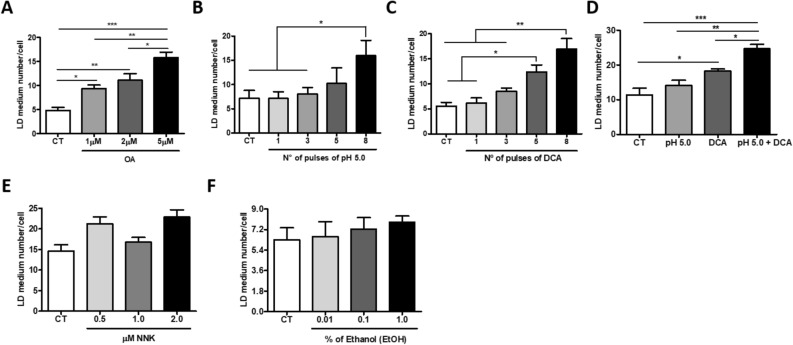
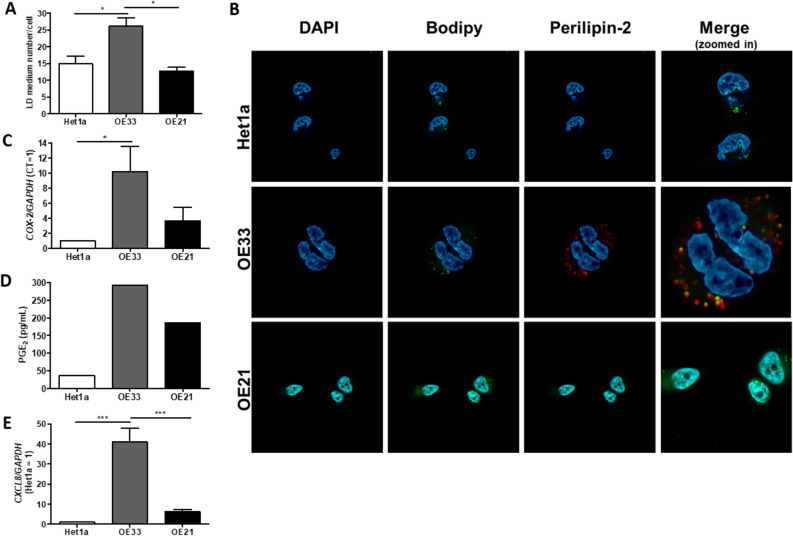
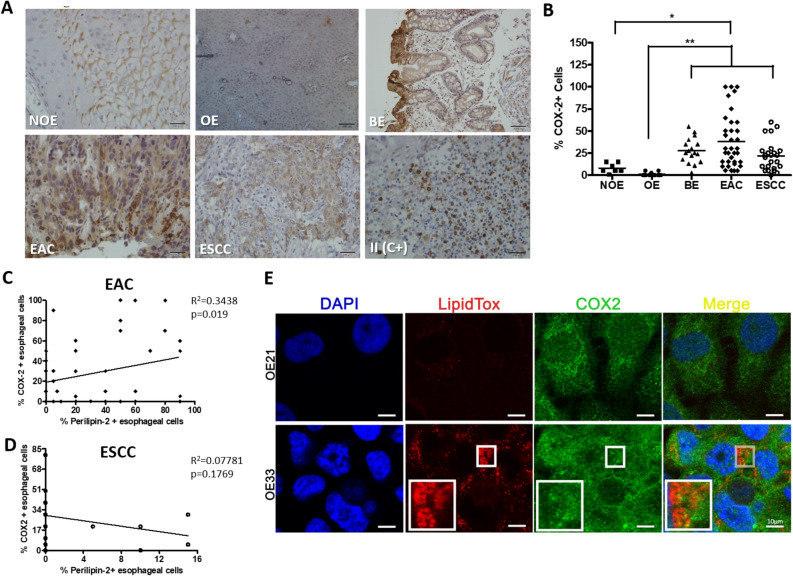
Esophageal cancer (EC) is an aggressive disease, presenting two main histological subtypes: adenocarcinoma (EAC) and squamous cell carcinoma (ESCC). The two EC subtypes widely differ concerning virtually all factors. ESCC development is mainly associated with tobacco and alcohol abuse, whereas obesity and chronic gastroesophageal reflux disease (GERD) are important risk factors not only for EAC, but also for for Barrett's esophagus (BE), an intestinal metaplasia that precedes EAC. Obesity triggers ectopic lipid droplets (LD) accumulation in non-adipose tissues. LD are organelles involved in cell metabolism, signaling, proliferation and production of inflammatory mediators. Therefore, the aim of this work was to investigate LD occurrence and role in EC. This study shows progressive LD levels increase along EAC development, in esophageal samples from non-obese through obese individuals, as well as BE, and EAC patients, whereas no significant changes were observed in ESCC samples, when compared to non-tumor samples. Additionally, in order to mimic BE and EAC risk factors exposure, a non-tumor esophageal cell line was incubated with oleic acid (OA) and acidified medium and/or deoxycholic acid (DCA), revealing a significant increment in LD amount as well as in COX-2 and CXCL-8 expression, and in IL-8 secretion. Further, COX-2 expression and LD amount presented a significant positive correlation and were detected co-localized in EAC, but not in ESCC, suggesting that LD may be the site for eicosanoid production in EAC. In conclusion, this study shows that obesity, and BE- and EAC-associated inflammatory stimuli result in a gradual increase of LD, that may be responsible for orchestrating inflammatory mediators' production and/or action, thus contributing to BE and EAC genesis and progression.
食管癌(EC)是一种侵袭性疾病,表现出两种主要的组织学亚型:腺癌(EAC)和鳞状细胞癌(ESCC)。这两种 EC 亚型在几乎所有因素上都有很大的不同。ESCC 的发展主要与烟草和酗酒有关,而肥胖和慢性胃食管反流病(GERD)不仅是 EAC 的重要危险因素,也是 Barrett 食管(BE)的重要危险因素,BE 是一种先于 EAC 的肠上皮化生。肥胖会引发异位脂质滴(LD)在非脂肪组织中的积累。LD 是参与细胞代谢、信号转导、增殖和炎症介质产生的细胞器。因此,本研究旨在探讨 LD 在 EC 中的发生和作用。本研究表明,随着 EAC 的发展,从非肥胖个体到肥胖个体,以及 BE 和 EAC 患者,非脂肪组织中的 LD 水平逐渐升高,而 ESCC 样本与非肿瘤样本相比,无明显变化。此外,为了模拟 BE 和 EAC 的风险因素暴露,用油酸(OA)和酸化培养基以及/或去氧胆酸(DCA)孵育非肿瘤食管细胞系,结果显示 LD 数量以及 COX-2 和 CXCL-8 的表达和 IL-8 的分泌显著增加。此外,COX-2 表达和 LD 数量呈显著正相关,在 EAC 中检测到两者共定位,但在 ESCC 中未检测到,提示 LD 可能是 EAC 中前列腺素产生的部位。综上所述,本研究表明肥胖和 BE 及 EAC 相关炎症刺激导致 LD 逐渐增加,这可能是协调炎症介质产生和/或作用的原因,从而促进了 BE 和 EAC 的发生和进展。