Totesora Darwin, Ramos-Rivera Marie Isobelle, Villegas-Florencio Mary Queen, Reyes-Sia Pia Natalya
Section of Endocrinology, Diabetes and Metabolism, The Medical City, Pasig City Philippines.
Section of Psychiatry, The Medical City, Pasig City, Philippines.
J ASEAN Fed Endocr Soc. 2019;34(2):189-196. doi: 10.15605/jafes.034.02.10. Epub 2019 Nov 10.
The study aims to determine the association of diabetes-related emotional distress with reported diabetes self-care, and glycemic control of adult Filipinos with type 2 diabetes mellitus at The Medical City using 2 psychometric tests.
This is a cross-sectional study conducted among 94 Filipinos diagnosed with type 2 diabetes mellitus, who answered 2 validated English questionnaires: Problem areas in diabetes (PAID-20) and Diabetes self-management questionnaire (DSMQ) that screen for diabetes-related emotional distress and diabetes reported self-care, respectively. Data were encoded and analyzed using Stata SE v.13.
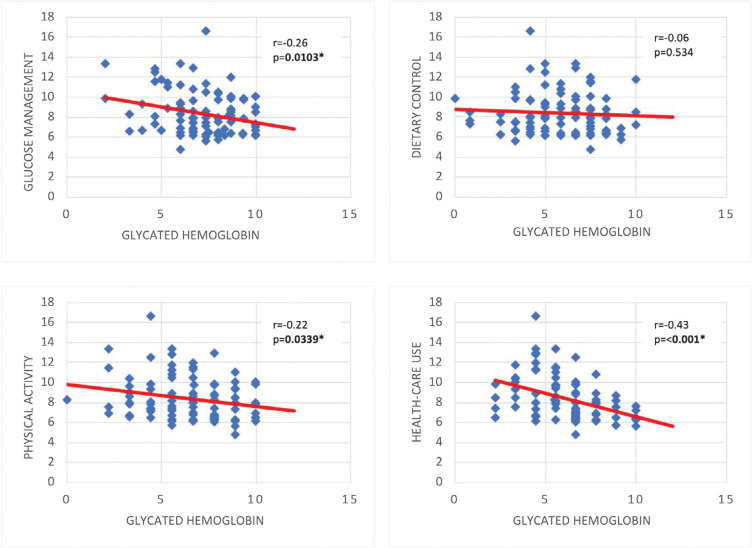
42.6% of Filipinos with type 2 diabetes mellitus had emotional distress showing moderate to severe distress in factor 1 (diabetes-related emotional distress) and factor 3 (food related problems). 51.1% had suboptimal self-care, poorly scoring in areas of health-care use and dietary control. Majority of those who had diabetes-related distress and poor self-care where young, pre-obese and had diabetes duration of ±5 years. There was no significant association between diabetes-related emotional distress with diabetes self-care and emotional distress with glycated hemoglobin, but majority of those who had diabetes distress had higher glycated hemoglobin. There was significant association between diabetes self-care and glycemic outcomes (=0.006) with relative risk of 1.51 (95% CI 1.10-2.07). There was linear inverse weak correlation between all subdomains of DSMQ with glycated hemoglobin except Dietary Control.
Diabetes-related emotional distress and sub-optimal self-care are prevalent among Filipinos with type 2 diabetes mellitus. Those who had poor self-care were 1.5 times more likely to have poor glycemic outcomes.
本研究旨在通过两项心理测量测试,确定菲律宾成年人2型糖尿病患者的糖尿病相关情绪困扰与报告的糖尿病自我护理以及血糖控制之间的关联。
这是一项横断面研究,对94名被诊断为2型糖尿病的菲律宾人进行,他们回答了两份经过验证的英文问卷:糖尿病问题领域(PAID - 20)和糖尿病自我管理问卷(DSMQ),分别用于筛查糖尿病相关情绪困扰和报告的糖尿病自我护理。数据使用Stata SE v.13进行编码和分析。
42.6%的2型糖尿病菲律宾人存在情绪困扰,在因素1(糖尿病相关情绪困扰)和因素3(食物相关问题)中表现为中度至重度困扰。51.1%的人自我护理不佳,在医疗保健使用和饮食控制方面得分较低。大多数有糖尿病相关困扰且自我护理差的人年轻、肥胖前期且糖尿病病程约5年。糖尿病相关情绪困扰与糖尿病自我护理之间以及情绪困扰与糖化血红蛋白之间无显著关联,但大多数有糖尿病困扰的人糖化血红蛋白较高。糖尿病自我护理与血糖结果之间存在显著关联(=0.006),相对风险为1.51(95%可信区间1.10 - 2.07)。除饮食控制外,DSMQ的所有子领域与糖化血红蛋白之间存在线性负弱相关。
糖尿病相关情绪困扰和自我护理不佳在菲律宾2型糖尿病患者中普遍存在。自我护理差的人血糖结果不佳的可能性高1.5倍。