Zhang Lei, Chen Wen-Xu, Li Ling-Li, Cao Yu-Zhu, Geng Ya-Di, Feng Xiao-Jun, Wang Ai-Yun, Chen Zhao-Lin, Lu Yin, Shen Ai-Zong
Department of Pharmacy, the First Affiliated Hospital of USTC, Division of Life Sciences and Medicine, University of Science and Technology of China, Anhui Provincial Hospital, Hefei, China.
Department of Pharmacy, Anhui Provincial Hospital, Anhui Medical University, Hefei, China.
Front Pharmacol. 2020 Nov 12;11:572616. doi: 10.3389/fphar.2020.572616. eCollection 2020.
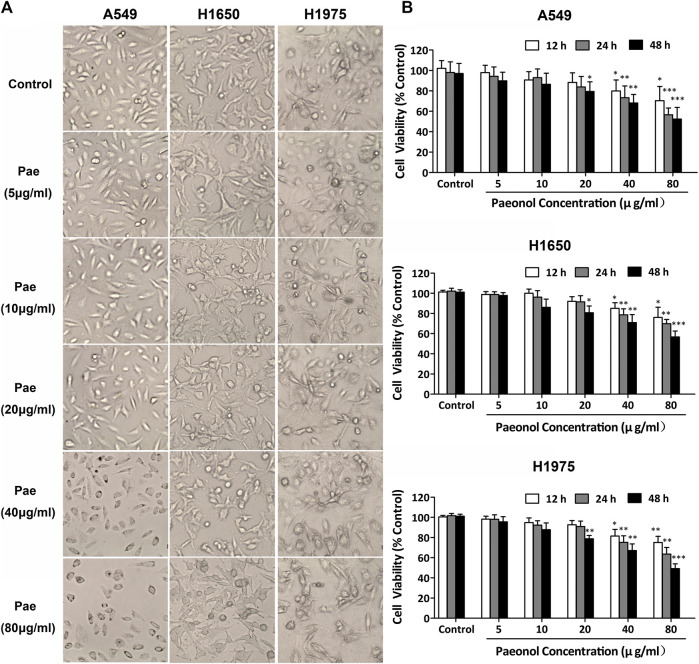
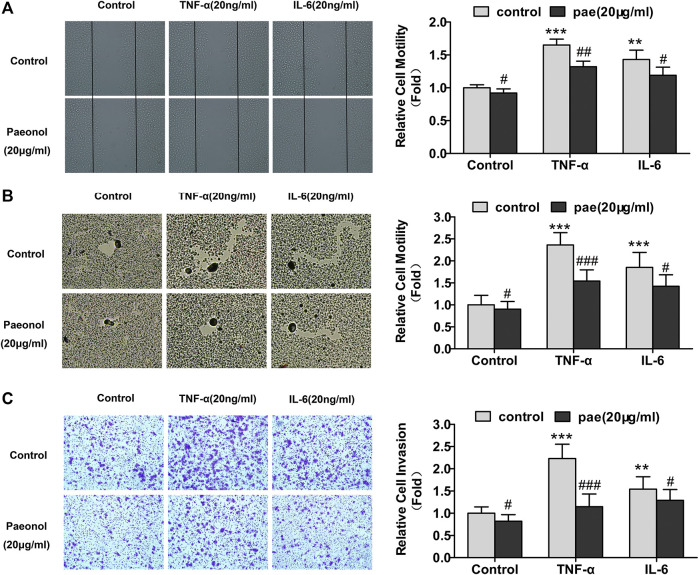
Targeting inflammatory microenvironment is a promising anti-tumor strategy. Paeonol is a phenolic compound with effective anti-inflammatory and anti-tumor properties. However, the effects of paeonol on non-small cell carcinoma (NSCLC) have not been fully investigated. Here, we evaluated the effects of paeonol on proliferation and metastasis of NSCLC and elucidated the underlying mechanisms. The effects of paeonol on inflammatory cytokines were determined by cell proliferation and ELISA assays. Assays of wound healing, single cell migration and perforation invasion were used to evaluate migration and invasion of NSCLC cells. Expression of marker proteins in epithelial-mesenchymal transition (EMT) and matrix metalloproteinase (MMP) family enzymes were detected by Western blot assays. Nude mouse A549 cells transplantation tumor model was used to study the anti-lung cancer effects of paeonol . TUNEL stanining were used to detect the apoptosis of tumor cells in A549 lung cancer mice, and Ki67 analysis was used to detect the proliferation of tumor cells in A549 lung cancer mice. Immunohistochemistry was used to detect the effects of paeonol on signaling molecules in tumor tissues. Paeonol inhibited A549 cancer cell migration and invasion . Paeonol inhibited secreaion of inflammatory cytokines in A549 cells, including tumor necrosis factor (TNF)-α, interleukin (IL)-6, IL-1β, and transforming growth factor (TGF)-β. Paeonol altered the expression of marker proteins involved in EMT and MMP family enzymes. In addition, paeonol inhibited the transcriptional activity of nuclear factor-κB (NF-κB) and phosphorylation of signal transducers and activators of transcription 3 (STAT3). Paeonol inhibited the growth of A549 cells transplanted tumors in nude mice. Paeonol potently inhibited NSCLC cell growth, migration and invasion associated with disruption of STAT3 and NF-κB pathways, suggesting that it could be a promising anti-metastatic candidate for tumor chemotherapy.
靶向炎症微环境是一种很有前景的抗肿瘤策略。丹皮酚是一种具有有效抗炎和抗肿瘤特性的酚类化合物。然而,丹皮酚对非小细胞肺癌(NSCLC)的影响尚未得到充分研究。在此,我们评估了丹皮酚对NSCLC增殖和转移的影响,并阐明了其潜在机制。通过细胞增殖和ELISA测定法确定丹皮酚对炎性细胞因子的影响。采用伤口愈合、单细胞迁移和穿孔侵袭测定法评估NSCLC细胞的迁移和侵袭。通过蛋白质免疫印迹法检测上皮-间质转化(EMT)中的标记蛋白表达和基质金属蛋白酶(MMP)家族酶。利用裸鼠A549细胞移植瘤模型研究丹皮酚的抗肺癌作用。采用TUNEL染色检测A549肺癌小鼠肿瘤细胞的凋亡,采用Ki67分析检测A549肺癌小鼠肿瘤细胞的增殖。免疫组织化学法用于检测丹皮酚对肿瘤组织中信号分子的影响。丹皮酚抑制A549癌细胞的迁移和侵袭。丹皮酚抑制A549细胞中炎性细胞因子的分泌,包括肿瘤坏死因子(TNF)-α、白细胞介素(IL)-6、IL-1β和转化生长因子(TGF)-β。丹皮酚改变了参与EMT的标记蛋白表达和MMP家族酶。此外,丹皮酚抑制核因子-κB(NF-κB)的转录活性和信号转导子及转录激活子3(STAT3)的磷酸化。丹皮酚抑制裸鼠体内A549细胞移植瘤的生长。丹皮酚通过破坏STAT3和NF-κB信号通路有效抑制NSCLC细胞的生长、迁移和侵袭,表明它可能是一种很有前景的肿瘤化疗抗转移候选药物。