Tapper Elliot B, Baki Jad, Nikirk Samantha, Hummel Scott, Asrani Sumeet K, Lok Anna S
Division of Gastroenterology and Hepatology, University of Michigan, Ann Arbor, MI, USA.
Gastroenterology Section, VA Ann Arbor Healthcare System, Ann Arbor, MI, USA.
Gastroenterol Rep (Oxf). 2020 Nov 12;8(6):453-456. doi: 10.1093/gastro/goaa059. eCollection 2020 Dec.
Ascites is a costly, morbid complication of cirrhosis. Although a low-sodium diet is central to the clinical management of ascites, its efficacy is limited by poor adherence. We aimed to determine the feasibility and impact of low-sodium medically tailored meals (MTM) intervention.
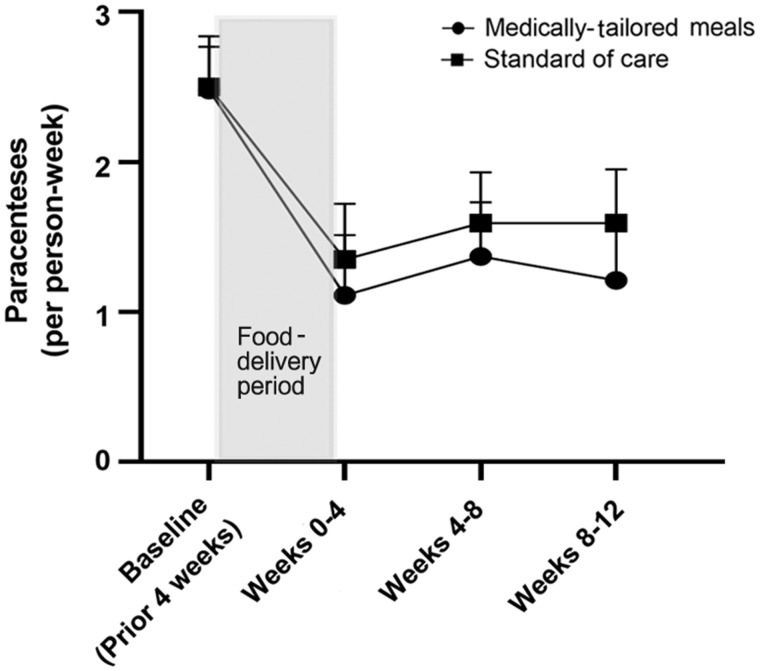
We enrolled 40 persons with cirrhosis and ascites at the time of a paracentesis in a 12-week, 1:1 randomized trial of standard of care (SOC) (low-sodium diet educational handout) or MTM with <2,000 mg of sodium, >2,100 kcal, and >80 g of protein including a nocturnal protein supplement. We determined the proportion of eligible candidates recruited and adherence to MTM. The primary outcome was the number of paracenteses performed during weeks 0-12. We also collected ascites-specific quality-of-life (ASI-7) scores.
The median age of the enrolled subjects was 54 (IQR, 47-63) years, 46% were female, with median MELD-Na 18 (IQR, 11-23) and albumin 2.7 (IQR, 2.5-3.3) g/dL. At baseline, subjects reported a median of two (IQR, 1-3) paracenteses in the prior 4 weeks. Adherence to the meal schedule was excellent save for when hospitalizations occurred. After 12 weeks, patients in the MTM arm required fewer paracenteses per week than those in the SOC group [median (IQR): 0.34 (0.14-0.54) vs 0.45 (0.25-0.64)]. During the trial, four (20%) SOC patients died, whereas two (10%) died and one (5%) was transplanted in the MTM arm. Ascites-specific quality of life improved to a greater degree in the MTM arm compared to the SOC arm, by 25% (IQR, -11% to 61%) vs 13% (IQR, -28% to 54%).
A trial of MTM for persons with ascites is feasible and potentially effective. Both arms experienced benefits, highlighting the role for improved education and closer monitoring in this challenging condition.
腹水是肝硬化代价高昂且引发病变的并发症。尽管低钠饮食是腹水临床管理的核心,但由于依从性差,其疗效有限。我们旨在确定低钠医学定制餐(MTM)干预的可行性和影响。
在一项为期12周的1:1随机试验中,我们纳入了40例在进行腹腔穿刺术时患有肝硬化和腹水的患者,分为标准治疗(SOC)组(低钠饮食教育手册)或MTM组,MTM组的餐食含钠量<2000毫克、热量>2100千卡、蛋白质>80克,包括夜间蛋白质补充剂。我们确定了招募的合格候选人比例以及对MTM的依从性。主要结局是0至12周内进行腹腔穿刺术的次数。我们还收集了腹水特异性生活质量(ASI-7)评分。
入组受试者的中位年龄为54岁(四分位间距,47 - 63岁),46%为女性,中位终末期肝病模型钠评分(MELD-Na)为18(四分位间距,11 - 23),白蛋白为2.7克/分升(四分位间距,2.5 - 3.3)。基线时,受试者报告在过去4周内中位进行了两次(四分位间距,1 - 3次)腹腔穿刺术。除住院期间外,对餐食计划的依从性良好。12周后,MTM组患者每周所需的腹腔穿刺术次数少于SOC组[中位数(四分位间距):0.34(0.14 - 0.54)对0.45(0.25 - 0.64)]。在试验期间,SOC组有4例(20%)患者死亡,而MTM组有2例(10%)死亡,1例(5%)接受了移植。与SOC组相比,MTM组的腹水特异性生活质量改善程度更大,分别为25%(四分位间距,-11%至61%)对13%(四分位间距,-28%至54%)。
对腹水患者进行MTM试验是可行的且可能有效。两组均有获益,凸显了在这种具有挑战性的情况下改善教育和加强监测的作用。