Sautter Jessica M, Henstenburg Jule Anne, Crafford Adrian Glass, Rowe-Nicholls Ian, Diaz Victor S, Bartholomew Kaitlyn Ann, Evans Julia S, Johnson Maria R, Zhou Jeffrey, Ajeya Deeksha
Department of Sociology & Criminal Justice, Saint Joseph's University, 5600 City Ave, Philadelphia, PA, 19131, USA.
Metropolitan Area Neighborhood Nutrition Alliance (MANNA), 420 N 20th St Philadelphia, Philadelphia, PA, 19130, USA.
BMC Nutr. 2024 Nov 4;10(1):147. doi: 10.1186/s40795-024-00955-6.
Medically tailored meal (MTM) programs provide home-delivered meals to people living with serious illness and poor nutritional status. Client outcome studies have found evidence of decreased healthcare utilization and cost savings associated with MTM program participation, and inconclusive evidence of change in health measures. The purpose of this study was to use a novel observational framework to describe the client profile and change in health outcomes using routinely collected health and program data from a community-based MTM program at MANNA (Philadelphia, PA).
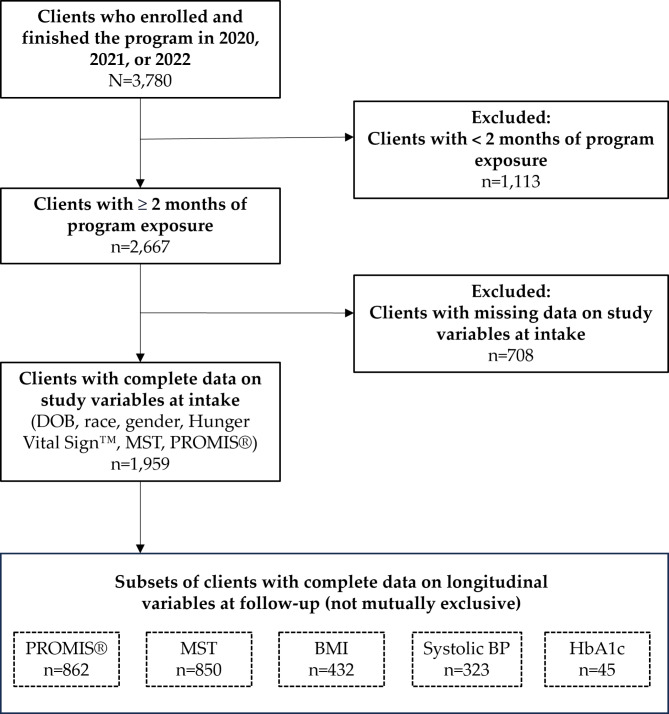
Clients reported their self-rated health and experiences of food insecurity and malnutrition. Healthcare providers reported clients' body mass index, systolic blood pressure, and hemoglobin A1C. These health outcomes, measured at program intake and 3-6 months later, were linked with administrative data for 1,959 clients who completed at least two months of MTM services in 2020, 2021, and 2022.
Clients exhibited substantial heterogeneity in demographics and health status at intake. Self-reported malnutrition risk decreased significantly over program duration (p < .001). Nearly one-third of clients with poor health reported improvement over time. Over 60% of clients with obesity experienced stable BMI. Clients with hypertension experienced significant improvements in systolic blood pressure (p < .001). Clients with diabetes and available data (n = 45) demonstrated significant reduction in hemoglobin A1C (p = .005).
We found evidence that participation in MANNA's MTM program was associated with favorable health outcomes for clients with serious illness and nutritional risk. Community-based organizations can maximize the completeness of their data by focusing on routinely collected internal data like validated health screeners and surveys.
医学定制膳食(MTM)项目为患有严重疾病且营养状况不佳的人群提供上门送餐服务。客户结果研究发现,有证据表明参与MTM项目可降低医疗保健利用率并节省成本,而关于健康指标变化的证据尚无定论。本研究的目的是使用一种新颖的观察框架,通过从宾夕法尼亚州费城MANNA的一个社区MTM项目中定期收集的健康和项目数据,描述客户概况以及健康结果的变化。
客户报告他们的自我健康评分以及粮食不安全和营养不良经历。医疗保健提供者报告客户的体重指数、收缩压和糖化血红蛋白A1C。这些在项目开始时和3至6个月后测量的健康结果,与2020年、2021年和2022年完成至少两个月MTM服务的1959名客户的管理数据相关联。
客户在入组时的人口统计学和健康状况存在很大差异。在项目期间,自我报告的营养不良风险显著降低(p < .001)。近三分之一健康状况不佳的客户报告随着时间推移有所改善。超过60%的肥胖客户体重指数保持稳定。高血压客户的收缩压有显著改善(p < .001)。有糖尿病且有可用数据的客户(n = 45)糖化血红蛋白A1C显著降低(p = .00)。
我们发现证据表明,参与MANNA的MTM项目与患有严重疾病和营养风险的客户的良好健康结果相关。社区组织可以通过关注如经过验证的健康筛查和调查等定期收集的内部数据,最大限度地提高数据的完整性。