Renner Sharon W, Cauley Jane A, Brown Patrick J, Boudreau Robert M, Bear Todd M, Blackwell Terri, Lane Nancy E, Glynn Nancy W
Department of Epidemiology, Graduate School of Public Health, University of Pittsburgh, Pennsylvania, US.
Department of Psychiatry, Columbia University College of Physicians and Surgeons, and The New York State Psychiatric Institute, New York, US.
Innov Aging. 2020 Nov 27;5(1):igaa061. doi: 10.1093/geroni/igaa061. eCollection 2021.
Fatigue is a common complaint and shares many risk factors with falls, yet the independent contribution of fatigue on fall risk is unclear. This study's primary aim was to assess the association between fatigue and prospective fall risk in 5642 men aged 64-100 enrolled in the Osteoporotic Fractures in Men Study (MrOS). The secondary aim was to examine the association between fatigue and recurrent fall risk.
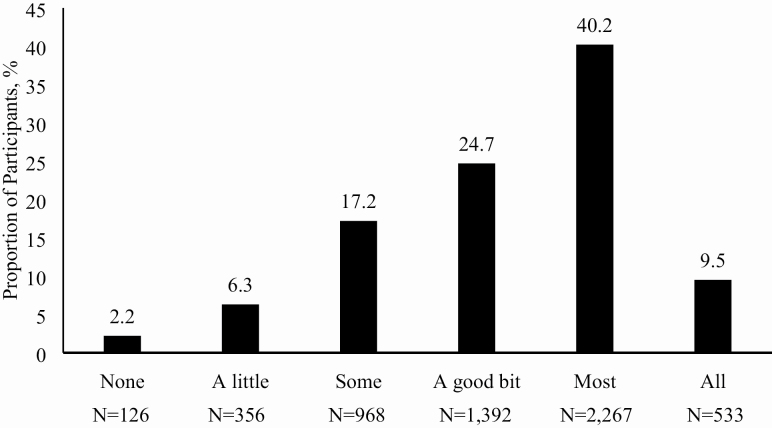
Fatigue was measured at baseline using the Medical Outcomes Study (short form) single-item question "During the past four weeks, how much of the time did you feel energetic?" Responses were then classified: higher fatigue = "none," "a little," or "some" of the time and lower fatigue = "a good bit," "most," or "all" of the time. We assessed falls using triannual questionnaires. Fall risk was examined prospectively over 3 years; recurrent falling was defined as at least 2 falls within the first year. Generalized estimating equations and multinomial logistic regression modeled prospective and recurrent fall risk as a function of baseline fatigue status, adjusted for demographics, medications, physical activity, and gait speed.
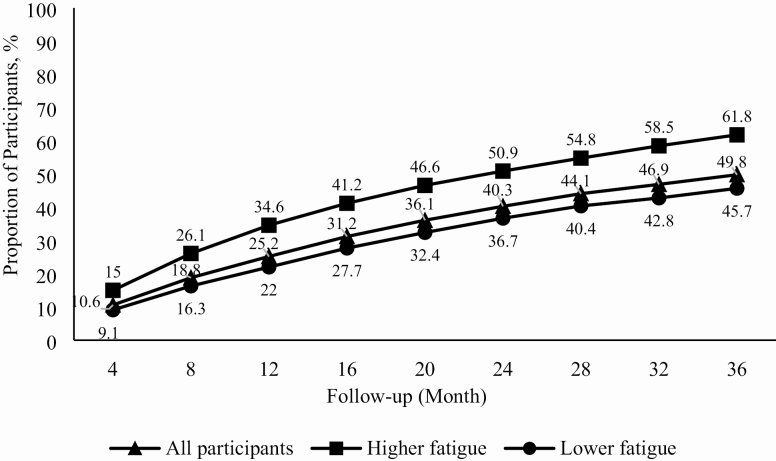
Men with higher (26%) versus lower baseline fatigue were older (75.1 ± 6.2 vs 73.2 ± 5.7 years), 24% less active, and had worse physical function (gait speed = 1.09 ± 0.24 vs 1.24 ± 0.21 m/s), all < .0001. Within 1 year, 25.4% ( = 1409) had fallen at least once, of which 47.4% ( = 668) were recurrent fallers. Men with higher versus lower fatigue had 25% increased fall risk (relative risk = 1.25, 95% CI: 1.14-1.36) over 3 years follow-up, but had 50% increased odds of recurrent falling (odds ratio = 1.50, 95% CI: 1.22-1.85) within the first year.
Fatigue is an important risk factor of falling independent of established risk factors. Reductions in fatigue (ie, increased energy) may lessen the burden of falls in older men and provide a novel avenue for fall risk intervention.
疲劳是一种常见症状,与跌倒有许多共同的风险因素,但疲劳对跌倒风险的独立影响尚不清楚。本研究的主要目的是评估参加男性骨质疏松性骨折研究(MrOS)的5642名64至100岁男性中疲劳与未来跌倒风险之间的关联。次要目的是研究疲劳与反复跌倒风险之间的关联。
在基线时使用医学结局研究(简表)单项问题“在过去四周内,您感到精力充沛的时间占比是多少?”来测量疲劳程度。然后对回答进行分类:较高疲劳程度 = “没有”、“有一点”或“部分”时间,较低疲劳程度 = “相当多”、“大部分”或“全部”时间。我们使用每三年一次的问卷调查来评估跌倒情况。前瞻性地观察3年的跌倒风险;反复跌倒定义为在第一年内至少跌倒2次。使用广义估计方程和多项逻辑回归将前瞻性和反复跌倒风险建模为基线疲劳状态的函数,并对人口统计学、药物治疗、身体活动和步速进行了调整。
基线疲劳程度较高(26%)的男性比疲劳程度较低的男性年龄更大(75.1±6.2岁对73.2±5.7岁),身体活动少24%,身体功能更差(步速 = 1.09±0.24米/秒对1.24±0.21米/秒),所有差异均<0.0001。在1年内,25.4%(n = 1409)的人至少跌倒过一次,其中47.4%(n = 668)是反复跌倒者。在3年的随访中,疲劳程度较高的男性比疲劳程度较低的男性跌倒风险增加25%(相对风险 = 1.25,95%置信区间:1.14 - 1.36),但在第一年内反复跌倒的几率增加50%(优势比 = 1.50,95%置信区间:1.22 - 1.85)。
疲劳是独立于既定风险因素的跌倒重要风险因素。减轻疲劳(即增加精力)可能减轻老年男性的跌倒负担,并为跌倒风险干预提供新途径。