Engberg Isak, Segerstedt Johan, Waller Göran, Wennberg Patrik, Eliasson Mats
Department of Public Health and Clinical Medicine, Sunderby Research Unit, Umeå University, Umeå, Sweden.
Department of Public Health and Clinical Medicine, Family Medicine, Umeå University, Umeå, Sweden.
BMC Public Health. 2017 Aug 14;17(1):654. doi: 10.1186/s12889-017-4623-y.
Fatigue is widespread in the population and a common complaint in primary care. Little is known about prevalence of fatigue in the population and its predictors. We aimed to describe the pattern of fatigue in the general population and to explore the associations with age, sex, socioeconomic status, self-reported physical activity, sitting time and self-rated health.
One thousand, five hundred and fifty-seven out of 2500 invited subjects in the Northern Sweden MONICA Study 2014, aged 25-74 years, filled out the Multidimensional Fatigue Inventory (MFI-20), consisting of four subscales: General fatigue (GF), Physical fatigue (PF), Reduced activity (RA) and Mental fatigue (MF). Questions regarding age, sex, socioeconomic status, physical activity, sitting time and self-rated health were also included.
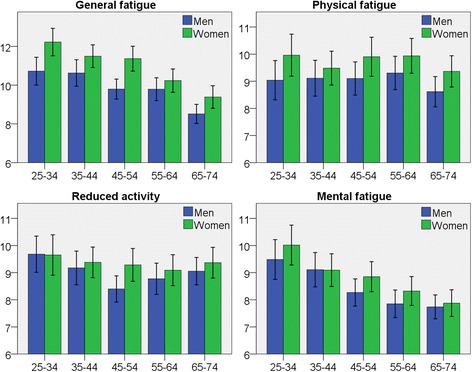
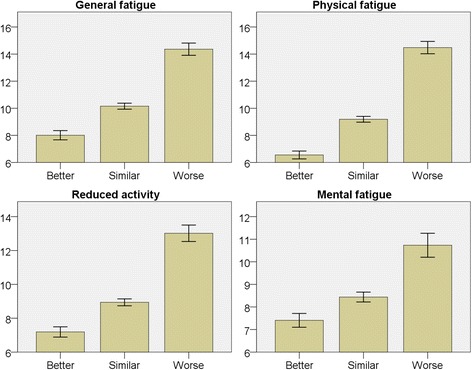
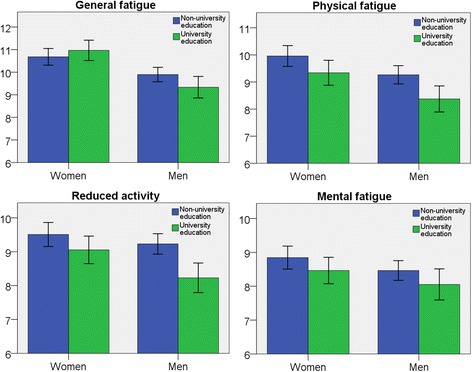
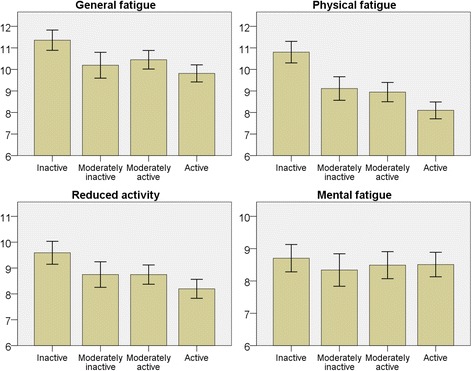
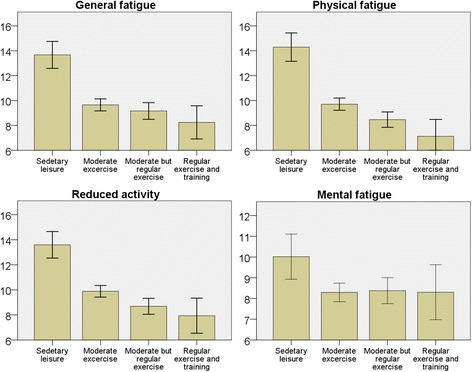
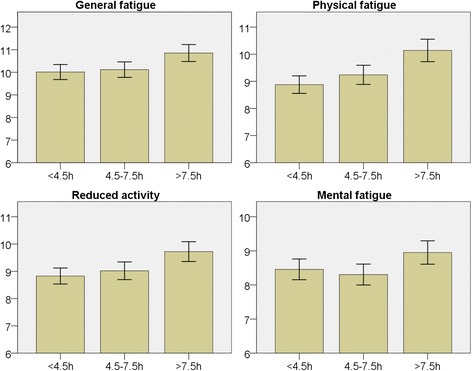
Higher age correlated significantly with lower fatigue scores for the GF and MF subscales. Women had higher fatigue scores than men on all subscales (p < 0.05). Among men, higher socioeconomic status was related to lower fatigue for the GF, PF and RA subscales (age adjusted p < 0.05). Among women, higher socioeconomic status was related to lower fatigue for the PF and MF subscales (age adjusted p < 0.05). Higher physical activity was connected to lower levels of fatigue for all subscales (age and sex adjusted p < 0.001) except for MF. Longer time spent sitting was also related to more fatigue on all subscales (age and sex adjusted p < 0.005) except for MF. Better self-rated health was strongly associated with lower fatigue for all subscales (age and sex adjusted p < 0.001).
Older, highly educated, physically active men, with little sedentary behavior are generally the least fatigued. Self-rated health is strongly related to fatigue. Interventions increasing physical exercise and reducing sedentary behavior may be important to help patients with fatigue and should be investigated in prospective studies.
疲劳在人群中普遍存在,是初级保健中常见的主诉。关于人群中疲劳的患病率及其预测因素知之甚少。我们旨在描述普通人群中的疲劳模式,并探讨其与年龄、性别、社会经济地位、自我报告的身体活动、久坐时间和自我评定健康状况之间的关联。
在2014年瑞典北部莫尼卡研究中,2500名受邀受试者中有1557名年龄在25 - 74岁之间,填写了多维疲劳量表(MFI - 20),该量表由四个分量表组成:总体疲劳(GF)、身体疲劳(PF)、活动减少(RA)和精神疲劳(MF)。还包括了关于年龄、性别、社会经济地位、身体活动、久坐时间和自我评定健康状况的问题。
年龄越大,GF和MF分量表的疲劳得分越低。在所有分量表上,女性的疲劳得分均高于男性(p < 0.05)。在男性中,较高的社会经济地位与GF、PF和RA分量表的较低疲劳程度相关(年龄调整后p < 0.05)。在女性中,较高的社会经济地位与PF和MF分量表的较低疲劳程度相关(年龄调整后p < 0.05)。除MF外,较高的身体活动与所有分量表的较低疲劳水平相关(年龄和性别调整后p < 0.001)。久坐时间越长,除MF外,所有分量表的疲劳程度也越高(年龄和性别调整后p < 0.005)。自我评定健康状况越好,与所有分量表的较低疲劳程度密切相关(年龄和性别调整后p < 0.001)。
年龄较大、受过高等教育、身体活跃且久坐行为少的男性通常疲劳程度最低。自我评定健康状况与疲劳密切相关。增加体育锻炼和减少久坐行为的干预措施可能对帮助疲劳患者很重要,应在前瞻性研究中进行调查。