Division of General Internal Medicine and Clinical Innovation, Department of Medicine, NYU Grossman School of Medicine, New York, NY, USA.
Division of Healthcare Delivery Science, Department of Population Health, NYU Grossman School of Medicine, New York, NY, USA.
J Gen Intern Med. 2021 Mar;36(3):738-745. doi: 10.1007/s11606-020-06338-4. Epub 2021 Jan 14.
Little is known about long-term recovery from severe COVID-19 disease. Here, we characterize overall health, physical health, and mental health of patients 1 month after discharge for severe COVID-19.
This was a prospective single health system observational cohort study of patients ≥ 18 years hospitalized with laboratory-confirmed COVID-19 disease who required at least 6 l of oxygen during admission, had intact baseline cognitive and functional status, and were discharged alive. Participants were enrolled between 30 and 40 days after discharge. Outcomes were elicited through validated survey instruments: the PROMIS® Dyspnea Characteristics and PROMIS® Global Health-10.
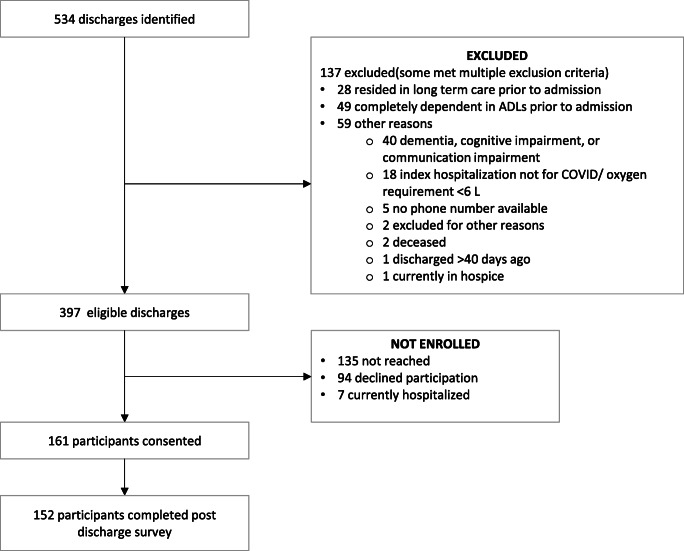
A total of 161 patients (40.6% of eligible) were enrolled; 152 (38.3%) completed the survey. Median age was 62 years (interquartile range [IQR], 50-67); 57 (37%) were female. Overall, 113/152 (74%) participants reported shortness of breath within the prior week (median score 3 out of 10 [IQR 0-5]), vs 47/152 (31%) pre-COVID-19 infection (0, IQR 0-1), p < 0.001. Participants also rated their physical health and mental health as worse in their post-COVID state (43.8, standard deviation 9.3; mental health 47.3, SD 9.3) compared to their pre-COVID state, (54.3, SD 9.3; 54.3, SD 7.8, respectively), both p < 0.001. Physical and mental health means in the general US population are 50 (SD 10). A total of 52/148 (35.1%) patients without pre-COVID oxygen requirements needed home oxygen after hospital discharge; 20/148 (13.5%) reported still using oxygen at time of survey.
Patients with severe COVID-19 disease typically experience sequelae affecting their respiratory status, physical health, and mental health for at least several weeks after hospital discharge.
目前对于严重 COVID-19 疾病的长期康复情况知之甚少。在这里,我们描述了严重 COVID-19 出院后 1 个月患者的整体健康状况、身体健康状况和心理健康状况。
这是一项前瞻性的单一医疗系统观察队列研究,纳入了≥18 岁因实验室确诊的 COVID-19 住院且住院期间至少需要 6L 氧气、基线认知和功能状态完整且存活出院的患者。参与者在出院后 30-40 天入组。使用经过验证的调查工具评估结局:PROMIS®呼吸困难特征和 PROMIS®全球健康-10。
共纳入 161 例患者(符合条件者的 40.6%);其中 152 例(38.3%)完成了调查。中位年龄为 62 岁(四分位距 [IQR],50-67);57 例(37%)为女性。总体而言,152 例参与者中有 113 例(74%)在过去一周内报告有呼吸急促(中位数评分 3 分[IQR 0-5]),而在 COVID-19 感染前为 47 例(31%)(0 分,IQR 0-1),p<0.001。与 COVID-19 感染前相比,参与者在 COVID-19 后也报告身体和心理健康状况更差(43.8,标准差 9.3;心理健康 47.3,标准差 9.3),均 p<0.001。美国普通人群的身体和心理健康平均水平为 50(标准差 10)。在无 COVID-19 吸氧需求的 148 例患者中,共有 52 例(35.1%)在出院后需要家庭吸氧;在 148 例患者中,有 20 例(13.5%)在调查时仍在使用氧气。
患有严重 COVID-19 疾病的患者通常会出现影响呼吸状况、身体健康和心理健康的后遗症,至少在出院后数周内如此。