Durham VA Health Care System, Durham, NC, USA; VA Mid-Atlantic Mental Illness Research, Education, and Clinical Center, Durham, NC, USA; Duke University Medical Center, Durham, NC, USA.
Durham VA Health Care System, Durham, NC, USA; VA Mid-Atlantic Mental Illness Research, Education, and Clinical Center, Durham, NC, USA.
J Psychiatr Res. 2021 Mar;135:47-51. doi: 10.1016/j.jpsychires.2021.01.011. Epub 2021 Jan 7.
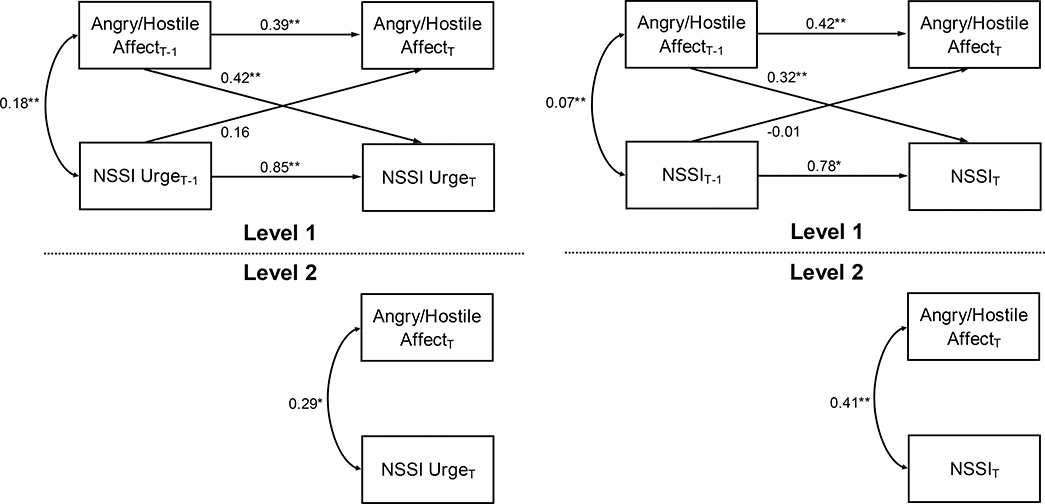
Veterans have high rates of suicide, and nonsuicidal self-injury (NSSI) is one of the strongest predictors of suicide risk; however, there is presently little known about antecedents of NSSI that might inform intervention efforts. Accumulating research suggests that anger and hostility play an important role in NSSI, but whether these emotions precede and predict NSSI is currently unknown. The aim of the current study was to examine the temporal relationships between anger/hostility and NSSI urges and behavior among veterans diagnosed with NSSI disorder. Our hypothesis was that angry/hostile affect would predict subsequent NSSI urge and engagement, but not vice versa. Forty veterans with NSSI disorder completed a 28-day ecological momentary assessment study with three daily prompts to report on their affect and NSSI urges and engagement. Multilevel cross-lagged path modeling was used to determine the direction of effects between angry/hostile affect and NSSI urges and engagement over time. Consistent with our hypothesis, results indicated that the lagged effects of angry/hostile affect on subsequent NSSI urge and engagement were significant, whereas the lagged effects of NSSI urge and engagement on angry/hostile affect were not significant. Findings highlight the importance of assessing and treating anger among veterans who engage in NSSI.
退伍军人的自杀率很高,非自杀性自伤(NSSI)是自杀风险的最强预测因素之一;然而,目前对于可能为干预措施提供信息的 NSSI 前因知之甚少。越来越多的研究表明,愤怒和敌意在 NSSI 中起着重要作用,但这些情绪是否先于和预测 NSSI 目前尚不清楚。本研究旨在探讨退伍军人中诊断为 NSSI 障碍的个体的愤怒/敌意与 NSSI 冲动和行为之间的时间关系。我们的假设是,愤怒/敌意会预测随后的 NSSI 冲动和参与,但反之则不然。40 名患有 NSSI 障碍的退伍军人完成了一项为期 28 天的生态瞬时评估研究,每天有三次提示,要求他们报告自己的情绪和 NSSI 冲动和参与情况。多层交叉滞后路径模型用于确定愤怒/敌意与 NSSI 冲动和参与随时间的影响方向。与我们的假设一致,结果表明,愤怒/敌意对随后的 NSSI 冲动和参与的滞后影响是显著的,而 NSSI 冲动和参与对愤怒/敌意的滞后影响则不显著。研究结果强调了在从事 NSSI 的退伍军人中评估和治疗愤怒的重要性。