Berardi Emanuele, Madaro Luca, Lozanoska-Ochser Biliana, Adamo Sergio, Thorrez Lieven, Bouche Marina, Coletti Dario
Department of Development and Regeneration, KU Leuven Campus Kulak, 8500 Kortrijk, Belgium.
Faculty of Rehabilitation Sciences, REVAL, Hasselt University (UHasselt), 3590 Diepenbeek, Belgium.
Diagnostics (Basel). 2021 Jan 12;11(1):116. doi: 10.3390/diagnostics11010116.
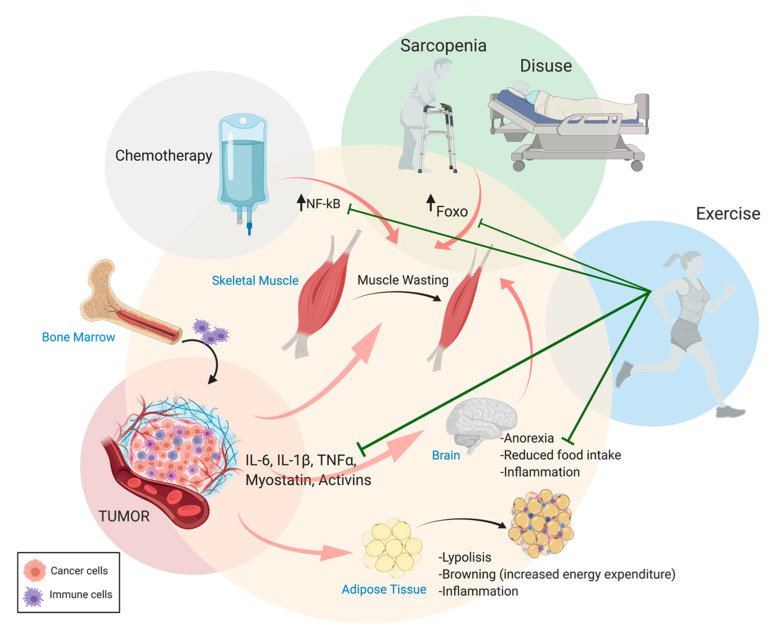
Body weight loss, mostly due to the wasting of skeletal muscle and adipose tissue, is the hallmark of the so-called cachexia syndrome. Cachexia is associated with several acute and chronic disease states such as cancer, chronic obstructive pulmonary disease (COPD), heart and kidney failure, and acquired and autoimmune diseases and also pharmacological treatments such as chemotherapy. The clinical relevance of cachexia and its impact on patients' quality of life has been neglected for decades. Only recently did the international community agree upon a definition of the term cachexia, and we are still awaiting the standardization of markers and tests for the diagnosis and staging of cancer-related cachexia. In this review, we discuss cachexia, considering the evolving use of the term for diagnostic purposes and the implications it has for clinical biomarkers, to provide a comprehensive overview of its biology and clinical management. Advances and tools developed so far for the in vitro testing of cachexia and drug screening will be described. We will also evaluate the nomenclature of different forms of muscle wasting and degeneration and discuss features that distinguish cachexia from other forms of muscle wasting in the context of different conditions.
体重减轻主要是由于骨骼肌和脂肪组织的消耗,是所谓恶病质综合征的标志。恶病质与多种急慢性疾病状态相关,如癌症、慢性阻塞性肺疾病(COPD)、心力衰竭和肾衰竭,以及获得性和自身免疫性疾病,还有化疗等药物治疗。数十年来,恶病质的临床相关性及其对患者生活质量的影响一直被忽视。直到最近,国际社会才就恶病质一词的定义达成共识,而我们仍在等待癌症相关恶病质诊断和分期的标志物及检测方法的标准化。在这篇综述中,我们讨论恶病质,考虑该术语在诊断目的方面不断演变的用法及其对临床生物标志物的影响,以全面概述其生物学特性和临床管理。将描述迄今为止为恶病质体外检测和药物筛选开发的进展和工具。我们还将评估不同形式肌肉消耗和退化的命名,并在不同情况下讨论区分恶病质与其他形式肌肉消耗的特征。