Hamzaoglu Azmi, Elsadig Mustafa, Karadereler Selhan, Mutlu Ayhan, Akman Yunus Emre, Ozturk Huseyin, Aslantürk Okan, Sanlı Tunay, Kahraman Sinan, Enercan Meric
74832Florence Nightingale Hospital, Istanbul, Turkey.
74832Istanbul Bilim University Faculty of Medicine, Istanbul, Turkey.
Global Spine J. 2022 Jun;12(5):801-811. doi: 10.1177/2192568220964453. Epub 2020 Oct 14.
Retrospective study.
The aim of this study is to evaluate the clinical, neurological, and radiological outcomes of posterior vertebral column resection (PVCR) technique for treatment of thoracic and thoracolumbar burst fractures.
Fifty-one patients (18 male, 33 female) with thoracic/thoracolumbar burst fractures who had been treated with PVCR technique were retrospectively reviewed. Preoperative and most recent radiographs were evaluated and local kyphosis angle (LKA), sagittal and coronal spinal parameters were measured. Neurological and functional results were assessed by the American Spinal Injury Association (ASIA) Impairment Scale, visual analogue scale score, Oswestry Disability Index, and Short Form 36 version 2.
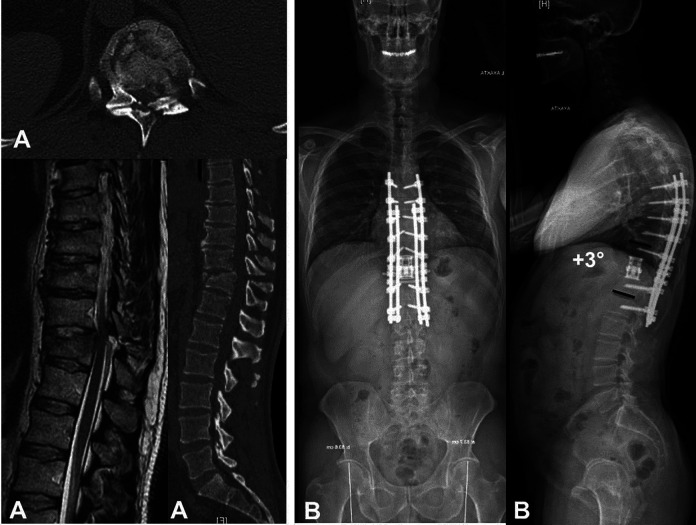
The mean age was 49 years (range 22-83 years). The mean follow-up period was 69 months (range 28-216 months). Fractures were thoracic in 16 and thoracolumbar in 35 of the patients. AO spine thoracolumbar injury morphological types were as follows: 1 type A3, 15 type A4, 4 type B1, 23 type B2, 8 type C injuries. PVCR was performed in a single level in 48 of the patients and in 2 levels in 3 patients. The mean operative time was 434 minutes (range 270-530 minutes) and mean intraoperative blood loss was 520 mL (range 360-1100 mL). The mean LKA improved from 34.7° to 4.9° (85.9%). For 27 patients, the initial neurological deficit (ASIA A in 8, ASIA B in 3, ASIA C in 5, and ASIA D in 11) improved at least 1 ASIA grade (1-3 grades) in 22 patients (81.5%). Solid fusion, assessed with computed tomography at the final follow-up, was achieved in all patients.
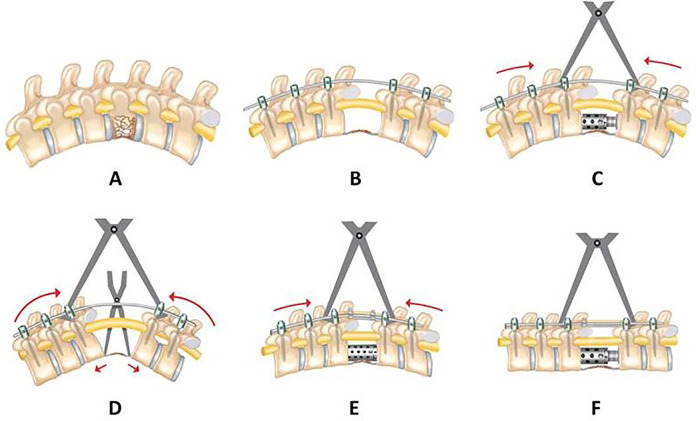
Single-stage PVCR provides complete spinal canal decompression, ideal kyphosis correction with gradual lengthening of anterior column together with sequential posterior column compression. Anterior column support, avoidance of the morbidity of anterior approach and improvement of neurological deficit are the other advantages of the single stage PVCR technique in patients with thoracic/thoracolumbar burst fractures.
回顾性研究。
本研究旨在评估后路脊柱椎体切除术(PVCR)治疗胸段及胸腰段爆裂骨折的临床、神经学及影像学结果。
回顾性分析51例接受PVCR技术治疗的胸段/胸腰段爆裂骨折患者(男18例,女33例)。评估术前及最近的X线片,测量局部后凸角(LKA)、矢状面和冠状面脊柱参数。采用美国脊髓损伤协会(ASIA)损伤分级、视觉模拟评分、Oswestry功能障碍指数及简明健康调查问卷第2版评估神经学和功能结果。
平均年龄49岁(范围22 - 83岁)。平均随访时间69个月(范围28 - 216个月)。16例患者骨折位于胸段,35例位于胸腰段。AO脊柱胸腰段损伤形态学类型如下:A3型1例,A4型15例,B1型4例,B2型23例,C型8例。48例患者行单节段PVCR,3例患者行双节段PVCR。平均手术时间434分钟(范围270 - 530分钟),平均术中出血量520 mL(范围360 - 1100 mL)。平均LKA从34.7°改善至4.9°(改善85.9%)。27例患者存在初始神经功能缺损(ASIA A级8例,ASIA B级3例,ASIA C级5例,ASIA D级11例),其中22例(81.5%)至少改善1个ASIA等级(1 - 3级)。末次随访时通过CT评估所有患者均实现了坚固融合。
一期PVCR可实现完全椎管减压,通过前柱逐渐延长及后柱序贯加压实现理想的后凸畸形矫正。前柱支撑、避免前路手术相关并发症及改善神经功能缺损是一期PVCR技术治疗胸段/胸腰段爆裂骨折患者的其他优势。