P Oprel Pim, Tuinebreijer Wim E, Patka Peter, den Hartog Dennis
Department of Surgery-Traumatology, Erasmus MC, University Medical Center Rotterdam, 's-Gravendijkwal 230, 3015 CE Rotterdam, The Netherlands.
Open Orthop J. 2010 Feb 17;4:93-100. doi: 10.2174/1874325001004010093.
A systematic quantitative review of the literature.
To compare combined anterior-posterior surgery versus posterior surgery for thoracolumbar fractures in order to identify better treatments.
Axial load of the anterior and middle column of the spine can lead to a burst fracture in the vertebral body. The management of thoracolumbar burst fractures remains controversial. The goals of operative treatment are fracture reduction, fixation and decompressing the neural canal. For this, different operative methods are developed, for instance, the posterior and the combined anterior-posterior approach. Recent systematic qualitative reviews comparing these methods are lacking.
We conducted an electronic search of MEDLINE, EMBASE, LILACS and the Cochrane Central Register for Controlled Trials.
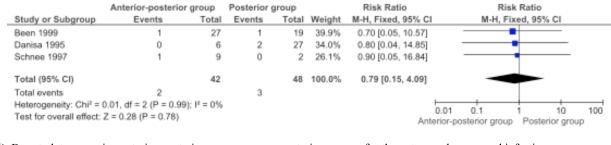
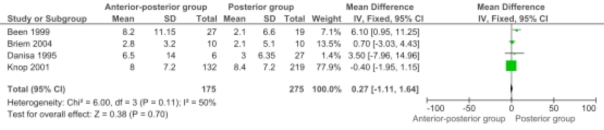
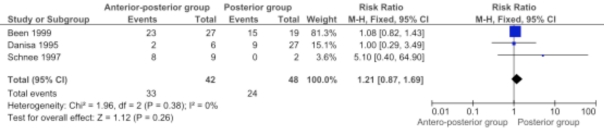
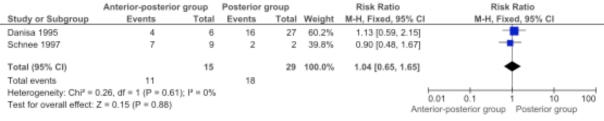
Five observational comparative studies and no randomized clinical trials comparing the combined anteriorposterior approach with the posterior approach were retrieved. The total enrollment of patients in these studies was 755 patients. The results were expressed as relative risk (RR) for dichotomous outcomes and weighted mean difference (WMD) for continuous outcomes with 95% confidence intervals (CI).
A small significantly higher kyphotic correction and improvement of vertebral height (sagittal index) observed for the combined anterior-posterior group is cancelled out by more blood loss, longer operation time, longer hospital stay, higher costs and a possible higher intra- and postoperative complication rate requiring re-operation and the possibility of a worsened Hannover spine score. The surgeons' choices regarding the operative approach are biased: worse cases tended to undergo the combined anterior-posterior approach.
对文献进行系统的定量综述。
比较胸腰椎骨折的前后联合手术与后路手术,以确定更好的治疗方法。
脊柱前柱和中柱的轴向负荷可导致椎体爆裂骨折。胸腰椎爆裂骨折的治疗仍存在争议。手术治疗的目标是骨折复位、固定和椎管减压。为此,人们开发了不同的手术方法,例如后路和前后联合入路。目前缺乏比较这些方法的系统定性综述。
我们对MEDLINE、EMBASE、LILACS和Cochrane对照试验中央注册库进行了电子检索。
检索到五项观察性比较研究,没有随机临床试验比较前后联合入路与后路入路。这些研究中的患者总入组人数为755例。结果以二分结果的相对风险(RR)和连续结果的加权平均差(WMD)表示,并带有95%置信区间(CI)。
前后联合组观察到的较小但显著更高的后凸畸形矫正和椎体高度改善(矢状指数)被更多的失血、更长的手术时间、更长的住院时间、更高的费用以及可能更高的术中和术后并发症发生率(需要再次手术)以及汉诺威脊柱评分可能恶化所抵消。外科医生对手术入路的选择存在偏差:病情较重的患者倾向于采用前后联合入路。