Department of Structural Heart Disease, Xi'an Jiaotong University Medical College First Affiliated Hospital, Xi'an, 710061, Shaanxi Province, China.
School of Nursing, Guangdong Pharmaceutical University, 283 Jianghai Avenue, Haizhu District, Guangzhou, China.
Sci Rep. 2021 Jan 14;11(1):1329. doi: 10.1038/s41598-020-79264-4.
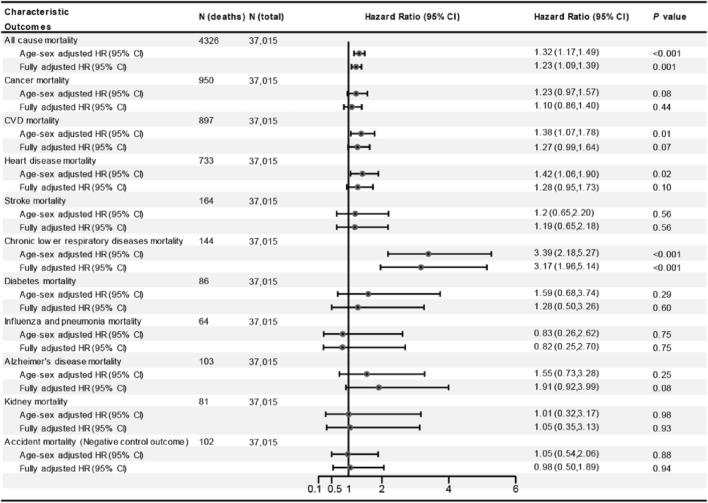
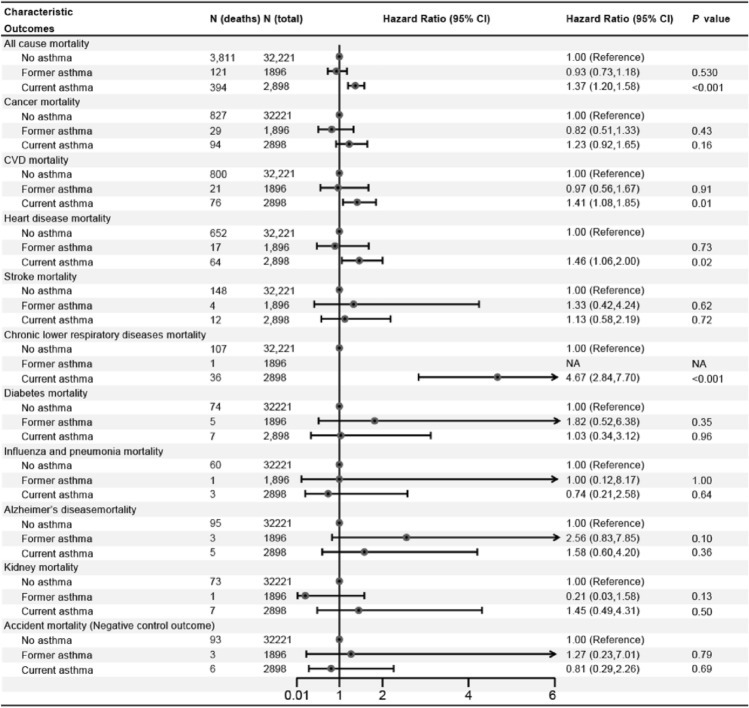
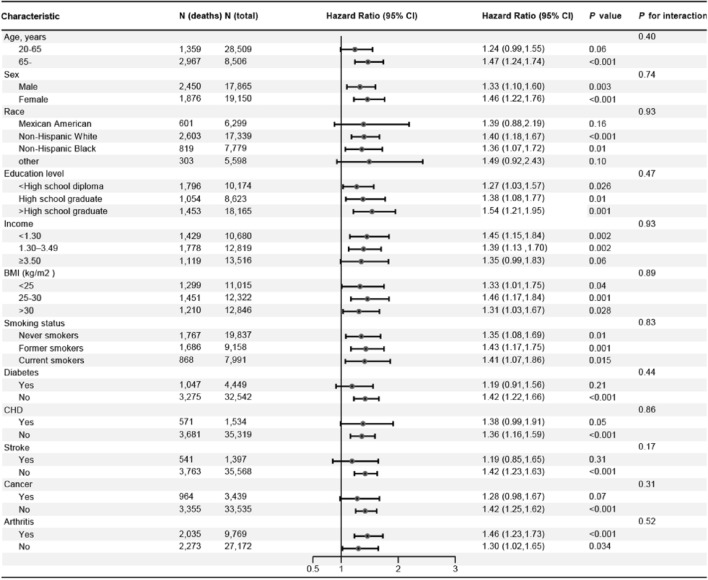
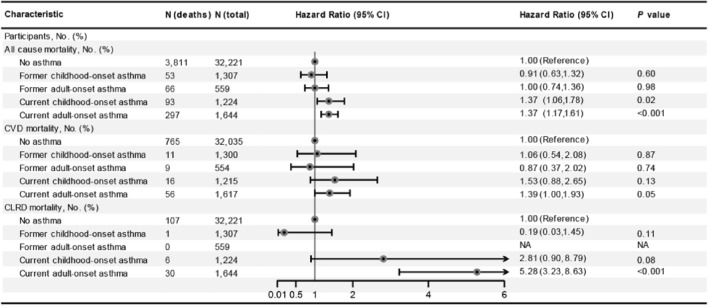
Higher mortality in asthmatics has been shown previously. However, evidence on different asthma phenotypes on long-term mortality risk is limited. The aim was to evaluate the impact of asthma phenotypes on mortality in general population. Data from the National Health and Nutrition Examination Survey from 2001-2002 to 2013-2014 linked mortality files through December 31, 2015, were used (N = 37,015). Cox proportional hazards regression was used to estimate the risk of all-cause and cause-specific mortality adjusting for sociodemographic characteristics, smoking, body mass index, and chronic conditions. During the mean follow-up time of 7.5 years, 4326 participants died from a variety of causes. Current asthma, but not former asthma was associated with increased all-cause mortality (current asthma: HR = 1.37; 95% CI 1.20-1.58; Former asthma: HR = 0.93; 95% CI 0.73-1.18); as well as mortality from cardiovascular disease (HR = 1.41; 95% CI 1.08-1.85) and chronic lower respiratory diseases (HR = 3.17; 95% CI 1.96-5.14). In addition, we found that the HR for cardiovascular disease (CVD) mortality was slightly greater in people with childhood-onset asthma than those with adult-onset asthma. The HR for chronic lower respiratory diseases (CLRD) mortality was greater in people with adult-onset asthma than those with childhood-onset asthma. However, the differences were not statistically significant. Our study suggested that current asthma but not former asthma was associated with increased all-cause, CLRD and CVD mortality. Future well-designed studies with larger sample are required to demonstrate the association and clarify the potential mechanisms involved.
先前已有研究表明哮喘患者的死亡率较高。然而,关于不同哮喘表型对长期死亡率风险的证据有限。本研究旨在评估一般人群中哮喘表型对死亡率的影响。我们使用了 2001-2002 年至 2013-2014 年国家健康和营养调查(National Health and Nutrition Examination Survey,NHANES)的数据,并将其与截至 2015 年 12 月 31 日的死亡档案相关联(N=37015)。我们采用 Cox 比例风险回归模型,根据社会人口统计学特征、吸烟、体重指数和慢性疾病,调整了全因死亡率和死因特异性死亡率的风险比(hazard ratio,HR)。在平均 7.5 年的随访期间,有 4326 名参与者死于各种原因。当前哮喘(HR=1.37;95%置信区间 1.20-1.58)而非既往哮喘(HR=0.93;95%置信区间 0.73-1.18)与全因死亡率增加相关;此外,与心血管疾病(HR=1.41;95%置信区间 1.08-1.85)和慢性下呼吸道疾病(HR=3.17;95%置信区间 1.96-5.14)死亡率增加相关。此外,我们发现,与成年起病的哮喘患者相比,儿童起病的哮喘患者的心血管疾病死亡率的 HR 略高。与儿童起病的哮喘患者相比,成年起病的哮喘患者的慢性下呼吸道疾病死亡率的 HR 更高。然而,这些差异无统计学意义。我们的研究表明,当前哮喘而非既往哮喘与全因死亡率、慢性下呼吸道疾病死亡率和心血管疾病死亡率增加相关。需要未来进行设计良好、样本量更大的研究来证明这种关联,并阐明潜在的相关机制。