Institute of Nature Conservation, Polish Academy of Sciences, Al. Adama Mickiewicza 33, 31-120, Kraków, Poland.
Senckenberg Biodiversity and Climate Research Centre (Sbik-F), Senckenberganlage 25, 60325, Frankfurt am Main, Germany.
Sci Rep. 2021 Jan 14;11(1):1282. doi: 10.1038/s41598-020-80440-9.
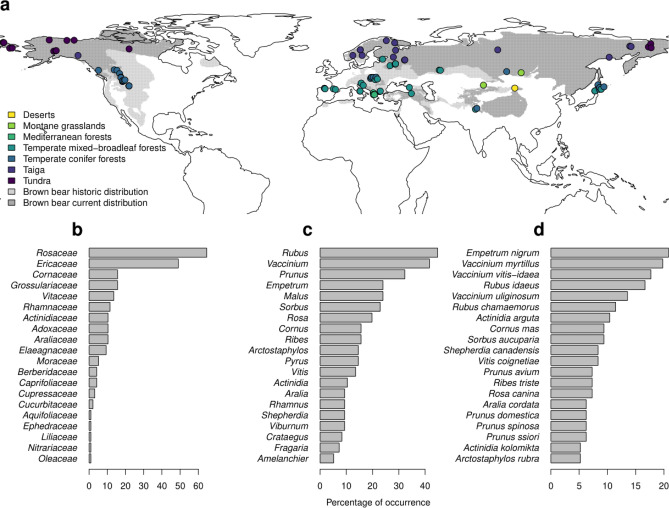
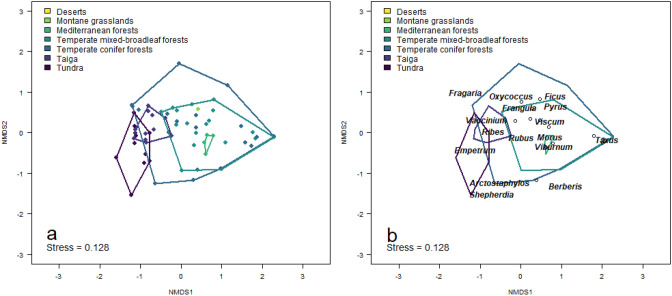
Megafaunal frugivores can consume large amounts of fruits whose seeds may be dispersed over long distances, thus, affecting plant regeneration processes and ecosystem functioning. We investigated the role of brown bears (Ursus arctos) as legitimate megafaunal seed dispersers. We assessed the quantity component of seed dispersal by brown bears across its entire distribution based on information about both the relative frequency of occurrence and species composition of fleshy fruits in the diet of brown bears extracted from the literature. We assessed the quality component of seed dispersal based on germination experiments for 11 fleshy-fruited plant species common in temperate and boreal regions and frequently eaten by brown bears. Across its distribution, fleshy fruits, on average, represented 24% of the bear food items and 26% of the total volume consumed. Brown bears consumed seeds from at least 101 fleshy-fruited plant species belonging to 24 families and 42 genera, of which Rubus (Rosaceae) and Vaccinium (Ericaceae) were most commonly eaten. Brown bears inhabiting Mediterranean forests relied the most on fleshy fruits and consumed the largest number of species per study area. Seeds ingested by bears germinated at higher percentages than those from whole fruits, and at similar percentages than manually depulped seeds. We conclude that brown bears are legitimate seed dispersers as they consume large quantities of seeds that remain viable after gut passage. The decline of these megafaunal frugivores may compromise seed dispersal services and plant regeneration processes.
巨型食果动物可以消耗大量的果实,这些果实的种子可能会被传播到很远的地方,从而影响植物的再生过程和生态系统的功能。我们研究了棕熊(Ursus arctos)作为合法的巨型食果动物种子传播者的作用。我们根据文献中关于棕熊饮食中肉质果实的相对出现频率和物种组成的信息,评估了棕熊在其整个分布区内的种子扩散的数量组成。我们基于 11 种常见于温带和北方地区且经常被棕熊食用的肉质果实植物的萌发实验,评估了种子扩散的质量组成。在其分布区内,肉质果实平均占熊食物的 24%,占总消耗量的 26%。棕熊食用了至少 101 种属于 24 科 42 属的肉质果实植物的种子,其中悬钩子(蔷薇科)和越橘(杜鹃花科)是最常食用的。栖息在地中海森林中的棕熊最依赖肉质果实,并且在每个研究区域内食用的物种数量最多。熊摄入的种子萌发率高于整果的萌发率,与手动去果皮的种子萌发率相似。我们的结论是,棕熊是合法的种子传播者,因为它们消耗大量的种子,这些种子在通过肠道后仍然具有活力。这些巨型食果动物的减少可能会影响种子传播服务和植物再生过程。