Mika Maeda, Kanzaki Hideaki, Hasegawa Takuya, Fukuda Hiroki, Amaki Makoto, Kim Jiyoong, Asakura Masanori, Asanuma Hiroshi, Nishimura Motonobu, Kitakaze Masafumi
Division of Organ Regeneration Surgery, Department of Surgery, Tottori University, Yonago, Japan.
Division of Cardiology, Department of Internal Medicine, National Cerebral and Cardiovascular Center, Suita, Japan.
Int J Cardiol Hypertens. 2020 Jun 20;6:100038. doi: 10.1016/j.ijchy.2020.100038. eCollection 2020 Sep.
Left ventricular (LV) diastolic dysfunction is an important underlying hemodynamic mechanism for heart failure. Hypertension reportedly increases aortic stiffness with histological changes in the aorta assessed using aortic pulse wave velocity (PWV) that is associated with LV diastolic dysfunction. The role of hypertension in the relationship between aortic stiffness and LV diastolic dysfunction has not been clarified; therefore, we investigated whether this relation works for normotensive subjects.
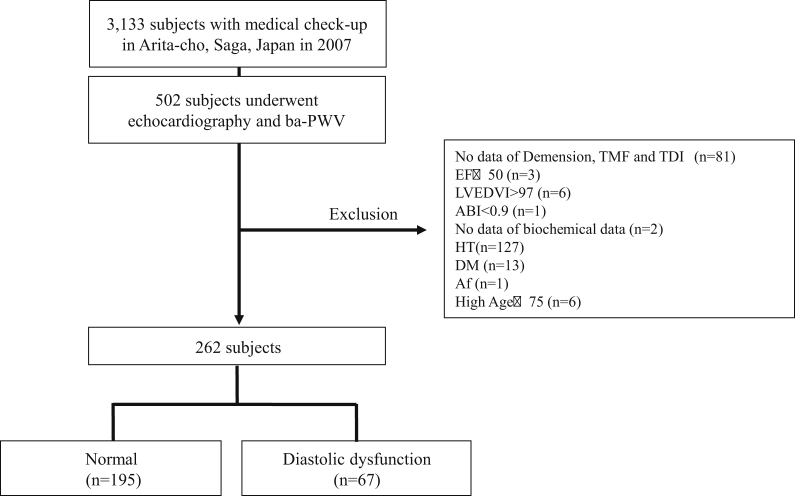
Of the 502 subjects who underwent both echocardiography and PWV measurement in a medical check-up conducted in Arita, Japan, we enrolled 262 consecutive normotensive subjects (age 52 ± 13 years). LV diastolic dysfunction was defined as abnormal relaxation and pseudonormal or restrictive patterns determined with both transmitral flow velocity and mitral annular velocity. Aortic stiffness was assessed via non-invasive brachial-ankle PWV measurement.
LV diastolic dysfunction was detected in 67 of the 262 (26%) normotensive subjects, and PWV was higher in subjects with LV diastolic dysfunction (15.4 ± 3.6 vs. 13.0 ± 2.7 m/s, < 0.01). Multivariate logistic regression analyses revealed that PWV was independently associated with LV diastolic dysfunction ( = 0.02) after the adjustment for age; body mass index; blood pressure; eGFR; blood levels of BNP, glucose, and HDL cholesterol; LV mass index; and LA dimension.
Both aortic stiffness and LV diastolic function are mutually related even in normotensive subjects, independent of the potential confounding factors. The increase in aortic stiffness may be a risk factor for LV diastolic dysfunction, irrespective of blood pressure.
左心室舒张功能障碍是心力衰竭的一个重要潜在血流动力学机制。据报道,高血压会增加主动脉僵硬度,通过主动脉脉搏波速度(PWV)评估的主动脉组织学变化与左心室舒张功能障碍相关。高血压在主动脉僵硬度与左心室舒张功能障碍之间关系中的作用尚未阐明;因此,我们研究了这种关系在血压正常的受试者中是否成立。
在日本有田进行的一次体检中,对502名同时接受了超声心动图检查和PWV测量的受试者,我们纳入了262名连续的血压正常受试者(年龄52±13岁)。左心室舒张功能障碍定义为通过二尖瓣血流速度和二尖瓣环速度确定的舒张功能异常及假性正常化或限制性模式。通过无创臂踝PWV测量评估主动脉僵硬度。
262名血压正常受试者中有67名(26%)检测到左心室舒张功能障碍,左心室舒张功能障碍受试者的PWV更高(15.4±3.6 vs. 13.0±2.7 m/s,<0.01)。多因素逻辑回归分析显示,在调整年龄;体重指数;血压;估算肾小球滤过率;脑钠肽(BNP)、血糖和高密度脂蛋白胆固醇的血水平;左心室质量指数;以及左心房内径后,PWV与左心室舒张功能障碍独立相关(=0.02)。
即使在血压正常的受试者中,主动脉僵硬度和左心室舒张功能也是相互关联的,且不受潜在混杂因素影响。主动脉僵硬度增加可能是左心室舒张功能障碍的一个危险因素,与血压无关。