Wood Thomas K, Song Sooyeon
Department of Chemical Engineering, Pennsylvania State University, University Park, PA, 16802-4400, USA.
Biofilm. 2020 Jan 7;2:100018. doi: 10.1016/j.bioflm.2019.100018. eCollection 2020 Dec.
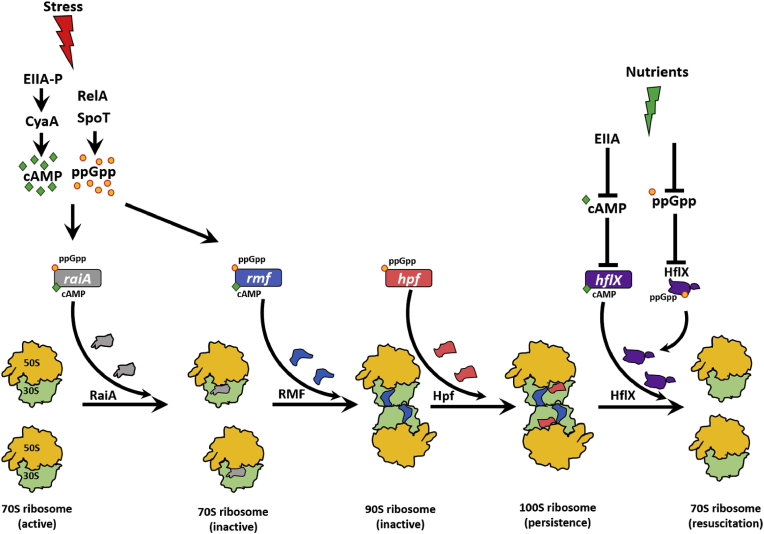
Procaryotes starve and face myriad stresses. The bulk population actively resists the stress, but a small population weathers the stress by entering a resting stage known as persistence. No mutations occur, and so persisters behave like wild-type cells upon removal of the stress and regrowth; hence, persisters are phenotypic variants. In contrast, resistant bacteria have mutations that allow cells to grow in the presence of antibiotics, and tolerant cells survive antibiotics better than actively-growing cells due to their slow growth (such as that of the stationary phase). In this review, we focus on the latest developments in studies related to the formation and resuscitation of persister cells and propose the guanosine pentaphosphate/tetraphosphate (henceforth ppGpp) ribosome dimerization persister (PRDP) model for entering and exiting the persister state.
原核生物会面临饥饿和各种压力。大多数个体能积极抵抗压力,但一小部分个体通过进入一种称为“持留态”的静止阶段来承受压力。此过程不会发生突变,因此持留菌在压力消除并重新生长时表现得像野生型细胞;所以,持留菌是表型变异体。相比之下,耐药细菌具有能使其在抗生素存在的情况下生长的突变,而耐受菌由于生长缓慢(如稳定期细胞),比活跃生长的细胞更能耐受抗生素。在本综述中,我们聚焦于与持留菌细胞形成和复苏相关研究的最新进展,并提出鸟苷五磷酸/四磷酸(以下简称ppGpp)核糖体二聚化持留菌(PRDP)模型,用于解释进入和退出持留态的过程。