
阿替利珠单抗治疗非小细胞肺癌的真实世界疗效:一项针对体能状态和抗 PD-1 抗体治疗失败后再次治疗的多中心队列研究。
Real-world efficacy of atezolizumab in non-small cell lung cancer: A multicenter cohort study focused on performance status and retreatment after failure of anti-PD-1 antibody.
机构信息
Division of Respiratory Medicine, Department of Internal Medicine, St. Marianna University School of Medicine, Kawasaki, Japan.
Department of Experimental Therapeutics, National Cancer Center Hospital, Tokyo, Japan.
出版信息
Thorac Cancer. 2021 Mar;12(5):613-618. doi: 10.1111/1759-7714.13824. Epub 2021 Jan 15.
BACKGROUND
Atezolizumab is a programmed death-ligand 1 (PD-L1) targeted monoclonal antibody that inhibits PD-L1 interacting with its receptors PD-1 and B7-1, thereby enhancing anticancer immunity. Some real-world efficacy and safety studies of anti-PD-1 antibody have been previously reported. However, there have been no reports investigating the efficacy of atezolizumab monotherapy in clinical practice which have focused on performance status and previous anti-PD-1 antibody treatment.
METHODS
We retrospectively reviewed consecutive advanced NSCLC patients who received atezolizumab monotherapy between April 2018 and February 2019 at eight institutions. A total of 152 patients with NSCLC were enrolled in this study.
RESULTS
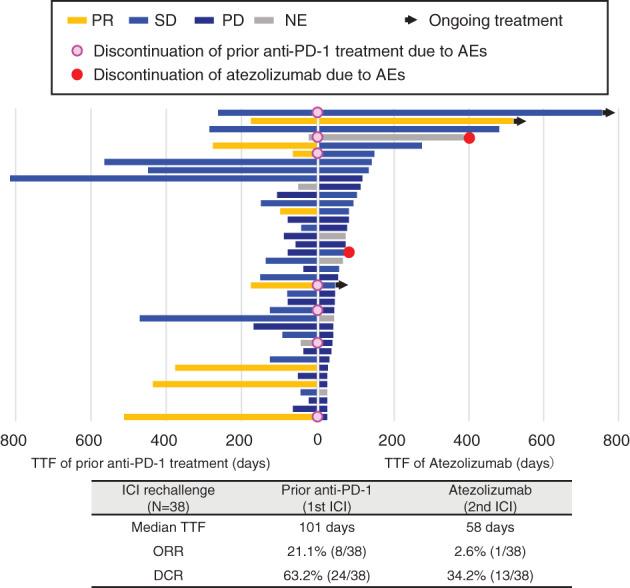
A total of 38 patients (25%) had already been treated with anti-PD-1 treatment (nivolumab or pembrolizumab) before atezolizumab. The median OS and TTF was 384 days (12.8 months) (95% confidence interval [CI]: 206-424), and 42 days (1.4 months) (95% CI: 27-56) in all patients, respectively. ECOG PS 0 had significantly longer OS (median OS; not reached, p < 0.0001) and TTF (median TTF; 63 days, p = 0.012) compared with PS 1 or 2-3. Most retreated patients were unable to continue atezolizumab for a longer period, but seven patients (18.4%) were able to continue atezolizumab over four months as an ICI retreatment.
CONCLUSIONS
In previously treated advanced NSCLC patients, atezolizumab monotherapy demonstrated good efficacy and safety regardless of heavily treated patients in real-world clinical practice, and ECOG PS 0 was a favorable predictive factor. The efficacy of retreatment with atezolizumab was limited but was well tolerated in patients treated with prior anti-PD-1 antibody.
背景
阿特珠单抗是一种程序性死亡配体 1(PD-L1)靶向单克隆抗体,可抑制 PD-L1 与其受体 PD-1 和 B7-1 相互作用,从而增强抗癌免疫。先前已经报道了一些抗 PD-1 抗体的真实世界疗效和安全性研究。然而,尚无研究调查阿特珠单抗单药治疗在临床实践中的疗效,这些研究侧重于表现状态和先前的抗 PD-1 抗体治疗。
方法
我们回顾性分析了 2018 年 4 月至 2019 年 2 月在 8 家机构接受阿特珠单抗单药治疗的连续晚期 NSCLC 患者。本研究共纳入 152 例 NSCLC 患者。
结果
共有 38 例(25%)患者在接受阿特珠单抗治疗前已经接受过抗 PD-1 治疗(nivolumab 或 pembrolizumab)。所有患者的中位 OS 和 TTF 分别为 384 天(12.8 个月)(95%置信区间 [CI]:206-424)和 42 天(1.4 个月)(95% CI:27-56)。ECOG PS 0 的 OS(中位 OS;未达到,p<0.0001)和 TTF(中位 TTF;63 天,p=0.012)明显更长。大多数接受再治疗的患者无法继续更长时间的阿特珠单抗治疗,但有 7 例(18.4%)患者能够作为 ICI 再治疗继续使用阿特珠单抗超过 4 个月。
结论
在先前接受过治疗的晚期 NSCLC 患者中,阿特珠单抗单药治疗表现出良好的疗效和安全性,无论在真实世界的临床实践中是否为重度治疗患者,ECOG PS 0 是一个有利的预测因素。先前接受过抗 PD-1 抗体治疗的患者,阿特珠单抗再治疗的疗效有限,但耐受性良好。


 Zotero 插件