Department of Rheumatology, Amsterdam Rheumatology and Immunology Center, Reade, Amsterdam, The Netherlands.
Department of Medicine, Division of Rheumatology, Maastricht University Medical Center, Maastricht, The Netherlands.
Rheumatol Int. 2021 Mar;41(3):565-573. doi: 10.1007/s00296-020-04771-6. Epub 2021 Jan 15.
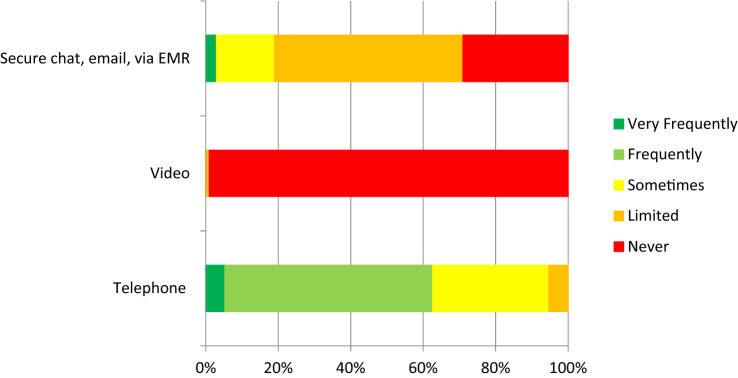
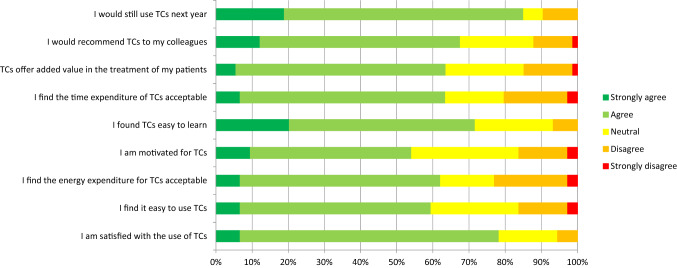
To describe the delivery of care for patients with rheumatic and musculoskeletal diseases (RMDs) from the perspective of rheumatologists in the Netherlands during the first months of the COVID-19 pandemic. A mixed methods design was used with quantitative and qualitative data from a cross-sectional survey sent to all members of the Dutch Rheumatology Society in May 2020. The survey contained questions on demographics, the current way of care delivery, and also on usage, acceptance, facilitators and barriers of telemedicine. Quantitative data were analyzed descriptively. The answers to the open questions were categorized into themes. Seventy-five respondents completed the survey. During the COVID-19 pandemic, continuity of care was guaranteed through telephone and video consultations by 99% and 9% of the respondents, respectively. More than 80% of the total number of outpatient visits were performed exclusively via telephone with in-person visits only on indication. One-quarter of the respondents used patient reported outcomes to guide telephone consultations. The top three facilitators for telemedicine were less travel time for patients, ease of use of the system and shorter waiting period for patients. The top three barriers were impossibility to perform physical examination, difficulty estimating how the patient is doing and difficulty in reaching patients. During the COVID-19 epidemic, care for patients with RMDs in the Netherlands continued uninterrupted by the aid of telemedicine. On average, respondents were content with current solutions, although some felt insecure mainly because of the inability to perform physical examination and missing nonverbal communication with their patients.
描述 COVID-19 大流行期间荷兰风湿病学家提供风湿和肌肉骨骼疾病(RMD)患者护理的情况。采用混合方法设计,使用 2020 年 5 月向荷兰风湿病学会所有成员发送的横断面调查的定量和定性数据。该调查包含人口统计学、当前护理提供方式以及远程医疗的使用、接受程度、促进因素和障碍的问题。定量数据采用描述性分析。对开放式问题的回答进行了分类归纳主题。75 名受访者完成了调查。在 COVID-19 大流行期间,通过电话和视频咨询分别保证了 99%和 9%的受访者的连续性护理。通过电话进行的门诊就诊次数超过了总门诊就诊次数的 80%,仅在有指征的情况下才进行面对面就诊。四分之一的受访者使用患者报告的结果来指导电话咨询。远程医疗的三大促进因素是患者旅行时间减少、系统使用方便和患者等待时间缩短。远程医疗的三大障碍是无法进行体格检查、难以评估患者的情况以及难以联系到患者。在 COVID-19 疫情期间,荷兰 RMD 患者的护理通过远程医疗得以持续进行。平均而言,受访者对当前的解决方案感到满意,尽管有些人感到不安全,主要是因为无法进行体格检查和与患者缺乏非语言交流。