Department of Rheumatology & Hiller Research Unit, Heinrich Heine University Düsseldorf, Düsseldorf, Germany.
Working Group Young Rheumatology, German Society for Rheumatology, Berlin, Germany.
RMD Open. 2021 Feb;7(1). doi: 10.1136/rmdopen-2020-001548.
To analyse the impact of the COVID-19 pandemic on rheumatic patients' and rheumatologists' usage, preferences and perception of digital health applications (DHAs).
A web-based national survey was developed by the Working Group Young Rheumatology of the German Society for Rheumatology and the German League against Rheumatism. The prospective survey was distributed via social media (Twitter, Instagram and Facebook), QR code and email. Descriptive statistics were calculated, and regression analyses were performed to show correlations.
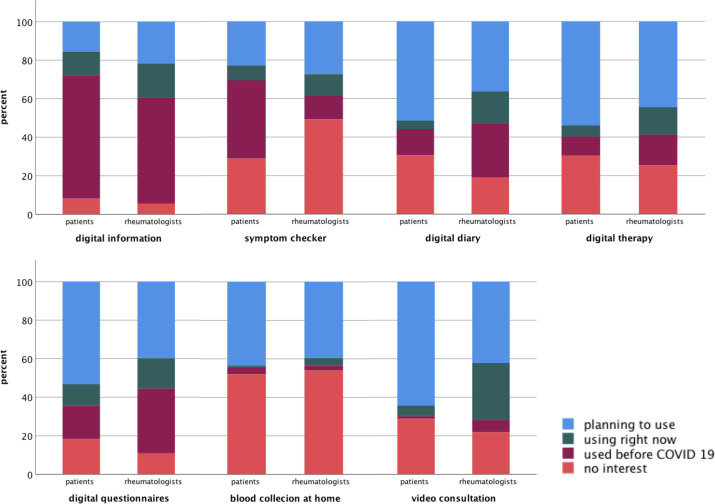
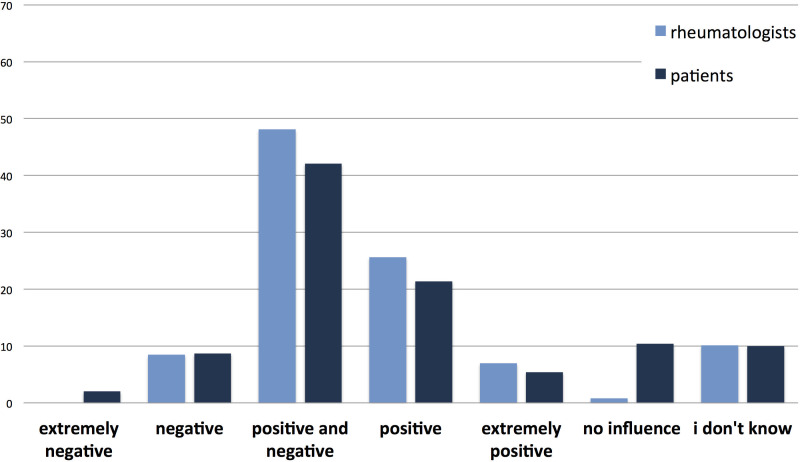
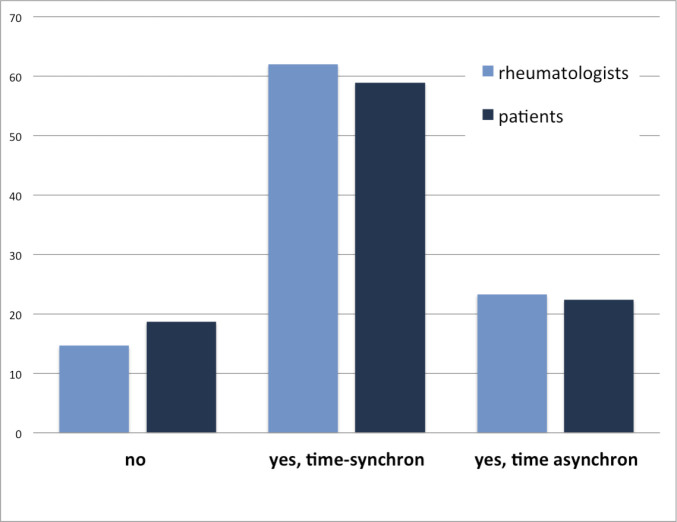
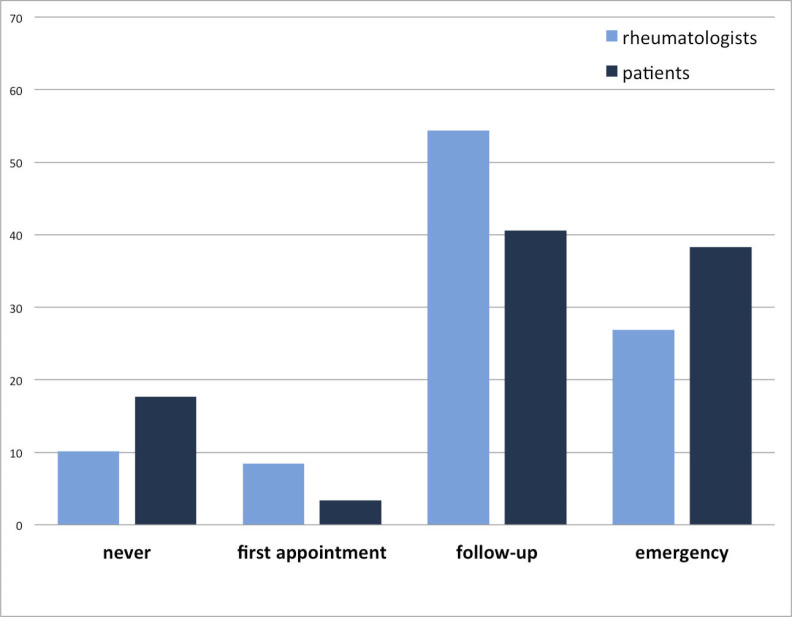
We analysed the responses of 299 patients and 129 rheumatologists. Most patients (74%) and rheumatologists (76%) believed that DHAs are useful in the management of rheumatic and musculoskeletal diseases (RMDs) and felt confident in their own usage thereof (90%; 86%). 38% of patients and 71% of rheumatologists reported that their attitude had changed positively towards DHAs and that their usage had increased due to COVID-19 (29%; 48%). The majority in both groups agreed on implementing virtual visits for follow-up appointments in stable disease conditions. The most reported advantages of DHAs were usage independent of time and place (76.6%; 77.5%). The main barriers were a lack of information on suitable, available DHAs (58.5%; 41.9%), poor usability (42.1% of patients) and a lack of evidence supporting the effectiveness of DHAs (23.2% of rheumatologists). Only a minority (<10% in both groups) believed that digitalisation has a negative impact on the patient-doctor relationship.
The COVID-19 pandemic instigated an increase in patients' and rheumatologists' acceptance and usage of DHAs, possibly introducing a permanent paradigm shift in the management of RMDs.
分析 COVID-19 大流行对风湿病患者和风湿病医生对数字健康应用(DHAs)的使用、偏好和认知的影响。
德国风湿病学会青年风湿病工作组和德国抗风湿病联盟开发了一项基于网络的全国性调查。前瞻性调查通过社交媒体(Twitter、Instagram 和 Facebook)、二维码和电子邮件进行分发。计算描述性统计数据,并进行回归分析以显示相关性。
我们分析了 299 名患者和 129 名风湿病医生的回答。大多数患者(74%)和风湿病医生(76%)认为 DHAs 在管理风湿和肌肉骨骼疾病(RMDs)方面有用,并对自己的使用有信心(90%;86%)。38%的患者和 71%的风湿病医生报告说,他们对 DHAs 的态度变得更加积极,并且由于 COVID-19,他们的使用有所增加(29%;48%)。两组中的大多数人都同意在疾病稳定的情况下为随访预约实施虚拟访问。两组都认为 DHAs 的最大优势是使用不受时间和地点限制(76.6%;77.5%)。主要障碍是缺乏关于合适、可用的 DHAs 的信息(58.5%;41.9%)、可用性差(42.1%的患者)和缺乏支持 DHAs 有效性的证据(23.2%的风湿病医生)。只有少数人(两组均<10%)认为数字化对医患关系有负面影响。
COVID-19 大流行促使患者和风湿病医生对 DHAs 的接受度和使用率增加,这可能在 RMDs 的管理方面引入了永久的范式转变。