Radiology, Research, and Psychiatry Services, VA San Diego Healthcare System, San Diego, California, USA.
Department of Radiology, University of California, San Diego, California, USA.
Hum Brain Mapp. 2021 May;42(7):1987-2004. doi: 10.1002/hbm.25340. Epub 2021 Jan 15.
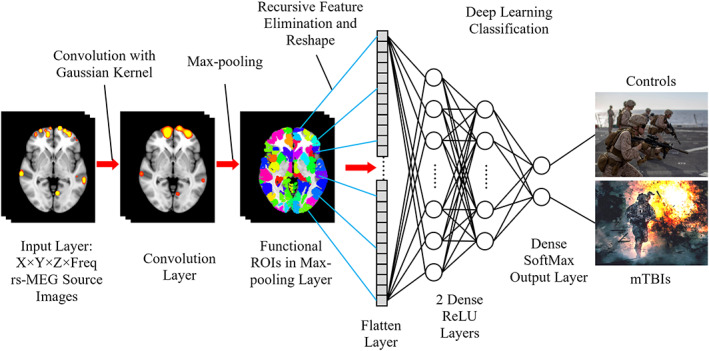
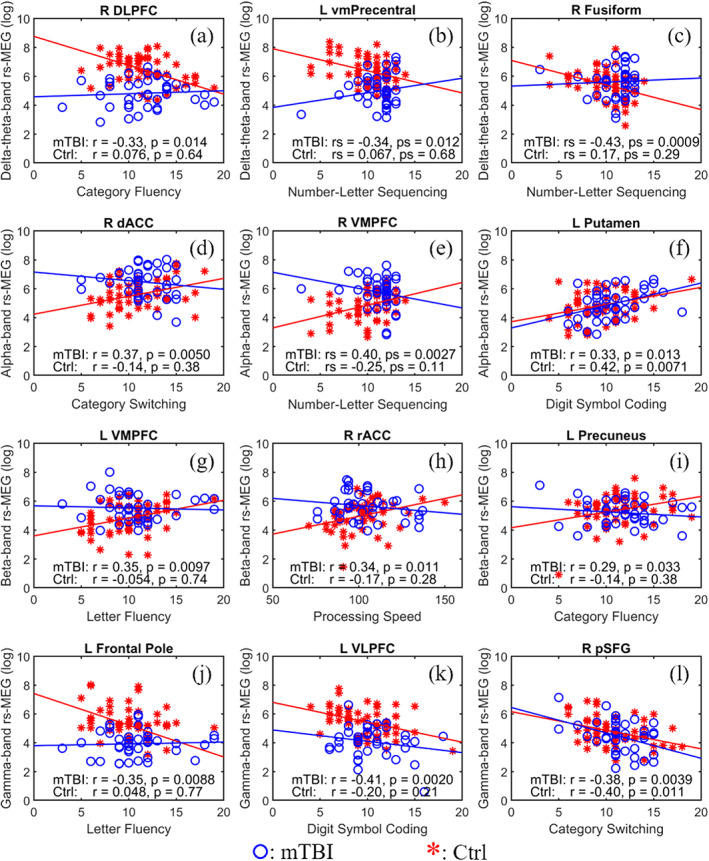
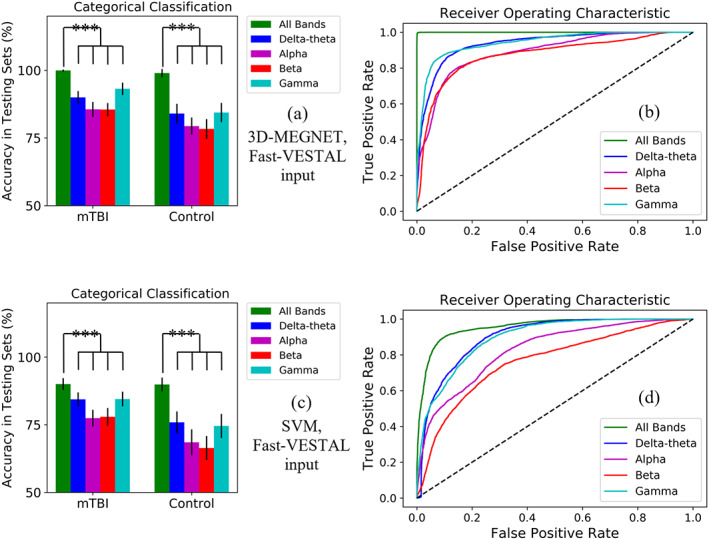
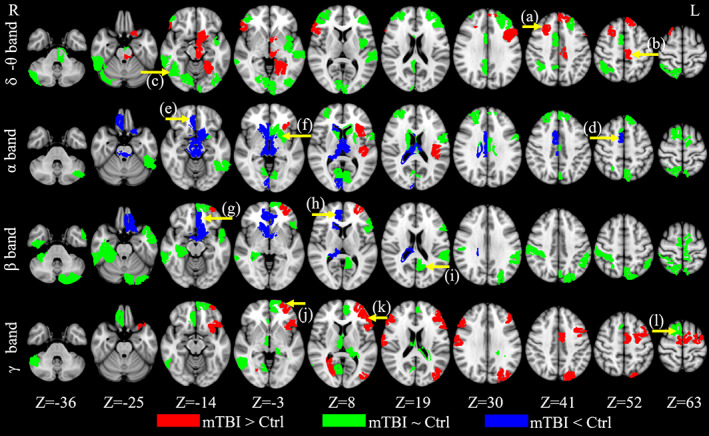
Combat-related mild traumatic brain injury (cmTBI) is a leading cause of sustained physical, cognitive, emotional, and behavioral disabilities in Veterans and active-duty military personnel. Accurate diagnosis of cmTBI is challenging since the symptom spectrum is broad and conventional neuroimaging techniques are insensitive to the underlying neuropathology. The present study developed a novel deep-learning neural network method, 3D-MEGNET, and applied it to resting-state magnetoencephalography (rs-MEG) source-magnitude imaging data from 59 symptomatic cmTBI individuals and 42 combat-deployed healthy controls (HCs). Analytic models of individual frequency bands and all bands together were tested. The All-frequency model, which combined delta-theta (1-7 Hz), alpha (8-12 Hz), beta (15-30 Hz), and gamma (30-80 Hz) frequency bands, outperformed models based on individual bands. The optimized 3D-MEGNET method distinguished cmTBI individuals from HCs with excellent sensitivity (99.9 ± 0.38%) and specificity (98.9 ± 1.54%). Receiver-operator-characteristic curve analysis showed that diagnostic accuracy was 0.99. The gamma and delta-theta band models outperformed alpha and beta band models. Among cmTBI individuals, but not controls, hyper delta-theta and gamma-band activity correlated with lower performance on neuropsychological tests, whereas hypo alpha and beta-band activity also correlated with lower neuropsychological test performance. This study provides an integrated framework for condensing large source-imaging variable sets into optimal combinations of regions and frequencies with high diagnostic accuracy and cognitive relevance in cmTBI. The all-frequency model offered more discriminative power than each frequency-band model alone. This approach offers an effective path for optimal characterization of behaviorally relevant neuroimaging features in neurological and psychiatric disorders.
战斗相关轻度创伤性脑损伤(cmTBI)是退伍军人和现役军人持续存在身体、认知、情感和行为障碍的主要原因。由于症状谱广泛,且常规神经影像学技术对潜在神经病理学不敏感,cmTBI 的准确诊断具有挑战性。本研究开发了一种新的深度学习神经网络方法 3D-MEGNET,并将其应用于 59 名有症状 cmTBI 个体和 42 名战斗部署健康对照者(HCs)的静息状态脑磁图(rs-MEG)源幅度成像数据。测试了个体频带和所有频带的分析模型。全频带模型(结合了 delta-theta(1-7 Hz)、alpha(8-12 Hz)、beta(15-30 Hz)和 gamma(30-80 Hz)频带)优于基于单个频带的模型。优化后的 3D-MEGNET 方法以优异的敏感性(99.9 ± 0.38%)和特异性(98.9 ± 1.54%)区分了 cmTBI 个体和 HCs。接受者操作特征曲线分析显示诊断准确性为 0.99。伽马和 delta-theta 带模型优于 alpha 和 beta 带模型。在 cmTBI 个体中,但在对照组中,过度的 delta-theta 和 gamma 带活动与神经心理学测试的较低表现相关,而低 alpha 和 beta 带活动也与较低的神经心理学测试表现相关。本研究提供了一个综合框架,用于将大型源成像变量集压缩为具有高诊断准确性和认知相关性的最优区域和频率组合,用于 cmTBI。全频带模型比单独的每个频带模型提供了更多的辨别力。这种方法为神经和精神疾病中与行为相关的神经影像学特征的最佳特征提供了有效的途径。