Department of Environmental Health, School of Pharmacy, Tokyo University of Pharmacy and Life Sciences, 1432-1 Horinouchi, Hachioji 192-0392, Japan.
Department of Environmental Health, Faculty of Pharmaceutical Sciences, Toho University, 2-2-1 Miyama, Funabashi 274-8510, Japan.
Int J Mol Sci. 2021 Jan 13;22(2):739. doi: 10.3390/ijms22020739.
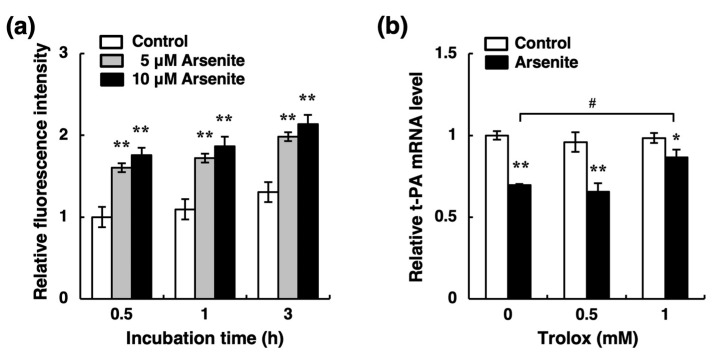
Chronic arsenic exposure is known to be related to the progression of atherosclerosis. However, the pathogenic mechanisms of arsenic-induced atherosclerosis have not been fully elucidated. Because disruption of the blood coagulation/fibrinolytic system is involved in the development of arteriosclerosis, we investigated the effect of arsenite on fibrinolytic activity in human vascular endothelial EA.hy926 cells in the present study. Fibrinolysis depends on the balance between tissue-type plasminogen activator (t-PA) and plasminogen activator inhibitor 1 (PAI-1) secreted from vascular endothelial cells. We found that arsenite reduced fibrinolytic t-PA activity by inhibiting its synthesis without affecting PAI-1 production. The inhibitory effect of arsenite on t-PA expression was partially recovered by the reactive oxygen species (ROS) scavenger Trolox. The nuclear factor erythroid 2 related factor 2 (NRF2) pathway is known to be activated by arsenite via ROS production. We confirmed that arsenite activated the NRF2 pathway, and arsenite-induced inhibition of fibrinolytic t-PA activity was abrogated in NRF2-knockdown EA.hy926 cells. These results suggest that arsenite inhibits the fibrinolytic activity of t-PA by selectively suppressing its synthesis via activation of the NRF2 pathway in vascular endothelial cells.
慢性砷暴露已知与动脉粥样硬化的进展有关。然而,砷诱导的动脉粥样硬化的发病机制尚未完全阐明。因为凝血/纤维蛋白溶解系统的破坏参与了动脉硬化的发生,所以我们在本研究中研究了亚砷酸盐对人血管内皮 EA.hy926 细胞纤维蛋白溶解活性的影响。纤维蛋白溶解依赖于血管内皮细胞分泌的组织型纤溶酶原激活物(t-PA)和纤溶酶原激活物抑制剂 1(PAI-1)之间的平衡。我们发现亚砷酸盐通过抑制其合成而不影响 PAI-1 的产生来降低纤维蛋白溶解 t-PA 活性。ROS 清除剂 Trolox 部分恢复了亚砷酸盐对 t-PA 表达的抑制作用。已知 NRF2 途径通过 ROS 的产生被亚砷酸盐激活。我们证实亚砷酸盐激活了 NRF2 途径,并且在 NRF2 敲低的 EA.hy926 细胞中,亚砷酸盐诱导的纤维蛋白溶解 t-PA 活性抑制被消除。这些结果表明,亚砷酸盐通过激活血管内皮细胞中的 NRF2 途径,选择性地抑制 t-PA 的合成,从而抑制 t-PA 的纤维蛋白溶解活性。