Laboratory of Biological Structure Mechanics (LaBS), Department of Chemistry, Materials and Chemical Engineering "Giulio Natta", Politecnico di Milano, Milan, Italy.
Department of Surgery, University of Florida, Gainesville, FL, USA.
Sci Rep. 2021 Jan 15;11(1):1613. doi: 10.1038/s41598-020-80681-8.
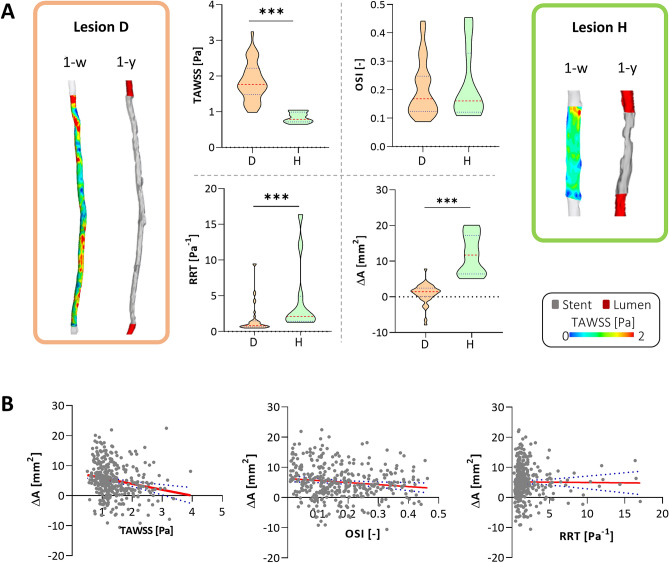
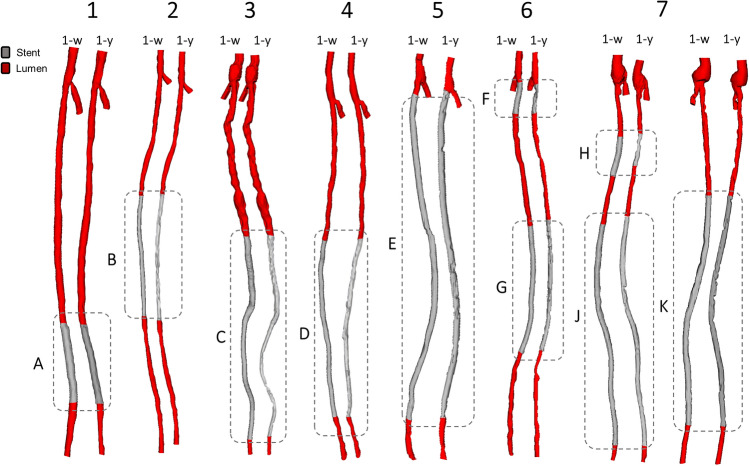
In-stent restenosis (ISR) is the major drawback of superficial femoral artery (SFA) stenting. Abnormal hemodynamics after stent implantation seems to promote the development of ISR. Accordingly, this study aims to investigate the impact of local hemodynamics on lumen remodeling in human stented SFA lesions. Ten SFA models were reconstructed at 1-week and 1-year follow-up from computed tomography images. Patient-specific computational fluid dynamics simulations were performed to relate the local hemodynamics at 1-week, expressed in terms of time-averaged wall shear stress (TAWSS), oscillatory shear index and relative residence time, with the lumen remodeling at 1-year, quantified as the change of lumen area between 1-week and 1-year. The TAWSS was negatively associated with the lumen area change (ρ = - 0.75, p = 0.013). The surface area exposed to low TAWSS was positively correlated with the lumen area change (ρ = 0.69, p = 0.026). No significant correlations were present between the other hemodynamic descriptors and lumen area change. The low TAWSS was the best predictive marker of lumen remodeling (positive predictive value of 44.8%). Moreover, stent length and overlapping were predictor of ISR at follow-up. Despite the limited number of analyzed lesions, the overall findings suggest an association between abnormal patterns of WSS after stenting and lumen remodeling.
支架内再狭窄(ISR)是股浅动脉(SFA)支架置入术的主要缺点。支架植入术后异常的血液动力学似乎促进了 ISR 的发展。因此,本研究旨在探讨局部血液动力学对人支架置入 SFA 病变管腔重塑的影响。从 CT 图像重建了 10 个 SFA 模型,随访时间为 1 周和 1 年。进行了患者特定的计算流体动力学模拟,以将 1 周时的局部血液动力学(以时均壁切应力(TAWSS)、振荡剪切指数和相对停留时间表示)与 1 年时的管腔重塑相关联,管腔重塑量化为 1 周和 1 年之间的管腔面积变化。TAWSS 与管腔面积变化呈负相关(ρ=-0.75,p=0.013)。暴露于低 TAWSS 的表面积与管腔面积变化呈正相关(ρ=0.69,p=0.026)。其他血液动力学指标与管腔面积变化之间无显著相关性。低 TAWSS 是管腔重塑的最佳预测标志物(阳性预测值为 44.8%)。此外,支架长度和重叠是随访时 ISR 的预测因素。尽管分析的病变数量有限,但总体研究结果表明支架置入后 WSS 异常模式与管腔重塑之间存在关联。