Department of Radiology, Third Hospital of Hebei Medical University, Hebei Province, Shijiazhuang, 050000, People's Republic of China.
DeepWise AI Lab, Beijing, People's Republic of China.
Sci Rep. 2021 Jan 15;11(1):1589. doi: 10.1038/s41598-021-81236-1.
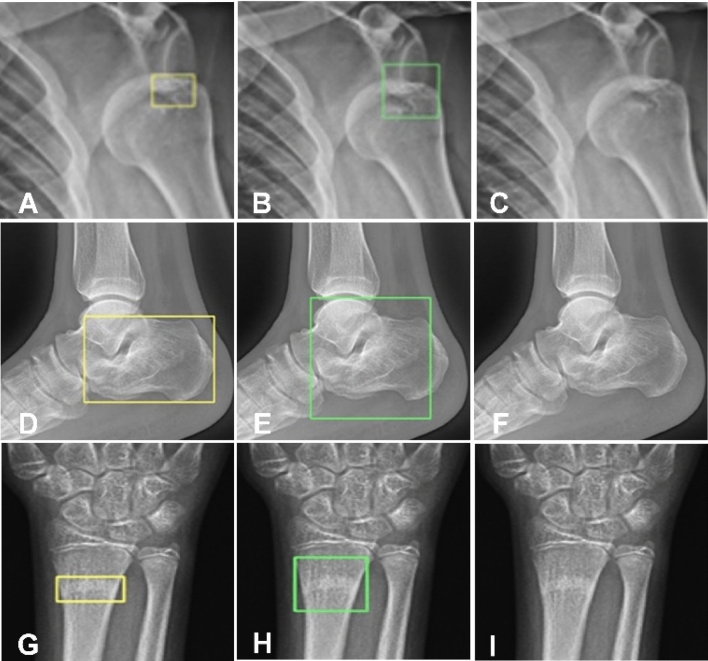
This study was performed to propose a method, the Feature Ambiguity Mitigate Operator (FAMO) model, to mitigate feature ambiguity in bone fracture detection on radiographs of various body parts. A total of 9040 radiographic studies were extracted. These images were classified into several body part types including 1651 hand, 1302 wrist, 406 elbow, 696 shoulder, 1580 pelvic, 948 knee, 1180 ankle, and 1277 foot images. Instance segmentation was annotated by radiologists. The ResNext-101+FPN was employed as the baseline network structure and the FAMO model for processing. The proposed FAMO model and other ablative models were tested on a test set of 20% total radiographs in a balanced body part distribution. To the per-fracture extent, an AP (average precision) analysis was performed. For per-image and per-case, the sensitivity, specificity, and AUC (area under the receiver operating characteristic curve) were analyzed. At the per-fracture level, the controlled experiment set the baseline AP to 76.8% (95% CI: 76.1%, 77.4%), and the major experiment using FAMO as a preprocessor improved the AP to 77.4% (95% CI: 76.6%, 78.2%). At the per-image level, the sensitivity, specificity, and AUC were 61.9% (95% CI: 58.7%, 65.0%), 91.5% (95% CI: 89.5%, 93.3%), and 74.9% (95% CI: 74.1%, 75.7%), respectively, for the controlled experiment, and 64.5% (95% CI: 61.3%, 67.5%), 92.9% (95% CI: 91.0%, 94.5%), and 77.5% (95% CI: 76.5%, 78.5%), respectively, for the experiment with FAMO. At the per-case level, the sensitivity, specificity, and AUC were 74.9% (95% CI: 70.6%, 78.7%), 91.7%% (95% CI: 88.8%, 93.9%), and 85.7% (95% CI: 84.8%, 86.5%), respectively, for the controlled experiment, and 77.5% (95% CI: 73.3%, 81.1%), 93.4% (95% CI: 90.7%, 95.4%), and 86.5% (95% CI: 85.6%, 87.4%), respectively, for the experiment with FAMO. In conclusion, in bone fracture detection, FAMO is an effective preprocessor to enhance model performance by mitigating feature ambiguity in the network.
本研究旨在提出一种方法,即特征歧义缓解算子(FAMO)模型,以减轻各种身体部位 X 光片上骨折检测中的特征歧义。共提取了 9040 项放射学研究。这些图像被分为几种身体部位类型,包括 1651 只手、1302 只手腕、406 只肘部、696 只肩部、1580 只骨盆、948 只膝盖、1180 只脚踝和 1277 只脚图像。由放射科医生对实例分割进行注释。采用 ResNext-101+FPN 作为基线网络结构,采用 FAMO 模型进行处理。在平衡身体部位分布的 20%总 X 光片的测试集中测试了所提出的 FAMO 模型和其他消融模型。对于每个骨折程度,进行了平均精度(AP)分析。对于每张图像和每个病例,分析了敏感性、特异性和 AUC(接收器工作特征曲线下的面积)。在骨折程度上,对照实验将基线 AP 设置为 76.8%(95%CI:76.1%,77.4%),而主要实验使用 FAMO 作为预处理器将 AP 提高到 77.4%(95%CI:76.6%,78.2%)。在图像级别,对照实验的敏感性、特异性和 AUC 分别为 61.9%(95%CI:58.7%,65.0%)、91.5%(95%CI:89.5%,93.3%)和 74.9%(95%CI:74.1%,75.7%),而 FAMO 实验的敏感性、特异性和 AUC 分别为 64.5%(95%CI:61.3%,67.5%)、92.9%(95%CI:91.0%,94.5%)和 77.5%(95%CI:76.5%,78.5%)。在病例级别,对照实验的敏感性、特异性和 AUC 分别为 74.9%(95%CI:70.6%,78.7%)、91.7%(95%CI:88.8%,93.9%)和 85.7%(95%CI:84.8%,86.5%),而 FAMO 实验的敏感性、特异性和 AUC 分别为 77.5%(95%CI:73.3%,81.1%)、93.4%(95%CI:90.7%,95.4%)和 86.5%(95%CI:85.6%,87.4%)。总之,在骨折检测中,FAMO 是一种有效的预处理方法,可以通过减轻网络中的特征歧义来提高模型性能。