Imagen Technologies, New York, NY 10012;
Faculty of Medicine, McGill University, Montreal, QC, Canada, H3A 2R7.
Proc Natl Acad Sci U S A. 2018 Nov 6;115(45):11591-11596. doi: 10.1073/pnas.1806905115. Epub 2018 Oct 22.
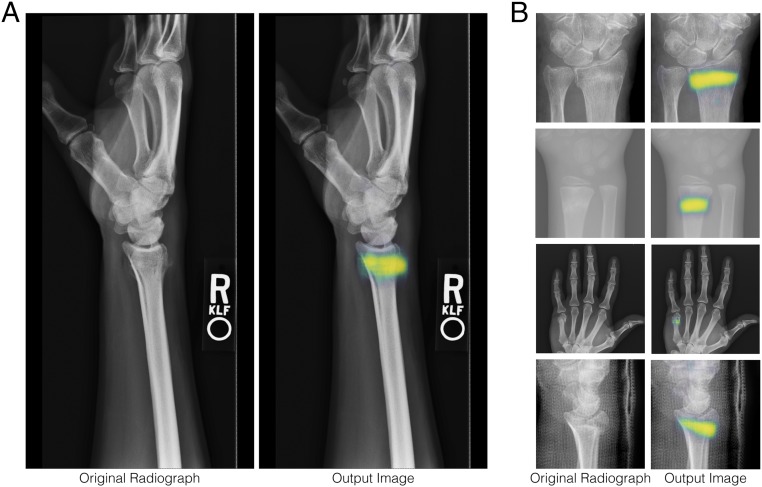
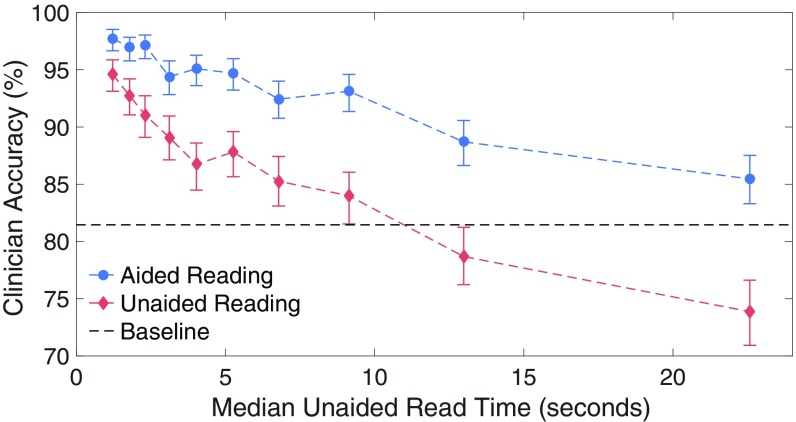
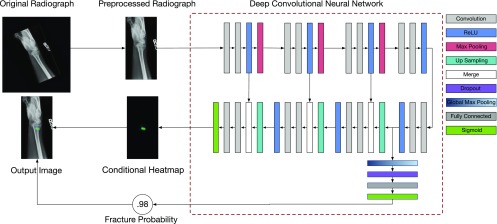
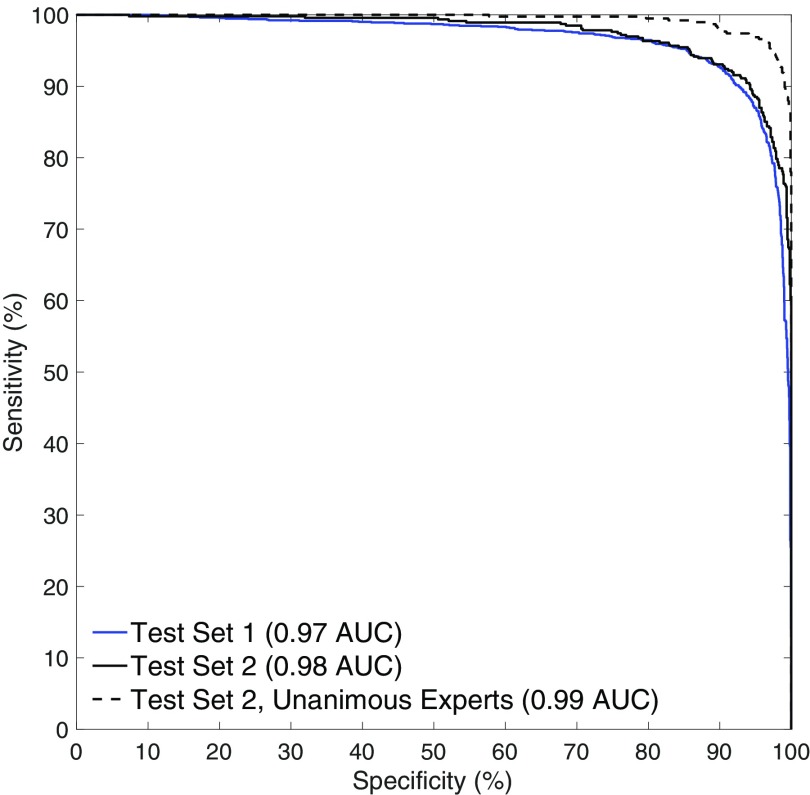
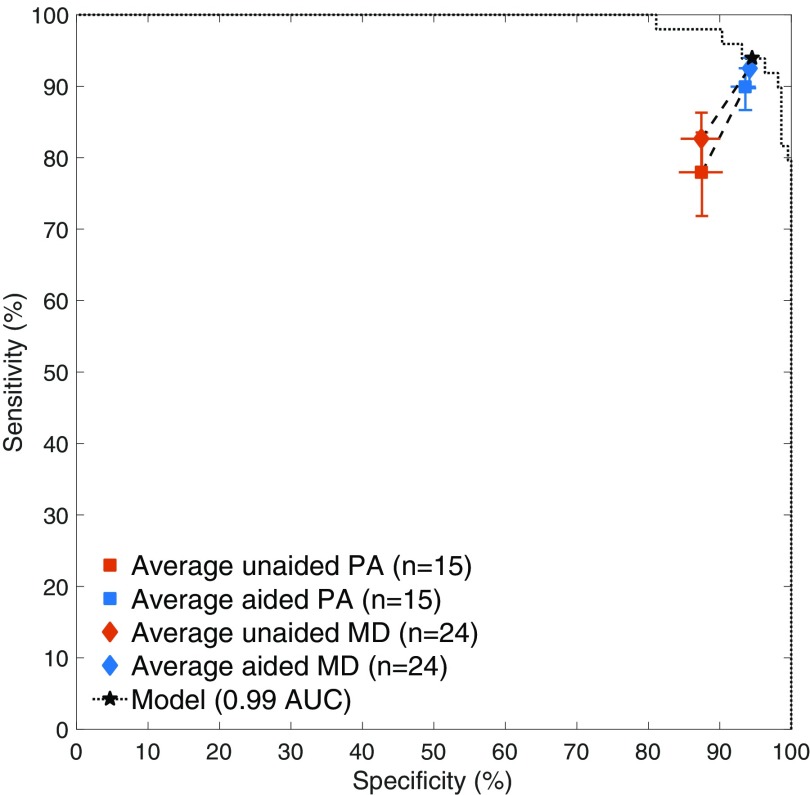
Suspected fractures are among the most common reasons for patients to visit emergency departments (EDs), and X-ray imaging is the primary diagnostic tool used by clinicians to assess patients for fractures. Missing a fracture in a radiograph often has severe consequences for patients, resulting in delayed treatment and poor recovery of function. Nevertheless, radiographs in emergency settings are often read out of necessity by emergency medicine clinicians who lack subspecialized expertise in orthopedics, and misdiagnosed fractures account for upward of four of every five reported diagnostic errors in certain EDs. In this work, we developed a deep neural network to detect and localize fractures in radiographs. We trained it to accurately emulate the expertise of 18 senior subspecialized orthopedic surgeons by having them annotate 135,409 radiographs. We then ran a controlled experiment with emergency medicine clinicians to evaluate their ability to detect fractures in wrist radiographs with and without the assistance of the deep learning model. The average clinician's sensitivity was 80.8% (95% CI, 76.7-84.1%) unaided and 91.5% (95% CI, 89.3-92.9%) aided, and specificity was 87.5% (95 CI, 85.3-89.5%) unaided and 93.9% (95% CI, 92.9-94.9%) aided. The average clinician experienced a relative reduction in misinterpretation rate of 47.0% (95% CI, 37.4-53.9%). The significant improvements in diagnostic accuracy that we observed in this study show that deep learning methods are a mechanism by which senior medical specialists can deliver their expertise to generalists on the front lines of medicine, thereby providing substantial improvements to patient care.
疑似骨折是患者前往急诊部(ED)最常见的原因之一,X 射线成像是临床医生评估骨折患者的主要诊断工具。在 X 光片上漏诊骨折通常会给患者带来严重后果,导致治疗延误和功能恢复不佳。然而,在急诊环境中,放射科医生通常由于缺乏骨科专业知识而不得不进行放射科读片,而在某些急诊室中,误诊的骨折占报告的诊断错误的四分之三以上。在这项工作中,我们开发了一种深度学习网络来检测和定位 X 光片中的骨折。我们通过让 18 名资深骨科专家对 135409 张 X 光片进行注释,对其进行了准确的训练,使其能够准确模仿专家的专长。然后,我们与急诊医学临床医生进行了一项对照实验,以评估他们在有无深度学习模型辅助的情况下检测腕关节 X 光片中骨折的能力。平均临床医生的敏感性在无辅助时为 80.8%(95%CI,76.7-84.1%),有辅助时为 91.5%(95%CI,89.3-92.9%),特异性在无辅助时为 87.5%(95%CI,85.3-89.5%),有辅助时为 93.9%(95%CI,92.9-94.9%)。平均临床医生的误诊率相对降低了 47.0%(95%CI,37.4-53.9%)。我们在这项研究中观察到的诊断准确性的显著提高表明,深度学习方法是一种机制,可以使资深医学专家将其专业知识传授给医学一线的通科医生,从而为患者提供实质性的护理改善。