Department of Genetics and Evolution, Faculty of Sciences, University of Geneva, quai Ernest-Ansermet 30, 1211, Geneva, Switzerland.
Department of Basic Neurosciences, Faculty of Medicine, University of Geneva, 1 rue Michel-Servet, 1211, Geneva, Switzerland.
Cell Tissue Res. 2021 Jan;383(1):387-393. doi: 10.1007/s00441-020-03393-5. Epub 2021 Jan 16.
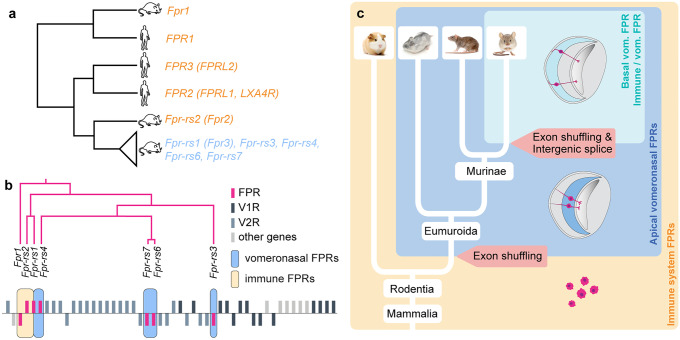
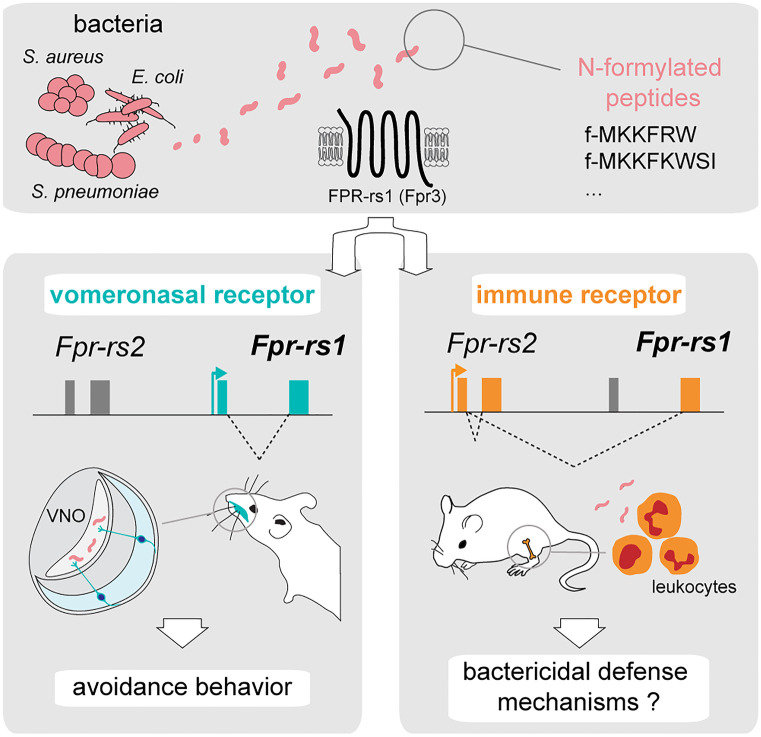
Variations in gene expression patterns represent a powerful source of evolutionary innovation. In a rodent living about 70 million years ago, a genomic accident led an immune formyl peptide receptor (FPR) gene to hijack a vomeronasal receptor regulatory sequence. This gene shuffling event forced an immune pathogen sensor to transition into an olfactory chemoreceptor, which thus moved from sensing the internal world to probing the outside world. We here discuss the evolution of the FPR gene family, the events that led to their neofunctionalization in the vomeronasal organ and the functions of immune and vomeronasal FPRs.
基因表达模式的变化代表了进化创新的强大源泉。在大约 7000 万年前生活的一种啮齿动物中,一个基因组的意外事件导致了一种免疫形式的肽受体(FPR)基因劫持了一个犁鼻器受体调节序列。这种基因重组事件迫使免疫病原体传感器转变为嗅觉化学感受器,从而使传感器从感知内部世界转变为探测外部世界。我们在这里讨论 FPR 基因家族的进化,导致它们在犁鼻器中发生新功能化的事件,以及免疫和犁鼻器 FPR 的功能。