Fazzini F, Lamina C, Raftopoulou A, Koller A, Fuchsberger C, Pattaro C, Del Greco F M, Döttelmayer P, Fendt L, Fritz J, Meiselbach H, Schönherr S, Forer L, Weissensteiner H, Pramstaller P P, Eckardt K-U, Hicks A A, Kronenberg F
From the, Department of Genetics and Pharmacology, Institute of Genetic Epidemiology, Medical University of Innsbruck, Innsbruck, Austria.
Eurac Research, Institute for Biomedicine, Affiliated Institute of the University of Lübeck, Bolzano, Italy.
J Intern Med. 2021 Jul;290(1):190-202. doi: 10.1111/joim.13242. Epub 2021 Feb 20.
Mitochondria play an important role in cellular metabolism, and their dysfunction is postulated to be involved in metabolic disturbances. Mitochondrial DNA is present in multiple copies per cell. The quantification of mitochondrial DNA copy number (mtDNA-CN) might be used to assess mitochondrial dysfunction.
We aimed to investigate the cross-sectional association of mtDNA-CN with type 2 diabetes and the potential mediating role of metabolic syndrome.
We examined 4812 patients from the German Chronic Kidney Disease (GCKD) study and 9364 individuals from the Cooperative Health Research in South Tyrol (CHRIS) study. MtDNA-CN was measured in whole blood using a plasmid-normalized qPCR-based assay.
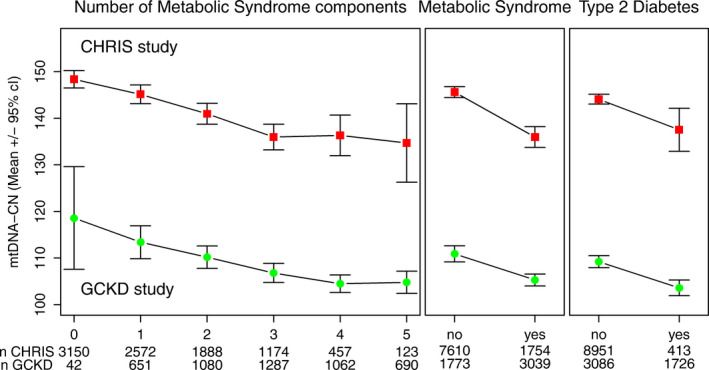
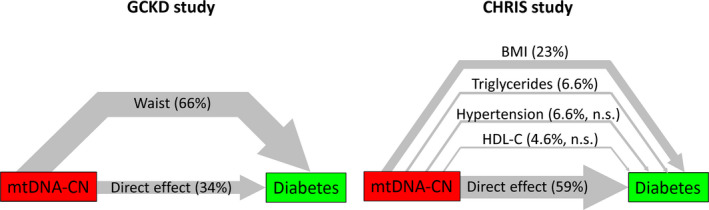
In both studies, mtDNA-CN showed a significant correlation with most metabolic syndrome parameters: mtDNA-CN decreased with increasing number of metabolic syndrome components. Furthermore, individuals with low mtDNA-CN had significantly higher odds of metabolic syndrome (OR = 1.025; 95% CI = 1.011-1.039, P = 3.19 × 10 , for each decrease of 10 mtDNA copies) and type 2 diabetes (OR = 1.027; 95% CI = 1.012-1.041; P = 2.84 × 10 ) in a model adjusted for age, sex, smoking and kidney function in the meta-analysis of both studies. Mediation analysis revealed that the association of mtDNA-CN with type 2 diabetes was mainly mediated by waist circumference in the GCKD study (66%) and by several metabolic syndrome parameters, especially body mass index and triglycerides, in the CHRIS study (41%).
Our data show an inverse association of mtDNA-CN with higher risk of metabolic syndrome and type 2 diabetes. A major part of the total effect of mtDNA-CN on type 2 diabetes is mediated by obesity parameters.
线粒体在细胞代谢中发挥重要作用,其功能障碍被认为与代谢紊乱有关。每个细胞中线粒体DNA以多拷贝形式存在。线粒体DNA拷贝数(mtDNA-CN)的定量分析可用于评估线粒体功能障碍。
我们旨在研究mtDNA-CN与2型糖尿病的横断面关联以及代谢综合征的潜在中介作用。
我们检测了德国慢性肾脏病(GCKD)研究中的4812例患者和南蒂罗尔合作健康研究(CHRIS)中的9364例个体。采用基于质粒标准化定量聚合酶链反应(qPCR)的检测方法测定全血中的mtDNA-CN。
在两项研究中,mtDNA-CN与大多数代谢综合征参数均呈显著相关:mtDNA-CN随代谢综合征组分数量的增加而降低。此外,在两项研究的荟萃分析中,经年龄、性别、吸烟和肾功能校正的模型中,mtDNA-CN低的个体患代谢综合征(每减少10个mtDNA拷贝,比值比[OR]=1.025;95%置信区间[CI]=1.011-1.039,P=3.19×10⁻⁴)和2型糖尿病(OR=1.027;95%CI=1.012-1.041;P=2.84×10⁻⁴)的几率显著更高。中介分析显示,在GCKD研究中,mtDNA-CN与2型糖尿病的关联主要由腰围介导(66%),而在CHRIS研究中,由几个代谢综合征参数,尤其是体重指数和甘油三酯介导(41%)。
我们的数据显示mtDNA-CN与代谢综合征和2型糖尿病的较高风险呈负相关。mtDNA-CN对2型糖尿病的总效应的主要部分由肥胖参数介导。