Department of Transplantation and Surgery, Semmelweis University, VIII. Baross u. 23, Budapest, H-1082, Hungary.
Langenbecks Arch Surg. 2021 May;406(3):863-871. doi: 10.1007/s00423-020-02063-y. Epub 2021 Jan 17.
In the Eurotransplant, 12.6% of kidney transplantations are a repeat procedure. Third transplants are significantly more complex than first and second ones. We compared the results of first (PRT) versus third (TRT) transplantations.
Between 2011 and 2016, we performed 779 deceased donor adult kidney transplantations, 14.2% out of them were second, 2.6% (20) third, and 0.3% fourth. We compared the pre-, intra-, and postoperative data, kidney function, and survival rate.
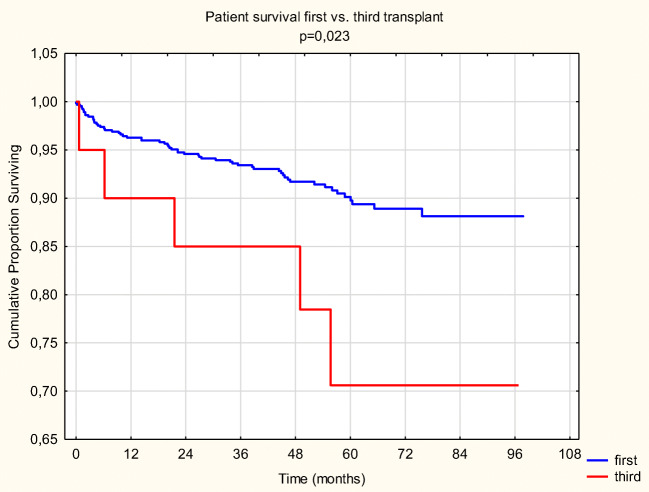
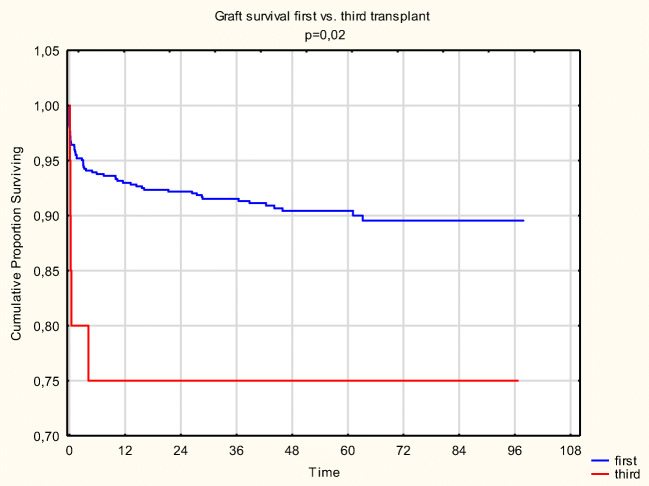
Recipients of TRT were younger (53.4 vs. 47.3 p = 0.02). HCV infection rate (20%, p = 0.00) is ten times higher. The operation time is longer (132 vs. 152 min, p = 0.02), and delayed graft function is much more frequent (22.4% vs. 60%, p = 0.00). Induction therapy was given to every TRT (7.9% vs.100%), but as a result, the rejection rate was the same (~ 15%). Hospital stay is a week longer. Patient's survival at 1, 3, and 5 years for PRT is 96.4%, 93.9%, and 91.2% and for TRT is 90%, 85%, and 78.4%, respectively (p = 0.023). TRT's odds ratio of fatal outcome is 4.35 (1.5-12.5). Graft survival at 1, 3, and 5 years for PRT is 93.1%, 91.4%, and 90.3% and for TRT is 75%, 75%, and 75%, respectively (p = 0.020). TRT's odds ratio of graft loss is 3.14 (1.1-8.9). Of PRT 85.76%, out of PRT 85.76%, while out of TRT 60% live with a functioning graft, p=0.00149.
In a third transplant, both graft and patient survival are significantly inferior to primer ones. Careful selection is required to minimize the patient risk and graft loss.
在欧洲器官移植中心,12.6%的肾脏移植是重复手术。第三次移植比第一次和第二次移植复杂得多。我们比较了第一次(PRT)和第三次(TRT)移植的结果。
在 2011 年至 2016 年间,我们进行了 779 例成人尸体供肾移植,其中 14.2%为第二次移植,2.6%(20 例)为第三次移植,0.3%为第四次移植。我们比较了术前、术中和术后数据、肾功能和存活率。
第三次移植的受者年龄较小(53.4 岁比 47.3 岁,p=0.02)。丙型肝炎病毒感染率(20%,p=0.00)高十倍。手术时间较长(132 分钟比 152 分钟,p=0.02),延迟肾功能恢复更为常见(22.4%比 60%,p=0.00)。每个第三次移植患者都接受了诱导治疗(7.9%比 100%),但排斥反应率相同(~15%)。住院时间长一周。PRT 患者的 1 年、3 年和 5 年存活率分别为 96.4%、93.9%和 91.2%,TRT 分别为 90%、85%和 78.4%(p=0.023)。TRT 的致命结局比值比为 4.35(1.5-12.5)。PRT 的 1 年、3 年和 5 年移植物存活率分别为 93.1%、91.4%和 90.3%,TRT 分别为 75%、75%和 75%(p=0.020)。TRT 的移植物丢失比值比为 3.14(1.1-8.9)。PRT 中有 85.76%的患者和 TRT 中有 60%的患者带着功能移植物存活,p=0.00149。
第三次移植的移植物和患者存活率明显低于第一次移植。需要仔细选择以最大程度地降低患者风险和移植物丢失。