Herrero Alba, Benedicto Aitor, Romayor Irene, Olaso Elvira, Arteta Beatriz
Department of Cell Biology and Histology, University of the Basque Country, School of Medicine and Nursing, Leioa 48940, Bizkaia, Spain.
Biomol Ther (Seoul). 2021 May 1;29(3):342-351. doi: 10.4062/biomolther.2020.160.
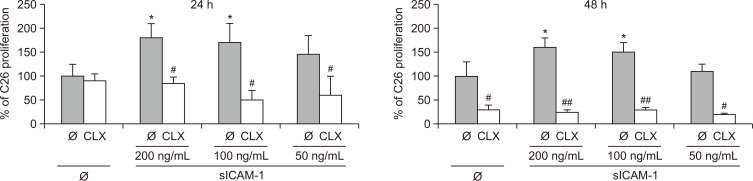
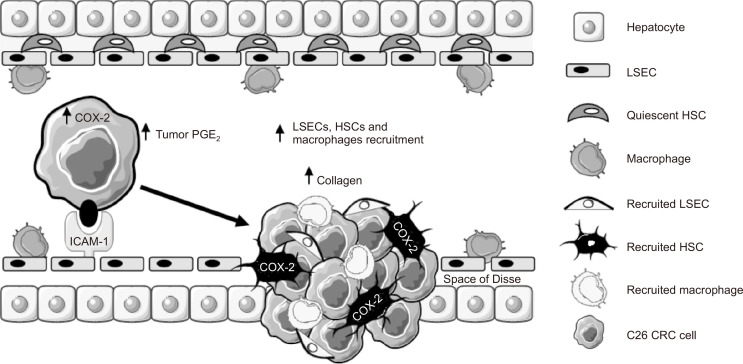
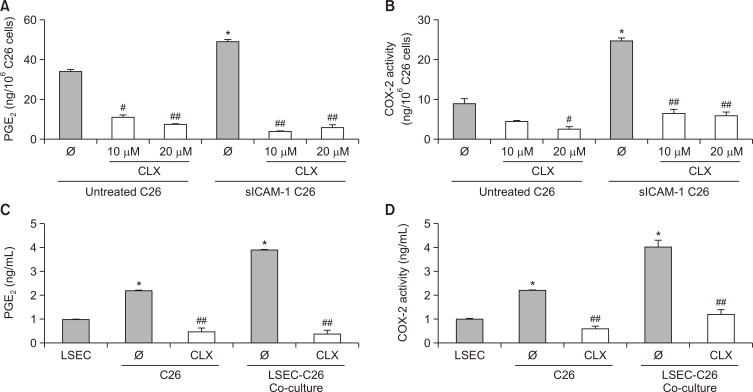
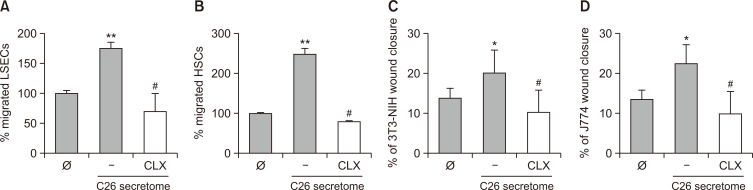
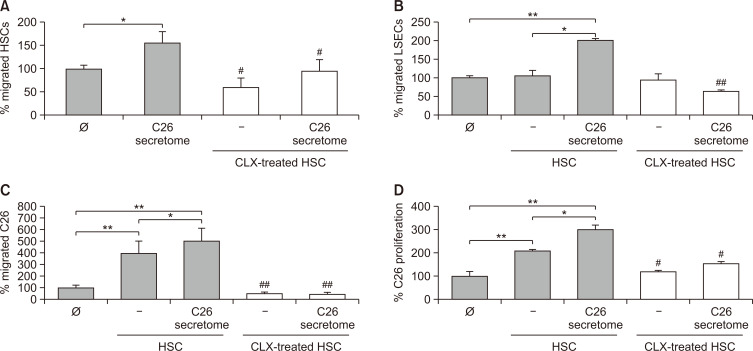
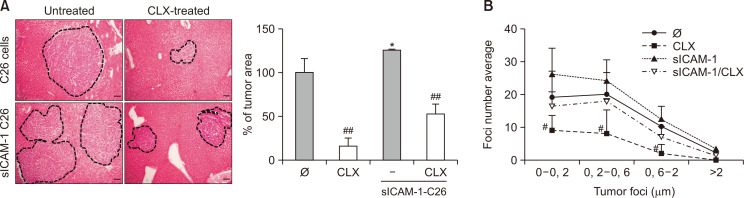
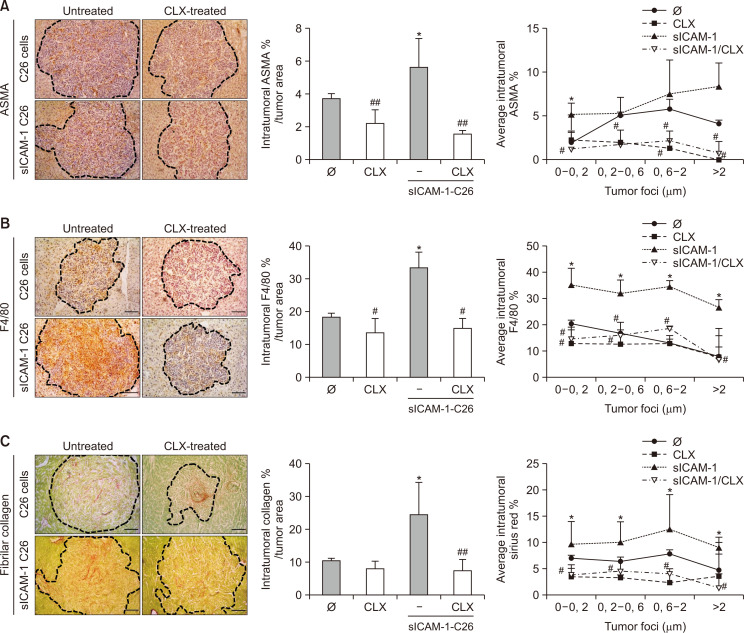
Liver colonization is initiated through the interplay between tumor cells and adhesion molecules present in liver sinusoidal endothelial cells (LSECs). This crosstalk stimulates tumor COX-2 upregulation and PGE secretion. To elucidate the role of the LSEC intercellular adhesion molecule-1 (ICAM-1) in the prometastatic response exerted by tumor and stromal COX-2, we utilized celecoxib (CLX) as a COX-2 inhibitory agent. We analyzed the proliferative and secretory responses of murine C26 colorectal cancer (CRC) cells to soluble ICAM-1 (sICAM-1), cultured alone or with LSECs, and their effect on LSEC and hepatic stellate cell (HSC) migration and liver metastasis. CLX reduced sICAM-1-stimulated COX-2 activation and PGE secretion in C26 cells cultured alone or cocultured with LSECs. Moreover, CLX abrogated sICAM-1-induced C26 cell proliferation and C26 secretion of promigratory factors for LSECs and HSCs. Interestingly, CLX reduced the protumoral response of HSC, reducing their migratory potential when stimulated with C26 secretomes and impairing their secretion of chemotactic factors for LSECs and C26 cells and proliferative factors for C26 cells. , CLX abrogated the prometastatic ability of sICAM-1-activated C26 cells while reducing liver metastasis. COX-2 inhibition blocked the creation of a favorable tumor microenvironment (TME) by hindering the intratumoral recruitment of activated HSCs and macrophages in addition to the accumulation of fibrillar collagen. These results point to COX-2 being a key modulator of processes initiated by host ICAM-1 during tumor cell/LSEC/HSC crosstalk, leading to the creation of a prometastatic TME in the liver.
肝脏定植是通过肿瘤细胞与肝窦内皮细胞(LSEC)中存在的粘附分子之间的相互作用启动的。这种相互作用刺激肿瘤COX-2上调和PGE分泌。为了阐明LSEC细胞间粘附分子-1(ICAM-1)在肿瘤和基质COX-2发挥的促转移反应中的作用,我们使用塞来昔布(CLX)作为COX-2抑制剂。我们分析了小鼠C26结直肠癌(CRC)细胞对可溶性ICAM-1(sICAM-1)的增殖和分泌反应,单独培养或与LSEC共同培养,以及它们对LSEC和肝星状细胞(HSC)迁移和肝转移的影响。CLX降低了单独培养或与LSEC共培养的C26细胞中sICAM-1刺激的COX-2激活和PGE分泌。此外,CLX消除了sICAM-1诱导的C26细胞增殖以及C26细胞分泌对LSEC和HSC的促迁移因子。有趣的是,CLX降低了HSC的促肿瘤反应,在用C26分泌组刺激时降低了它们的迁移潜力,并损害了它们分泌对LSEC和C26细胞的趋化因子以及对C26细胞的增殖因子的能力。CLX消除了sICAM-1激活的C26细胞的促转移能力,同时减少了肝转移。COX-2抑制通过阻碍激活的HSC和巨噬细胞在肿瘤内的募集以及纤维状胶原的积累,阻止了有利的肿瘤微环境(TME)的形成。这些结果表明,COX-2是宿主ICAM-1在肿瘤细胞/LSEC/HSC相互作用过程中启动的过程的关键调节因子,导致在肝脏中形成促转移的TME。