Department of Food and Nutrition, Faculty of Human Sciences and Design, Japan Women's University.
Division of Food and Nutrition, Graduate School of Human Sciences and Design, Japan Women's University.
J Atheroscler Thromb. 2021 Oct 1;28(10):1035-1051. doi: 10.5551/jat.60376. Epub 2021 Jan 17.
The Japan Diet (JD) recommended by the Japan Atherosclerosis Society based on the traditional Japanese diet is presumably favorable for preventing atherosclerotic cardiovascular diseases, but few high-quality controlled clinical trials have examined its benefits as compared with other diets. We studied effects of nutrition education for JD intake as compared with partial JD (PJD) intake on serum lipids and inflammatory parameters in subjects with dyslipidemia.
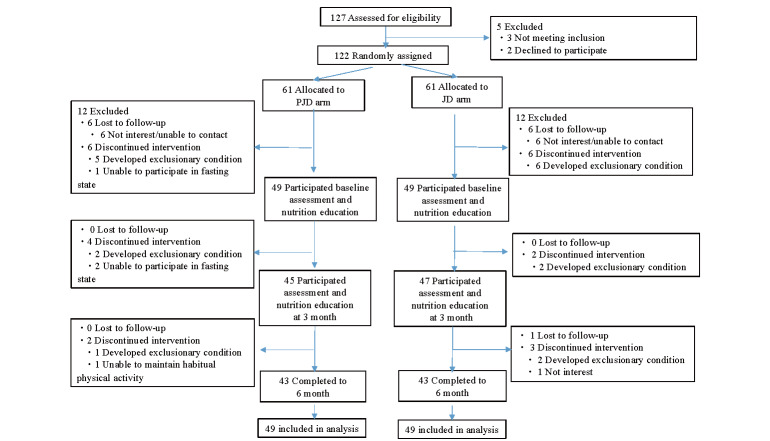
A randomized parallel controlled clinical trial was conducted on outpatients with dyslipidemia. Participants were randomly divided into the JD or the PJD group. Face-to-face nutrition education based on each diet at baseline and at 3 months, as well as monthly counseling by mail during the intervening 3-month period, were provided and participants practiced up to 6 months. Both groups were advised to reduce consumptions of animal fat/ fatty meat/poultry, confections, and alcoholic drinks. Additionally, the JD group participants were recommended to consume more fish, soybean products especially natto, vegetables, and seaweed/mushrooms/konjak, and to switch from refined to unrefined cereals or barley.
Mean LDL-cholesterol was 125 +/- 29 mg/dL at baseline, and the JD group ( n=49) showed a greater mean LDL-cholesterol decrease than the PJD group (n=49) [- 8 mg/dL in JD vs 1 mg/dL in PJD, difference, -9 mg/dL (95%CI, -17 to 0) p=0.043)], and triglyceride (p=0.023) and insulin (p=0.033) reductions were larger in the JD group than in the PJD group at 6 months.
Nutrition education for JD intake was suggested to improve serum lipid and metabolic parameters in patients with dyslipidemia.
基于传统日本饮食的日本饮食(JD)是日本动脉粥样硬化学会推荐的,据推测其有利于预防动脉粥样硬化性心血管疾病,但很少有高质量的对照临床试验研究过其与其他饮食相比的益处。我们研究了 JD 摄入与部分 JD(PJD)摄入的营养教育对血脂异常患者血清脂质和炎症参数的影响。
对血脂异常的门诊患者进行了一项随机平行对照临床试验。参与者被随机分为 JD 组或 PJD 组。在基线和 3 个月时进行基于每种饮食的面对面营养教育,以及在 3 个月的间隔期间每月通过邮件提供咨询,并让参与者练习 6 个月。两组均被建议减少动物脂肪/肥肉/禽肉、糖果和酒精饮料的摄入。此外,JD 组参与者被建议多吃鱼、大豆制品特别是纳豆、蔬菜、海藻/蘑菇/魔芋,并将精制谷物或大麦改为未精制谷物。
基线时 LDL-胆固醇平均值为 125±29mg/dL,JD 组(n=49)的 LDL-胆固醇平均下降幅度大于 PJD 组(n=49)[-8mg/dL 在 JD 与 1mg/dL 在 PJD 之间,差异为-9mg/dL(95%CI,-17 至 0),p=0.043],6 个月时 JD 组的甘油三酯(p=0.023)和胰岛素(p=0.033)降低幅度也大于 PJD 组。
JD 摄入的营养教育被认为可以改善血脂异常患者的血清脂质和代谢参数。